

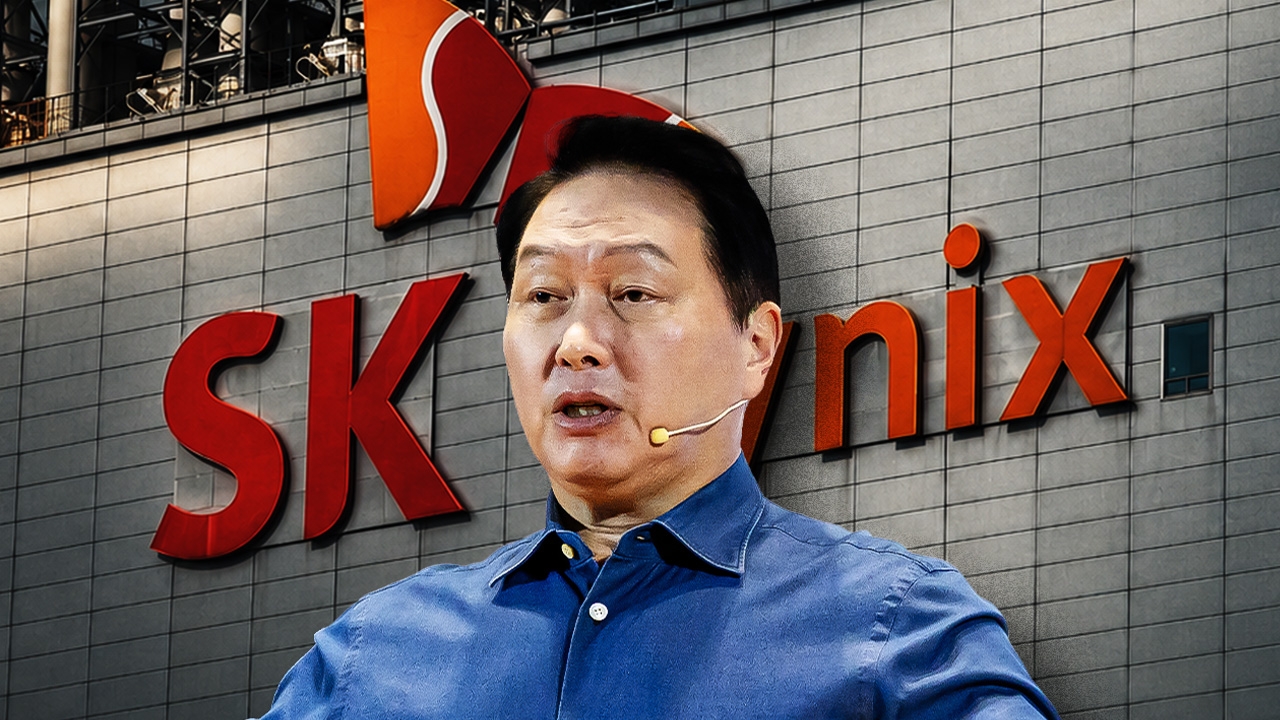
In recent times, the name of Chey Tae-won has frequently reappeared in the media. This is not only due to his family life attracting global attention but also because he is the chairman of SK Hynix, South Korea's major chip manufacturer, which has now become a leading global semiconductor player.
SK Group is another Chaebol, or large business conglomerate, with significant influence in South Korea. Founded in 1983, it began as Hyundai Electronics, producing electronic components under the Hyundai Group. The company faced multiple near-bankruptcy crises, continuously undergoing transitions and adaptations. Today, it has evolved into SK Group, becoming South Korea's second-largest Chaebol and a major semiconductor giant to watch.
Currently, SK Hynix, one of the world's largest memory chip producers, has taken a further step by listing on the U.S. stock market. This marked a historic capital raise of over $26.5 billion through ADR offerings to fund AI infrastructure development amid widespread enthusiasm for this technology.
One key figure behind SK Hynix's transformation from an industry laggard to a market leader in technology essential to today's world is Chey Tae-won, who has managed the company for over 35 years. His bold decisions defied expectations and revived a company that had faced multiple near-collapse moments, turning it into a shining gem in the business world.
This article from the Thairath Money columnHow to Make Moneyintroduces Chey Tae-won, a key figure in the AI technology era, exploring his mindset and strategic bets that propelled the company to become a major market player. It also reviews the business journey of SK Hynix, which has adapted and survived through numerous crises.
Before discussing Chey Tae-won, let's trace the origins of SK Group back to around 1950. Chey Jong-hyon purchased Sunkyong Textile, a Korean textile company being sold off after the Korean War. He revitalized the business, which later expanded into a large conglomerate covering diverse industries.
Sunkyong Textile was renamed Sunkyong Corporation after expanding into polyester fiber production, one of South Korea's first synthetic fiber manufacturers. This growth led into petrochemicals, energy, telecommunications, and later semiconductors.
The company grew steadily, expanding internationally and becoming SK Group, a major and influential conglomerate in South Korea. Although later impacted by economic and political challenges, it maintained its prominence.
Focusing on semiconductors, the journey began in 1983 with Hyundai Electronics, part of the Hyundai Chaebol. The company became an important electronic component producer, especially DRAM chips, eventually ranking as the ninth largest memory chip manufacturer worldwide.
During the 1997 Asian financial crisis, semiconductor businesses were hit hard. Chip prices plummeted, forcing major groups like Hyundai and LG to seek government assistance. This led to a merger; Hyundai Electronics acquired LG Semicon in 1998 and rebranded as Hynix Semiconductor.
At the same time, Chey Tae-won, eldest son of Chey Jong-hyon, returned to South Korea. Having earned master's and doctorate degrees in economics from the University of Chicago and executive experience at Sunkyong America, he brought valuable expertise back home.
Chey Tae-won's career path paralleled his father's. He received comprehensive education and support, graduating from the prestigious all-boys Shinil High School in Seoul, then studying physics at Korea University (Korea University), before gaining experience in the United States.
In 1997, at just 38, he became chairman of SK Group, succeeding his father. He shifted the business focus from traditional energy and telecommunications toward semiconductors, electric vehicle batteries, biotechnology, and AI.

In the early 2000s, the chip market slowed down. Despite government support helping Korean companies survive the financial crisis, Hynix Semiconductor, still under Hyundai, faced near-bankruptcy again in 2001.
This was due to steep drops in chip prices, especially DRAM. The government intervened again, with state-owned banks supporting the company and attempting to sell it off multiple times. One bid came from American chipmaker Micron, but it failed.
The memory chip crisis was worsened by rising production costs and plummeting selling prices. Hynix fell further behind market leader Samsung Electronics in technology and market share.
At that time, Samsung's market value was ten times that of Hynix. SK Group, led by Chey Tae-won, saw an opportunity and sought to acquire Hynix to revive it and expand further into the semiconductor business.
In 2012, despite financial challenges and internal opposition, SK Group acquired Hynix Semiconductor for over $3 billion, later rebranding it as SK Hynix.
However, SK Hynix faced many challenges. Shortly after acquisition, Standard & Poor’s downgraded its outlook to Negative, citing semiconductor market volatility, high costs, and SK's financial troubles, fearing the burden might harm the entire group.
In 2014, SK Hynix pursued the HBM (High Bandwidth Memory) market with high-speed memory chips designed for advanced processing. But competitor Samsung, the market leader, overtook them, and SK Hynix's second-generation products failed to meet expectations.
Consequently, some board members proposed shutting down HBM production entirely due to lack of customers and high capital expenditure. Yet, Chey Tae-won and most executives voted to maintain the business and even increased investment.
Chey Tae-won did not stop there. He continued investing in acquisitions and other ventures to expand the group's semiconductor ecosystem from upstream raw materials like silicon wafers to downstream NAND memory, beyond just HBM and DRAM production.
In 2019, SK Hynix invested over 800 billion won (about $547 million) to build a chip packaging plant, anticipating increased demand from major clients like Nvidia. However, with the AI market still immature, many viewed the new plant as underutilized.
SK Hynix struggled with low customer demand and declining chip sales despite advanced product designs and heavy investments. Chey Tae-won stated,“What I truly want is to transform this semiconductor manufacturer into a business the world cannot do without.”Ultimately, he decided to press on, even without knowing how much further the business might decline.
A turning point came in 2022 when ChatGPT ignited a major AI surge. Since then, SK Hynix's business rebounded sharply. Though initially trailing Samsung in DRAM production, SK Hynix focused on HBM, revitalizing previously quiet factories.
Although the chip market declined again in 2023, causing a loss of 7.73 trillion won due to heavy investments amid falling chip prices, SK Hynix rebounded within a year to record profits and rose from fifth to second place nationally.
On 22 June 2026, SK Hynix, long an underdog, dethroned Samsung, which had held South Korea's top market value for over 25 years, becoming number one largely due to growing HBM demand.
Though Samsung soon reclaimed the top spot, the two giants remain dominant in the Korean stock market. Driven by the AI boom, SK Hynix decided to enter the U.S. market with an ADR offering to raise funds for AI expansion, marking one of the world's largest IPOs.
Today, SK Hynix's market value exceeds $856 billion. Chairman Chey Tae-won, behind SK Group's growth and overseeing over 175 units, holds a net worth exceeding $5.3 billion.

However, global concerns remain about another chip market downturn after a long period of price surges and shortages. Despite current chip demand surpassing past levels, production increases risk oversupply. Forecasts suggest SK Hynix sales could drop as much as 45% by 2028.
Chey Tae-won has expressed concern about the memory chip cycle, noting AI demand may not grow indefinitely and emphasizing the risk of an oversupply era in the future.
Outside business, Chey Tae-won has faced a prolonged divorce case with his ex-wife, who is the daughter of a former South Korean president, resulting in him paying hundreds of millions of dollars in settlements.
Additionally, he was convicted of fraud and embezzlement, serving two years in prison before being pardoned in 2015. He resumed his chairman role and continues to lead SK Group today.
Sources: Reuters [1][2][3],CNBC,Forbes, SK [1][2],SK Heritage Museum,The Economist,All Things AI,Korea Who,UChicago Library,Euro News,Yahoo! Finance
Follow the Facebook page: Thairath Money at this link -https://www.facebook.com/ThairathMoney