

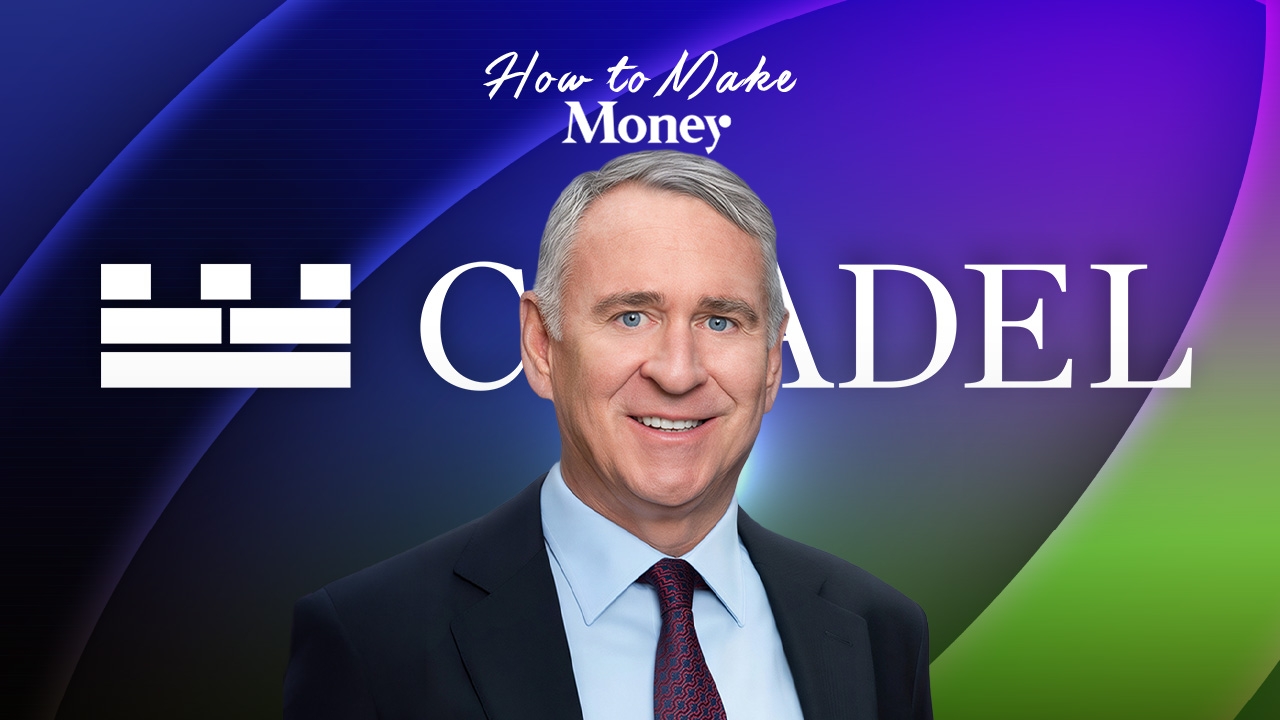
Citadel The giant hedge fund recently made headlines by purchasing the entire portfolio of Situational Awareness after it was forced to sell off completely. This was due to a steep market-wide drop in AI-related stocks, heavily concentrated in Citadel's investments, resulting in forced selling. It was Citadel itself that stepped in to buy nearly all the shares.
Behind this globally renowned successful fund is Ken Griffin. He is known as the manager who has generated the highest cumulative profits for investors in history by running Citadel with a Multi-Strategy approach—diversifying investments instead of relying on a single sector or strategy. This diversification has become part of the fund's DNA.
Ken Griffin is considered a genius in fund management, with an extraordinary life path. He started his first fund at just 19 years old and analyzed markets accurately by integrating technology into his work, enabling him to generate huge profits even when others failed. Ultimately, Citadel became one of the world's most influential financial institutions.
This article from Thairath Money in theHow to Make Moneycolumn will delve into the origins of Citadel, a fund over 35 years old, and explore Ken Griffin's journey guiding the fund through crises to its present success.
it all began with Kenneth, or Ken Griffin, a boy born and raised in Florida, USA. He was born in 1968 and attended Boca Raton Community High School, a large public high school in the state.
He loved mathematics from a young age and was chosen as president of the school's math club. Additionally, he was interested in computer programming and participated in the school's programming competition team.
However, he was a contrarian thinker who often questioned mainstream societal trends. In 1986, he told a local publisher that he believed demand for the type of computer programming he did would significantly decline in the coming decades, despite his own commitment to the field.
That same year, he went to study at Harvard University, where his trading career began. His first investment deal at 18 was buying Put Options on Home Shopping Network, earning a profit of $5,000.
After that, he became familiar with Convertible Bond Arbitrage—a strategy that profits from buying convertible bonds while short-selling the same company's common stock to exploit price differences. This approach requires real-time stock price data.
The main challenge then was that the internet was not as advanced as today. He obtained university permission to install a satellite dish on his dorm roof to receive live market data. This was essentially building his own data infrastructure, something almost no retail investor could do at the time, turning his dorm room into a miniature trading floor.
soon after, at just 19, Ken Griffin established his first fund with initial capital of $265,000 raised from his grandmother, a personal dentist, and acquaintances in brokerage.
However, the world soon faced Black Monday on 19 Oct 1987, a day when global stock markets crashed dramatically, with the Dow Jones dropping 22.6% in a single day. Most investors suffered heavy losses, but Ken Griffin's first fund made huge profits by holding short positions betting on the market's decline.
The key to his university success was not just correctly predicting market direction once, but discovering that convertible bonds were often undervalued due to their hybrid nature as both debt instruments and stock conversion rights, making valuation more complex than regular stocks or bonds.
At that time, many institutional investors lacked systems to accurately price these securities. Ken Griffin developed his own software and data analysis tools (leveraging his programming skills) connected to real-time stock data, allowing him to value convertible bonds more precisely than competitors.
His advantage was not market prediction but "information" and "technology," enabling him to manage two small funds from his Harvard dormitory while still a student.
Though the invested amounts were small compared to his current funds, the performance was enough to build trust with major investors. Upon graduating with honors in economics from Harvard in 1989, he left not only with a degree but with proven investment results.
shortly after graduation, Ken Griffin joined Frank Meyer, co-founder of Glenwood Capital Investments. Meyer entrusted him with $1 million to manage, and Ken achieved a 70% return in the first year.
More important than returns were Frank Meyer's words of advice:“Don’t build a fund relying on a single strategy; build a platform with diverse strategies.”This became a guiding principle for Ken Griffin's fund management philosophy.
The main reason is that multiple strategies attract talented people from various fields, and diverse sources of returns increase the fund’s chances to survive crises that could destroy single-strategy funds.
Starting with that $1 million, he founded his own fund in 1990 at age 22, establishing Wellington Financial Group with initial capital of $4.6 million, mostly from Frank Meyer.
The first two years were a breakthrough. In 1991, he generated 43% returns and over 40% in 1992. These results not only built his reputation as a young fund manager but paved the way for Citadel to become one of the world's most influential financial institutions.
The fund was renamed from Wellington Financial Group to Citadel Investment Group in 1994, and later in 2013 adopted the name Citadel LLC, as it is known today.
Citadel’s success under Ken Griffin is not about finding new stocks or increasing leverage, but designing a "system" that enables consistent returns despite ever-changing markets.
This system is called the “Pod Shop.” Instead of relying on a single fund manager to decide all investment strategies, Citadel divides into small teams or “Pods,” each with about 4-5 members including portfolio managers, analysts, researchers, and industry specialists.
This eliminates weaknesses: one team may specialize in tech stocks, another in banking, another in energy markets, or some focusing on fixed income and derivatives. Each team operates independently but under a unified risk management framework.
If one team errs, losses are limited to that segment. Ken Griffin believes that relying on a single manager risks collapsing the entire fund if they fail.
Each Pod’s goal is not to predict market direction but to generate Alpha—returns exceeding the market—without depending on market trends.
Typically, each team aims for 2-3% returns on allocated capital. When combined and leveraged appropriately, these small alphas from dozens of teams translate into overall fund returns of 10-15% annually.
Importantly, teams do not rely on one another; if one underperforms, others can compensate. This philosophy of diversifying profit sources, not just assets, has long been a Citadel hallmark.
Many might think anyone can split teams like this, but the challenge lies in risk management.
Imagine dozens of teams trading stocks, bonds, currencies, commodities, and derivatives worldwide simultaneously. How can one tell if teams are exposed to overlapping risks? Or if a crisis causes all markets to fall together, how much damage will the fund suffer?
Citadel invests heavily in technology systems to measure risk in real time at both team and fund levels. Ken Griffin has said, “Citadel’s real advantage is not having the best investors, but having a ‘system’ that enables many talented people to work together efficiently.”
In 1998, a key decision changed the fund’s investment terms. Ken Griffin offered investors two options: lock their money for at least two years or withdraw quarterly with penalties for early withdrawal. Most chose to lock funds.
At the time, many considered this rule strict. But weeks later, the financial world faced a major event when the famous hedge fund Long-Term Capital Management (LTCM) collapsed due to mismanagement, triggering massive investor withdrawals and margin calls.
LTCM had to sell huge amounts of assets cheaply, causing a market-wide selloff where many hedge funds sold quality assets just to return cash to clients.
Thanks to the locked-in capital strategy, Citadel was in a different position. It didn’t have to rush asset sales and instead used cash to buy quality assets being sold below true value. The result: Citadel earned up to 30% returns while most faced crisis.
After the LTCM crisis, Citadel’s reputation grew rapidly. Institutional investors recognized not only its outstanding returns but also its strong risk management structure.
By 2001, Citadel’s assets under management (AUM) rose from about $2 billion to $6 billion, a performance hard to replicate.
Since then, whatever financial crisis arose, Citadel’s name was involved—not as a loser but consistently as a winner.
Another major event was the Enron crisis. Seeing Enron’s high-potential human resources, Ken Griffin recruited many traders, analysts, and energy experts, reinforcing Citadel’s practice of hiring specialists who understand specific risks better.
However, Citadel has faced its own crises. In 2008, it suffered heavy losses of 55% due to Lehman Brothers’ collapse, then a key dealer of Citadel’s bonds.
The 2008 financial crisis impacted global financial institutions. Citadel, previously never having large losses, lost over half its portfolio but survived thanks to strong pre-existing strategies.
Besides locked-in investor funds preserving liquidity, Citadel negotiated flexible lending terms with prime brokers. During the crisis, it had more time than many funds to manage its portfolio.
Moreover, Citadel’s risk system runs over 500 daily stress test scenarios to identify and manage risks in advance, though not perfectly. Ken Griffin and senior executives also injected $500 million of their own money to support the firm, signaling confidence to clients.
After the crisis, in 2009, Citadel’s main fund rebounded strongly, generating 62% returns. Though insufficient to fully offset prior losses, it demonstrated the company’s graceful recovery. It took four years for the fund’s value to surpass previous peaks.
The 2008 crisis nearly ended Citadel, but after surviving, it became even more remarkable. Instead of just recovering, Citadel rose to become the most profitable hedge fund in history for its clients.
After four years to regain its level, investor confidence returned in 2012. Institutional investors worldwide poured money into Citadel—not because it never lost money, but because it proved it could survive the harshest crises.
By 2015, assets under management reached about $25.5 billion, touching $30 billion in 2018. Surprisingly, Ken Griffin began returning money to clients even though the fund could still raise more capital.
In finance, most believe larger assets under management are better, but Ken Griffin disagreed, believing that“Too much capital can become the enemy of returns.”
Many investment strategies have capacity limits. Larger funds find it harder to find high-return assets, and large trades can impact market prices, eroding previously generated alpha.
Therefore, instead of endlessly growing AUM, Citadel returns excess profits to clients to maintain fund size at levels that allow efficient returns. This contrasts with many asset managers who grow by increasing fund size.
Since 2018, Citadel has regularly returned profits to clients, including about $16 billion in 2022 and $7 billion in 2023, with additional billions returned in following years, totaling over $25 billion returned to investors.
Looking back over 35 years, Ken Griffin’s success was not from always predicting markets correctly. In reality, Citadel experienced heavy losses, crises, doubts, and near bankruptcy.
But each time, the firm recovered because Ken Griffin built not a one-man genius organization but a “system” enabling many talented people to work together.
He didn’t bet on single stocks but on organizational structure, data, technology, and risk management.
Today, Ken Griffin’s net worth exceeds $51.7 billion. Citadel holds the record as the most cumulatively profitable hedge fund globally, generating over $83 billion in net profits for investors. He is also a major philanthropist, donating about $2.4 billion to public welfare projects.
Sources: Citadel [1][2][3],Forbes,Quant Enthusiasts
Follow the Facebook page: Thairath Money at this link -https://www.facebook.com/ThairathMoney