

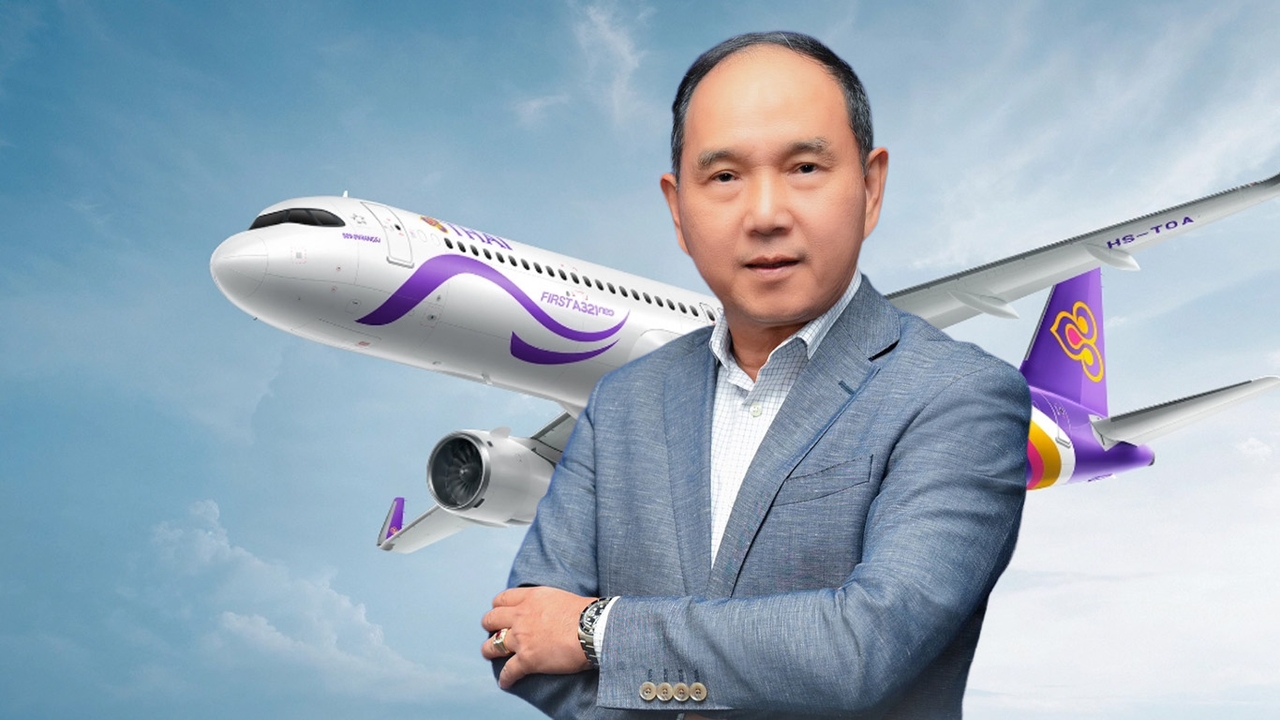
Thai Airways International Public Company Limited The company revealed its operational strategy going forward after consistently generating profits since completing its corporate rehabilitation. Despite ongoing global uncertainties affecting the overall aviation industry, Thai Airways stated it continues to maintain liquidity and profitability through a new management approach focused on long-term customer retention.
The main current challenge for the aviation industry remains rising energy costs due to instability in the Middle East, along with prolonged delays in aircraft deliveries—key assets critical to the business.
Chai Aiemsiri, Chief Executive Officer Speaking at the THAI TALK event organized by Thai Airways, he explained that since the COVID-19 crisis, aircraft deliveries have been delayed, causing the company to adopt a long-term perspective emphasizing business flexibility and rapid adaptation to manage current and future situations.
“We are fortunate to have already overcome hardships. The difference now is that we hold substantial cash reserves to be prepared for any changes. Having enough cash means we do not need to compete in the market through damaging price wars.” Chai Aiemsiri said.
Chai Aiemsiri highlighted Thai Airways' Q2 2026 performance, reporting a net profit of 1,537 million baht and total revenue (excluding one-time items) of 48,621 million baht—an increase of 3,793 million baht or 8.5% from the same period last year—demonstrating profitability despite the aviation industry's overall difficulties.
Chai Aiemsiri outlined current key strategies critical to maintaining Thai Airways' standards, including:

Since the rehabilitation period, Thai Airways has gradually sold older aircraft because a major previous problem was using outdated models that were never updated, making competition difficult and sometimes forcing discount promotions that hurt revenue.
Thus, the company decided to sell some older planes and invest significantly in refurbishing newer aircraft interiors entirely, aiming to provide passengers with the best possible experience.
Chai Aiemsiri described the airline's new aircraft image: whether old or new planes, interiors are completely redesigned while maintaining Thai Airways' distinctive identity. This ensures that if passengers must change planes unexpectedly, their experience remains consistent across all aircraft.


Additionally, the airline is upgrading Business Class seating by introducing a Premium Business Class, with comfort close to First Class—which currently operates on only three aircraft—to meet the needs of passengers seeking comfort without diminishing First Class availability in case of aircraft changes.

Furthermore, a Premium Economy Class has been added to cater to passengers desiring more comfort and service, along with enlarging overhead bin space to accommodate more luggage throughout the aircraft.

In Economy Class, seat designs have been updated to be lighter but equally comfortable, featuring modern color schemes and fully upgraded in-flight entertainment systems enhanced with new technology.
Another major Thai Airways strategy is steadily expanding its route network by reopening previously suspended routes and launching new ones to accommodate increasing customer numbers.

Kittipong Sarasomboon, Chief Commercial Officer explained that as a network airline, Thai Airways aims to distribute its network and channel travel through Suvarnabhumi Airport to other connections. Therefore, preparations for the upcoming winter travel season are essential.
The winter schedule covers 66 destinations with 998 weekly flights. New routes include Bangkok-Da Nang, Vietnam, with increased frequency to neighboring CLMV countries. In Europe, the Bangkok-Amsterdam route launched to support travel between Thailand and the Netherlands, alongside increased frequencies to several major cities.
Similarly in Asia, Thai Airways resumed flights on the Bangkok-Xiamen route to provide greater convenience for customers traveling to China.
which Kittipong Sarasomboon said that advance bookings from October through March are higher than the same period last year. He introduced the '3 Disciplines' strategy to generate quality revenue, consisting of:
“Our key strategy for this comeback is choosing steady, unhurried growth. Every route expansion is carefully studied and confidently launched to ensure Thai Airways grows solidly and sustainably over the long term.” Kittipong Sarasomboon said.
Kittipong Sarasomboon noted that Thai Airways serves nearly 20 million passengers annually, including over 300,000 children aged 2 to 12. Seizing this opportunity, the airline launched the Thai Junior Sky Explorers project.
This new initiative aims to build a new customer base and retain them long-term by fostering brand engagement from a young age, encouraging repeat purchases through parents, and creating new revenue streams from merchandise.

The airline introduced five mascots featuring animal characters designed to attract attention and tell engaging stories. These mascots appear on meal boxes, children's bags, ROP Card memberships for kids, and may be extended in the future to include collections featuring international guest characters.
Additionally, Thai Airways launched new products catering to lifestyle and wellbeing, including alcoholic and non-alcoholic beverages designed to enhance the in-flight experience.
They partnered with Jim Thompson and Sirivannavari to design comfortable pajamas and personal bags provided in Business and First Class.

Meanwhile, ROH, a Thai Airways subsidiary tour company, offers wellbeing-focused trips such as visits to Buddhist pilgrimage sites, and within Thailand highlights five key themes: cuisine, health relaxation, movie-related tourism, historical exploration, and experiencing Thailand's diverse cultures.
Ultimately, Thai Airways confirms its future course is planned for long-term sustainable growth. Chai Aiemsiri concluded, “This is not just about waiting for the future; we have already decided and taken action to build hope for our employees, confidence for the Thai people, and assurance for shareholders that Thai Airways is ready to grow strongly and sustainably.”
Read business news, marketing strategies, and exclusive interviews with Thairath Money to help you achieve “Better Finances, Better Life” athttps://www.thairath.co.th/money/business_marketing
Follow the Facebook page: Thairath Money at this link https://www.facebook.com/ThairathMoney