

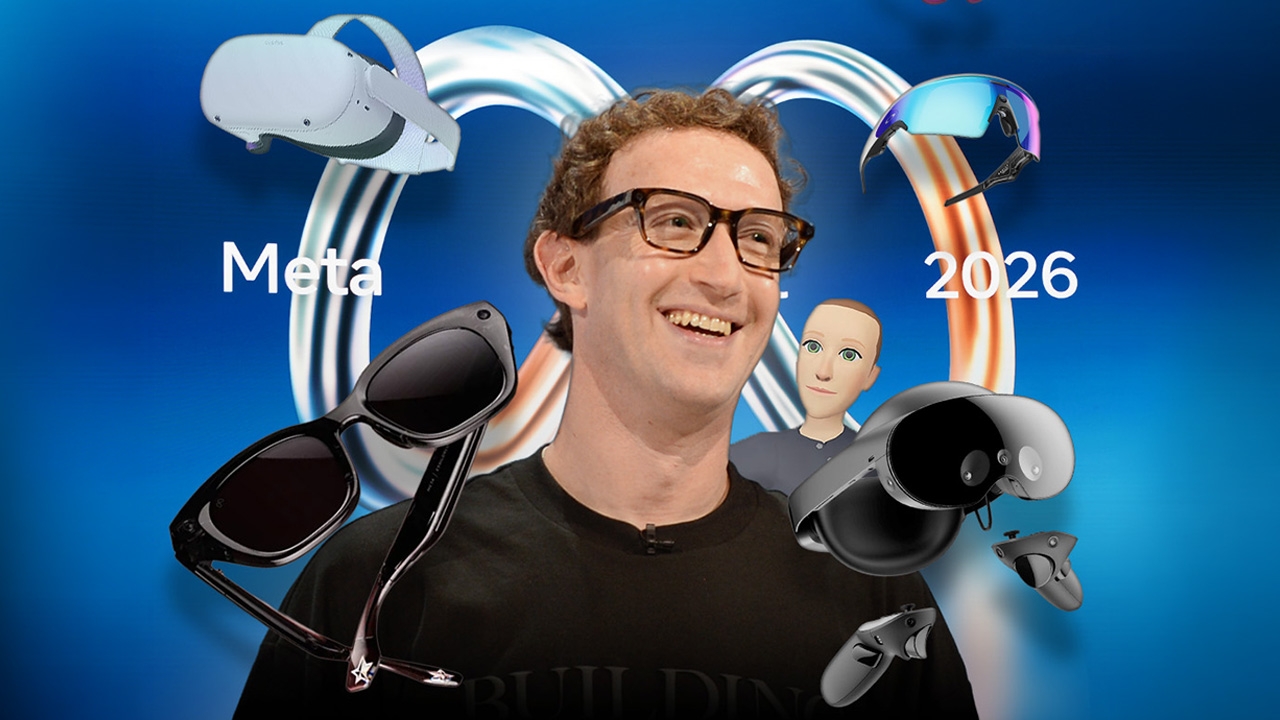
Image of Mark Zuckerberg holding Muse Charm an AI assistant miniaturized into hardware resembling a Tamagotchi, presented at the Meta Connect 2026 event last week, bringing Meta back onto investors' radar.
This follows Meta's major strategic shift, including investments in AI infrastructure, development of AI models, and integrating Meta AI and AI Agents into the Facebook, Instagram, WhatsApp, and Messenger ecosystems.
More intriguing than the AI launch itself is the hardware Meta is embedding AI into. Concurrent with Muse sparking investor interest, Meta unveiled and expanded its AI glasses lineup—from Ray-Ban Meta Audio, Ray-Ban Meta Gen 3, Meta Ray-Ban Display to Meta VR Glasses—announcing plans for over 100 AI Glasses models by the end of 2026 across Ray-Ban, Oakley, and Meta Glasses brands.
Following Muse’s debut on 8 September, Meta’s stock rose significantly, with numerous analysts revising their outlooks and target prices as they recognized Muse’s potential and its extension into AI Glasses.
How far does Zuckerberg’s vision go? How big is his bet on AI Glasses? And why have "glasses" become such a seriously prioritized hardware for Meta in the AI era?
This BrandStory column invites a retrospective look at Mark Zuckerberg and Meta’s post-social media journey—from Oculus, Reality Labs, Metaverse, Smart Glasses to AI Agent—to understand the strategic meaning of smart glasses for Meta’s new direction. This time, Zuckerberg is not merely betting on glasses but on the future computing platform itself.

The origins of this bet date back to 2014, when Facebook invested around 2 billion U.S. dollars to acquire Oculus VR, a company developing virtual reality technology during the early consumer VR market phase.
Zuckerberg did not see Oculus merely as a VR gaming hardware company. At the acquisition announcement, he viewed VR as having the potential to become a new platform for communication and social experience, comparing smartphones as the key platform of that era while VR could be the platform of the next era.
Two years later, Facebook launched “Oculus Rift” in March 2016 and continued developing Quest, Mixed Reality, and AR/VR technologies. The challenge was bigger than selling headsets; Meta aimed to build its own ecosystem encompassing hardware, software, developers, content, and social experiences.
A key driver was that if a new computing platform emerged, owning both hardware and software would give the company greater control over distribution than being just an application dependent on Apple’s or Google’s platforms.
By 2020, Facebook consolidated its AR and VR efforts under the name Reality Labs, declaring a clear mission to create the “Next Computing Platform.” They aimed to develop technologies enabling people to feel closer even when physically apart.
Reality Labs encompasses not only VR headsets but also AR, hardware, software, computer vision, spatial computing, and human-computer interaction.
This technology stack has been accumulated over a decade, and one of its most significant outcomes is not a VR headset but glasses that look like ordinary eyewear.

The bet escalated dramatically on 28 October 2021, when Facebook rebranded to Meta, announcing a new vision thatthe Metaversewould be the next chapter of the internet era. Zuckerberg’s vision then was of a world where people don't just view digital content on screens but immerse themselves within it.
VR serves to transport users into virtual worlds, while AR glasses overlay digital content onto the real world. Both technologies are part of a unified strategy to build a computing platform independent of smartphones.
However, this bet incurred massive costs. In 2025, Reality Labs generated $2.207 billion in revenue but suffered operating losses of $19.193 billion, compared to $17.729 billion losses in 2024. In the first half of 2026, Reality Labs earned about $833 million but operated at a loss of approximately $8.647 billion.
These figures make Reality Labs one of Meta’s costliest bets, especially as Metaverse adoption has not changed consumer behavior as fast as initially envisioned. Nonetheless, Meta has not stopped investing in hardware, as these investments build expertise in technologies potentially critical for the next computing platform, even if use cases shift away from Metaverse.

In the same year Meta announced its Metaverse bet, it also pursued a parallel strategy by partnering withEssilorLuxottica,the global eyewear giant owning Ray-Ban and Oakley, to launch "Ray-Ban Stories." This marked Meta’s first move to bring Reality Labs technology out of VR into a form factor wearable by everyday consumers. The collaboration covered both business and product development, especially pushing theRay-Ban Meta
model, where cameras, speakers, and microphones are integrated discreetly into frames resembling regular glasses. The initial functions included photo and video capture, music playback, and call handling. Behind the scenes, Meta faced the harder challenge of figuring out how to make people accept computing technology on their faces.
The turning point was not just hardware improvements but the advent of AI. Meta has been researching AI for many years, but 2023 marked the year AI clearly redefined smart glasses.
When Meta launchedthe new "Ray-Ban Meta" in September 2023, it embedded Meta AI directly into the glasses, enabling users to invoke AI by voice to ask questions, request information, or control functions without taking out their smartphones.Meta then advanced further: AI began not only listening but also seeing what users see.
At the end of 2023, Meta clarified that Ray-Ban Meta represents a convergence point of AI and Metaverse, where AI uses vision and language understanding to comprehend what the user is observing and provide hands-free assistance.
The glasses understand what the user is looking at because AI processes images, sounds, and language simultaneously. This makes the glasses a device with very high context awareness, a crucial ingredient for AI Agents, giving them an advantage over smartphones.
Meta then began experimenting with the limits of AI glasses. In 2024, they introduced "Orion," a prototype AR glasses integrating holographic displays, AI, and spatial computing. Meta stated Orion is the result of years of AR tech development, designed to learn and evolve towards future consumer AR glasses.
In 2025, Meta expanded into sports and performance with “Oakley Meta,” incorporating AI, cameras, and audio into glasses suited for outdoor and athletic activities. Most recently, in 2026, Meta added displays to the equation withthe "Meta Ray-Ban Display,"which shows navigation, notifications, calendars, and holographic experiences while users remain in the real world.
There is also "Ray-Ban Meta Audio," glasses without cameras focusing on audio and AI, featuring up to 12 hours battery life and starting at $349, and the "Ray-Ban Meta Gen 3," a primary model that is slimmer, more comfortable, with longer battery life, and a direct Meta AI activation button.
Additionally, the return of"Meta VR Glasses"weighing about 100 grams, designed as a personal theater, sports arena, workspace, and gaming platform, featuring a lightweight design that completely redefines the Meta-Quest image.
At Meta Connect 2026, Meta announced the introduction of Muse, a personal AI agent capable not only of answering questions but performing tasks on behalf of users, such as sending emails, booking travel, opening browsers, and filling forms, integrated into AI glasses.
This is where Meta’s strategy becomes most clear: glasses are not just high-tech devices with AI, but an interface for a personal AI agent that users can summon hands-free. Muse uses what the user is looking at as context—for example, answering questions about products on shelves, reading flyers, or managing items in front of the user—making the device context-aware and empowering AI to act.
To answer why Meta is so committed to glasses, the revenue from selling glasses alone is no longer the focus. Meta has massive user bases on Facebook, Instagram, WhatsApp, and Messenger, but most access these services via iPhones and Android devices.
This means Meta does not own the device interface. If smart glasses become the new computing interface, Meta could shift from being an application provider to owning hardware, AI, software, and distribution.
This strategic rationale explains why Zuckerberg invests in Reality Labs despite continuous losses; the value Meta seeks lies not in the glasses themselves but in data and direct relationships among Meta, AI, and users. Meta has clearly outlined this direction, building personal AI agents alongside device families that enable AI access everywhere.

Zuckerberg’s bet differs significantly from the Metaverse era because there are now real signals from consumers.
Recently, EssilorLuxottica, Ray-Ban’s parent company, revealed in July that revenue from Meta glasses tripled year-over-year, while multiple market research firms show Meta as the leading smart glasses brand with a substantial market share lead.
Counterpoint Research reported that global AI glasses shipments grew 263% year-over-year in H1 2026, with display-less AI glasses growing 258%, and Meta holding approximately 94% of global AI glasses shipments during that period.
IDC reported that in Q2 2026, the smart glasses and XR glasses market grew 35.3% year-over-year, with audio glasses—including Ray-Ban Meta—capturing 70.3% of shipments that quarter, and Meta’s overall market share at 68.7%.
These two data sets reflect the same picture: the market is expanding, and Meta leads currently. Importantly, growth is driven not only by AR display glasses but significantly by display-less AI glasses.
Meta Connect clearly positioned Muse as a new revenue channel beyond the company’s core advertising business, leading analysts to view this strategy as potentially creating an interesting new business model for Meta that complements its existing ecosystem.
Historically, hardware was a one-time purchase. But if glasses become the interface for Muse Personal AI, the business model could evolve to Hardware → Distribution → AI Service → Subscription/Commerce.
Meta may not aim for maximum profit from selling a single pair of glasses but wants glasses to become a distribution channel for AI. The more people wear them, the more user touchpoints Meta gains. When Muse connects with shopping, travel, work, and payment services, the ecosystem could expand from assistant functions to transactional channels.
Muse already has infrastructure supporting this vision; Meta says the agent can transact via payment systems linked to Stripe and collaborate with external services through connectors.
However, Meta still faces at least three challenges: first, whether consumers will accept wearing AI on their faces daily—technology may be ready, but fashion, comfort, and practical use remain issues.
Second, whether people will trust AI to see their world, as increased contextual awareness raises privacy risks.
What about the Metaverse?
Looking back from Oculus in 2014 to Meta Connect 2026, Zuckerberg’s path has not abandoned the Metaverse for AI but rather repurposed accumulated technology for new challenges.
What has changed more is the ecosystem’s priority: initially, Meta saw hardware as the gateway to the Metaverse; now AI motivates hardware to remain relevant in the real world, possibly explaining why Zuckerberg maintains his hold on Reality Labs despite steep losses.
Over more than a decade, Zuckerberg has bet on the "Next Computing Platform" multiple times—first VR, then Metaverse, and now AI. The most interesting aspect is that these three may be converging. If Zuckerberg’s smart glasses can enable AI to see, hear, understand, remember, and act with minimal smartphone use, Meta might be creating not just the smart glasses market but contending for the interface of the post-smartphone era.

That is why, after investing in VR and the Metaverse for over ten years, Zuckerberg still bets on “glasses.” Source information from CNBC [1] , [2] CNN, Techcrunch [1] , [2]
Read more BrandStory columns Read business news, marketing strategies, and exclusive interviews with ThairathMoney for "Good Finance, Good Life" at https://www.thairath.co.th/money/business_marketing
Follow the Facebook page: Thairath Money at https:// www.facebook.com/ThairathMoney