

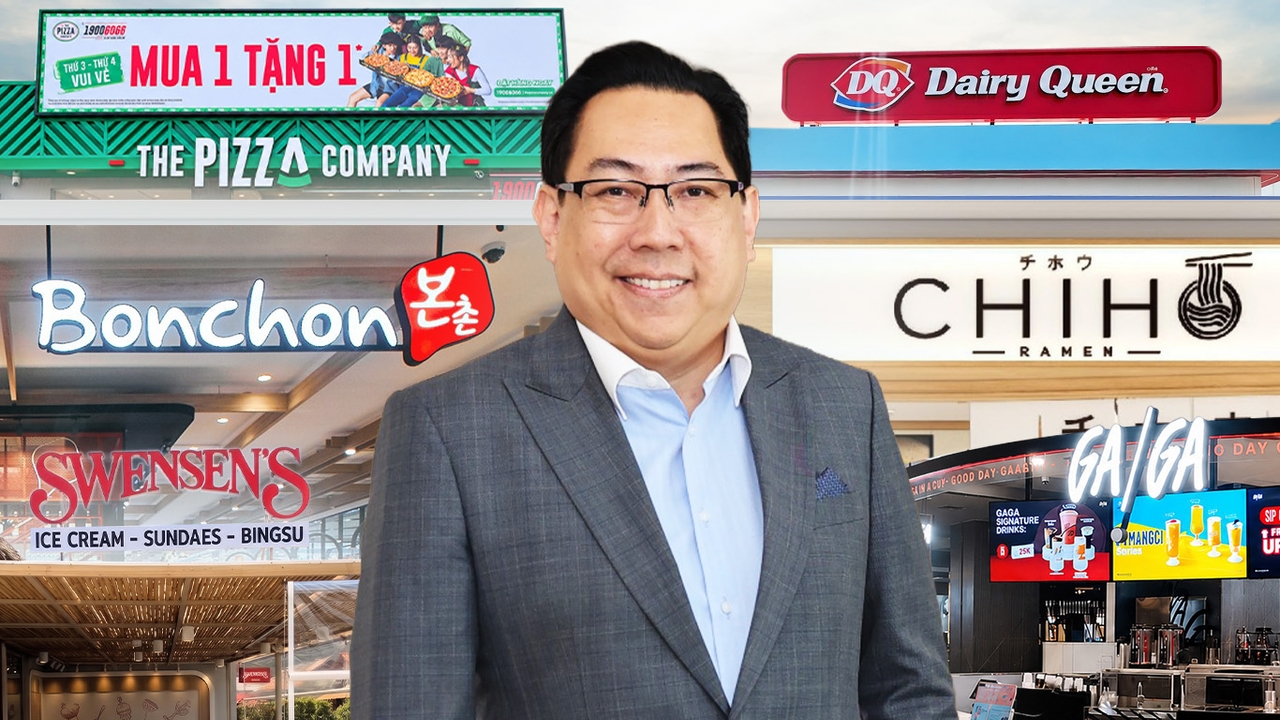
Did you know? Beloved everyday brands like The Pizza Company’s favorite pizzas, Swensen’s ice cream sundaes, Dairy Queen’s spill-proof soft serve, the top bubble tea brand GAGA, and the trendy Korean fried chicken Bonchon—all actually grow under the umbrella of the same giant, Minor Food.
In a fiercely competitive restaurant battlefield filled with friction from all directions, "Minor Food" is advancing a major organizational transformation to move beyond being just a large regional player toward the global goal of becoming the "Global Franchisor of Choice," a leading franchisor trusted by partners worldwide.
Behind this move is the acceleration of the "Asset-Light" strategy emphasizing serious franchise expansion alongside building brands and new innovative formats to grow the empire domestically and internationally.

Thanyachet Aekwechwit, Chief Business Development Officer of The Minor Food Group Public Company Limited, revealed that Minor Food’s overall portfolio has grown dramatically, now operating more than 3,000 outlets across 27 countries worldwide with nearly 40 brands under its management.
However, Minor Food’s ambitions go further. Their three-year strategic plan targets 4,500 outlets globally by 2029, averaging 500 new openings annually—equivalent to continuously opening 1.5 outlets daily—with franchises expected to rise to 2,400–2,500 outlets, or 54–56% of the total portfolio.
Thanyachet considers four key advantages that attract global franchise partners: a diverse portfolio with nearly 40 brands to choose from; extensive real-world restaurant management experience over 40 years allowing flexible localization—adjusting menus, pricing strategies, and communication to fit local consumer behavior—unlike many Western licensors with rigid frameworks.

A deep understanding of franchisee pain points, since Minor itself acts as a franchisee for global brands like Burger King and Dairy Queen; and a robust support system encompassing supply chain management, partner screening, and operational processes refined from long-standing franchise management in Thailand, ready to support global partners for rapid scaling.
In pursuing international markets, Thanyachet painted the picture of Minor’s major success partnering with a Canadian firm to acquire global rights to the Bonchon brand, with Minor holding franchise rights worldwide except for the U.S., where the Canadian partner holds rights.
Currently, Bonchon operates over 500 outlets globally, with about 150 in America and 350 outside. Strong markets include the Philippines with around 160 outlets, Thailand nearly 140, and Vietnam about 30—all countries with strong economic growth potential and large populations.

Minor Food’s marketing positioning for Bonchon does not view it as just selling fried chicken but as a cultural ambassador delivering “K-Culture,” the Korean lifestyle trending worldwide through the K-Wave.
Including the Middle East region, where consumer interest is overwhelming. This emotional and premium value drives consumer willingness to pay.
This differentiates Bonchon’s model from other Korean fried chicken brands that often imitate fast-food models competing in established QSR markets. Instead, Bonchon is designed as Casual Dining, focusing on dining experience with diverse lifestyle menus including ramen, rice, and Korean barbecue.
Currently, Bonchon has outlets in nine countries worldwide, including the new market Taiwan with 10 outlets opened in two years. Recently, it launched its first Malaysian outlet in August and plans to open its first outlet in Singapore, the tenth country. Minor plans to use Bonchon as the spearhead to penetrate international markets before introducing other portfolio brands like GA/GA, The Pizza Company, The Coffee Club, Sanook Kitchen, and Swensen's.

Besides Bonchon, other main brands continue growing internationally. The Pizza Company in Vietnam is set to reach 88 outlets by year-end, becoming the second-largest market after Thailand, aiming to be Vietnam’s top pizza brand next year. In Indonesia, Dairy Queen and GA/GA combined have nearly 100 outlets.
In Thailand, Minor operates roughly 1,900 to 2,000 outlets, consisting of company-managed and about 800 franchise outlets.
But the company is pushing further with a new model not done in over 20 years: accepting “Corporate Franchise” partners—large legal entities holding retail spaces—instead of the usual individual franchisees.
This historic alliance involves two giants: OR (PTT Oil and Retail Business Public Company Limited) and CP Extra (Lotus and Makro networks), enabling Minor to rapidly scale its business simultaneously.

Brands partnering with OR include Dairy Queen, The Pizza Company, Steak & More, and the new CHIHO brand. Lotus and Makro collaborate on five brands: Dairy Queen, Swensen's, Bonchon, Steak & More, and GA/GA. This cooperation model does not affect existing franchisees’ rights in those areas; if their contracts expire and they wish to renew, Minor prioritizes the original franchisees unless they choose to stop, then OR or CP Extra will manage those outlets.
Thanyachet said that domestic growth is also driven by continuous innovation in new formats, such as Dairy Queen’s Standalone Modular model partnered with 7-Eleven, placing sales points next to convenience stores with parking, allowing extended hours to target late-night customers.
This success is extended as a prototype for The Pizza Company’s small Modular format, with low investment, enabling expansion into secondary districts and new delivery zones without cannibalizing sales. It’s complemented by new formats like Chicken Trendies, combining pizza with fried chicken and dipping sauces to attract younger customers.
Meanwhile, Swensen's, with 370 outlets, breaks the mold by opening stores outside malls, such as on tourist beaches like Bang Saen and Khao Lak, to expand customer bases in high-potential locations.
Regarding Thailand’s franchise portfolio, Minor has made a major shift: in its first 20-plus years, only three brands—The Pizza Company, Swensen's, and Dairy Queen—were franchised.
But in the past two years, it rapidly added franchises such as Bonchon, GA/GA, and Steak & More. A key strategy is leveraging existing franchisees’ networks, space, system knowledge, and teams to manage new brands and strengthen the portfolio.

Minor Food’s latest highlight is launching its seventh franchise brand and its first full-scale entry into Japanese cuisine with “CHIHO,” a mass-market ramen brand designed to challenge the market leader. The niche ramen market in Thailand is valued at around 8 billion baht, previously dominated by one major player, with the rest being small independent stores—creating a large market opportunity.
Thanyachet revealed that CHIHO’s concept features affordable pricing starting at 99, 109, and 119 baht. The store is designed as a Small Format with compact space and low investment per outlet of about 4 million baht.
Notably, CHIHO’s expansion strategy involves franchising from day one without reserving prime locations in Bangkok, accelerating true Asset-Light growth. Minor aims to open 90–100 CHIHO outlets within three years, expecting at least 70% to be franchised.
Meanwhile, the reason for choosing CHIHO ramen despite already having the premium udon brand The Stone is due to targeting different customer segments. The Stone targets Premium Mass, while CHIHO is Mass-market, better suited for rapid and broad outlet expansion.
Thanyachet said that, looking deeper into Thailand’s operational results, The Pizza Company remains the top revenue-generating brand in the portfolio, followed by Swensen's second. Third place shows close figures between Dairy Queen and Bonchon.
Regarding cost pressures and inflation, Minor asserts that with over 3,000 outlets worldwide and nearly 2,000 in Thailand, it has strong bargaining power. Although logistics costs rose about 10% due to oil prices, logistics is a small part of total costs, so the overall cost impact is only 0.1–0.2%.
Overall, amid ongoing tight economic conditions and purchasing power into next year, Minor Food adheres to the mindset that “regardless of the economy, the business must grow,” proven by 4–5% growth in the first half of the year. Thus, if any market grows well, Minor creates new segments to expand.
But if any market slows, the company is ready to deploy new brands and fast franchise models to capture market share from competitors, driving the business toward becoming a strong, sustainable global food franchising leader.
In 2025, Minor Food’s foodservice and manufacturing business generated revenue of 32,594 million baht, while the first half of 2026 saw revenue of 16,708 million baht.
Read marketing news with Thairath Money to help you achieve “Good Finances, Good Life” athttps://www.thairath.co.th/money/business_marketing
Follow the Facebook page: Thairath Money at this linkhttps://www.facebook.com/ThairathMoney