

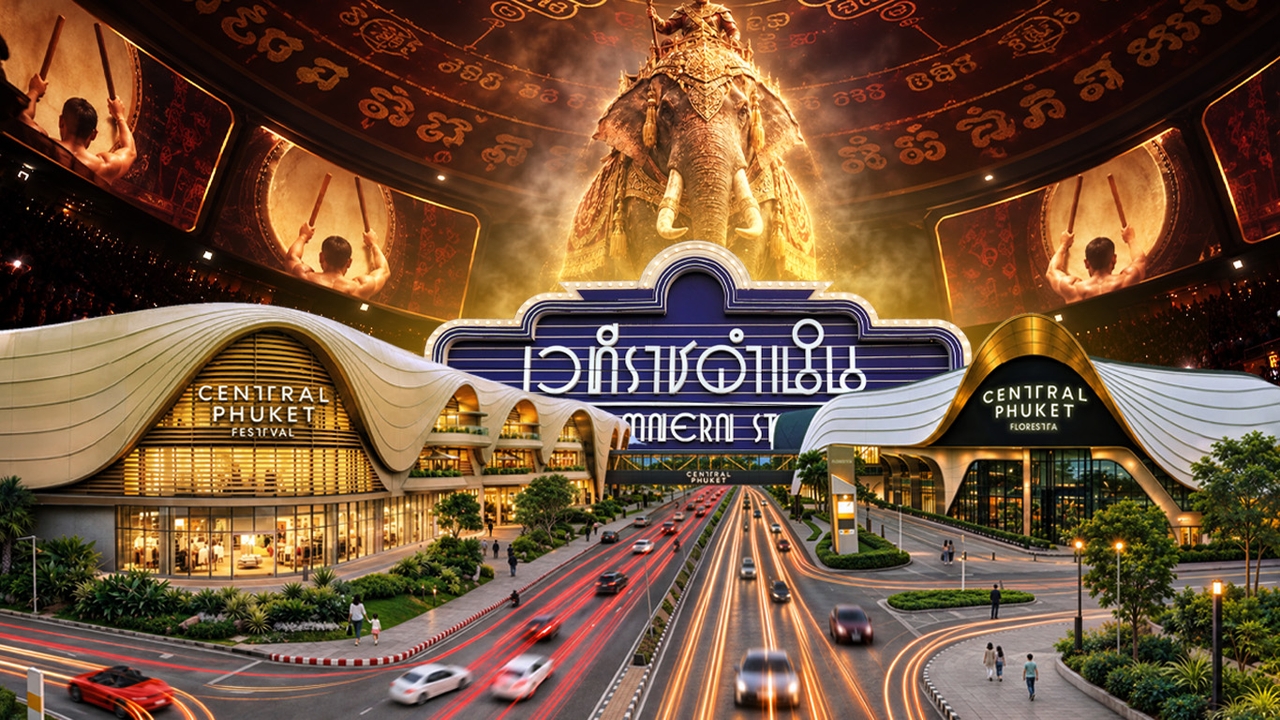
Once a world-renowned tourist resort, Phuket is now evolving beyond a mere travel destination into a new economic hub attracting investors, affluent consumers, and wealthy individuals worldwide who choose to live and settle there long-term, transforming it into The World’s Luxury Destination.
. Central Pattana Public Company Limited or CPN has announced a collaboration with Rajadamnern Stadium and the Rajadamnern World Series (RWS) to invest over one billion baht in developing “Rajadamnern Stadium Phuket”, a new world-class boxing arena and entertainment center located at Central Phuket shopping mall, covering approximately 9,000 square meters with 2,500 seats, scheduled to open in 2029, aiming to attract up to one million visitors annually.

This partnership represents one of Thailand and Southeast Asia’s first business models fully integrating sports with retail, aiming not just to build a new boxing stadium but to leverage Thailand’s cultural capital to develop a Sport Entertainment business offering luxury experiences and elevate Muay Thai from a national cultural heritage to a globally recognized sport with economic value.
Dr. Natthakitti Tangpoonsinthana, Chief Marketing Officer of Central Pattana Public Company Limited, said that today, sports are no longer just competitions but have become part of the entertainment industry, or Sport Entertainment, serving as a major attraction that draws tourists to cities worldwide.

This is evident from global sports events like Wimbledon in England, Roland-Garros in France, the US Open in New York, and the Australian Open in Melbourne, which serve not only as sports competitions but also as tools to promote cities and boost tourism.
Similarly, football fans dream of experiencing matches at Anfield, and F1 enthusiasts aspire to attend the Monaco Grand Prix; these examples show that sports have become a new reason for travel and can transform a city into a global destination.
For Thailand, a key existing asset is Muay Thai, the country's distinctive martial art, popular among foreigners who come to learn, train, and watch competitions.
“Sports today are not just competitions but a form of Sport Entertainment. We have combined sports with being a Tourist Destination. Thailand is proud to have Muay Thai, a symbol of Thai sports known worldwide.” Dr. Natthakitti Tangpoonsinthana added.
Over the past 20 years, Central Pattana was among the first to develop shopping centers in Phuket, gradually elevating the area from a Lifestyle Destination to a Luxury Destination nearly a decade ago, at a time when many operators had yet to recognize Phuket’s luxury market potential.
Central’s next step builds on existing strengths in Luxury Shopping, Dining, Culture, and Lifestyle by adding Sport Entertainment as a key attraction, leveraging Rajadamnern Stadium’s 80-year legacy to create a new global landmark in the heart of Phuket.
. Thianchai Pisithwuttinan, CEO of Rajadamnern World Series (RWS) and Executive Director of Rajadamnern Stadium, said that developing Rajadamnern Stadium Phuket marks a new historic chapter in Muay Thai, aiming not only to offer world-class sports viewing experiences but to create The Best Combat Sports Stadium in the World in Thailand.

This stadium will not only host boxing matches but function as an Entertainment Complex with activities seven days a week, offering diverse sports and event experiences during the day and Muay Thai matches every night.
It also provides an opportunity to build a Muay Thai industry ecosystem locally, including developing new fighters, training personnel, advancing fighters’ careers into coaching, and growing related businesses.
“Where tourists once came to Phuket to experience the destination and learn Muay Thai, we are now creating a new reason for global tourists to visit Phuket: to watch Muay Thai.” Thianchai Pisithwuttinan said.
Rajadamnern Stadium first opened in 1945 as Thailand’s first standard boxing venue and the world’s first Muay Thai stadium. Initially an open-air arena without a roof, it was later covered with a dome in 1950, becoming the iconic stadium known today.
Though Muay Thai has been part of Thailand’s culture for centuries, professional Muay Thai as a sport was established 81 years ago alongside Rajadamnern Stadium, with the first official professional Muay Thai rules introduced in 1954 to standardize competitions and elevate Muay Thai as a recognized sport.
Rajadamnern Stadium is not just a competition venue but the "birthplace of professional Muay Thai," home to the world’s first Muay Thai championship belt, the site of the first televised professional Muay Thai matches, and a stage that produced legendary fighters across generations.

Since 2022, the stadium has incorporated lighting, sound, and entertainment elements into Muay Thai competitions to create a world-class Sport Entertainment experience. By 2024, it integrated technology with its iconic dome architecture to present Muay Thai’s history, beliefs, arts, and culture alongside live competitions.
From only 20 spectators during the COVID-19 pandemic, Rajadamnern Stadium now hosts daily matches, becoming a major destination for tourists and combat sports fans globally, broadcasting 361 days per year to over 200 countries, drawing more than 700,000 viewers in 2026 with a goal of reaching one million the following year.
Although Rajadamnern Stadium in Bangkok has successfully transformed the Muay Thai viewing experience, its 80-year-old architectural and engineering limitations restrict full realization of new concepts.
Saran Ladawan, Managing Director of Rajadamnern World Series (RWS) and Executive Director of Rajadamnern Stadium, stated, “Everything at Phuket will be reimagined.” Building Rajadamnern Stadium Phuket is an opportunity for management to design every element anew—from structure, presentation technology, entertainment formats, amenities, to VIP experiences tailored to meet the demands of Phuket’s affluent clientele.

“When we first discussed Rajadamnern Stadium Phuket, the question wasn’t what we couldn’t do but what kind of Muay Thai experience we truly wanted to create. Every component and detail will be newly conceived to ensure this stadium becomes The Best Combat Sport Stadium in the World.” Saran Ladawan added.
A key highlight of this project is the collaboration with two world-renowned sports stadium architecture firms:
Both firms will help reimagine Muay Thai’s 80-year Rajadamnern heritage and its iconic dome through modern architecture and technology.

The stadium will cover about 9,000 square meters with seating for 2,500. Although seating capacity is similar to the Bangkok stadium, the usable space and dome size will be larger to enhance visual, lighting, sound, and entertainment experiences.

It is designed as a Multipurpose Arena capable of hosting sports competitions, world-class concerts, sports and music events, and Muay Thai educational activities, making it a Day and Night Entertainment Destination attracting visitors all day long.
However, elevating Muay Thai to a global, luxury sport is not about diluting its identity for international appeal but enhancing its inherent value through high-quality presentation worthy of Thailand’s cultural greatness.
Developments of Rajadamnern Stadium in Bangkok and Phuket rest on three pillars: Sport with top-level competition and athletes, Culture preserving authentic Thai art and heritage, and Entertainment delivering the best fun and viewing experience.
Beyond tourism potential and consumer purchasing power, another key reason Rajadamnern chose Phuket for expansion is its already strong combat sports ecosystem.
Thianchai Pisithwuttinan noted that Phuket is currently the world’s largest hub for Martial Arts and Combat Sports training, hosting camps for Muay Thai, Western boxing, and Mixed Martial Arts (MMA).
Training visitors range from fitness enthusiasts and amateur athletes to professionals and world champions who come to Phuket to prepare for global competitions.

Rajadamnern’s arrival complements Phuket’s existing ecosystem, transforming it from a global training center into a venue for world-class combat sports competitions and viewing. Phuket also benefits from a large international tourist base and attracts affluent consumers worldwide.
Data from Phuket province and the Tourism Authority of Thailand revealed that last year Phuket welcomed over 14 million tourists, generating approximately 540 billion baht in tourism revenue. From 1 January to 31 October 2026, about 11.3 million tourists visited, including 2.9 million domestic and 8.4 million international visitors.
The top five international visitor countries were Russia, China, India, Australia, and the United Kingdom. Phuket also has a long-term vision to develop as a new economic city based on 10 strategic pillars, including becoming a Sport City, Tourism Hub, and a city of music and entertainment.
Isaret Chirathivat, Head of Leasing at Central Pattana Public Company Limited, said that from a retail perspective, this investment is part of a major expansion plan for Central Phuket to support growing numbers of tourists and affluent consumers residing in the province.
Currently, sales of partner brands at Central Phuket are comparable to their highest-performing branches in Bangkok, with some brands even surpassing Bangkok’s sales, despite the expansion and Rajadamnern stadium not yet being operational.
Although Phuket’s tourist numbers have not fully recovered to pre-COVID-19 levels, retail sales and spending have significantly increased, with many stores seeing 30-50% growth and some doubling sales, highlighting the changing quality and purchasing power of customers.
Central Phuket already offers shopping, dining, and lifestyle experiences meeting consumer needs from morning to evening, but lacks Night Entertainment, which Rajadamnern Stadium’s arrival will fill.
Regarding business returns, although Central Pattana has not disclosed direct revenue targets for the project, increased income and opportunities will stem from rising tourist numbers, attracting quality customers, and creating activities that encourage longer stays and spending within the development.
Beyond business returns for both organizations, a crucial aspect is the potential economic value generated by the Muay Thai industry, encompassing athletes, gyms, trainers, promoters, event organizers, and related sectors such as tourism, hotels, restaurants, and services.
Thianchai Pisithwuttinan revealed that Rajadamnern Stadium in Bangkok currently provides jobs and career opportunities for over 5,000 Muay Thai fighters annually and directly supports more than 10,000 related jobs each year.
Furthermore, estimates with consulting firms indicate that Rajadamnern Stadium’s annual operations in Bangkok create an economic impact valued in the tens of billions of baht through competitions, broadcasts, and related economic activities, with expectations that Rajadamnern Stadium Phuket will generate similar economic effects.
This progress is also reflected in fighters’ incomes; previously, some earned only hundreds, thousands, or tens of thousands of baht pre-COVID-19, while today top champions at Rajadamnern can earn millions of baht annually from competition.

Elevating Muay Thai is thus not only about image or exporting Thailand’s Soft Power but about building an industry that creates jobs, increases incomes for Thai people, and motivates new generations to sustainably pursue sports careers.
For Thailand, having globally recognized cultural resources is no longer sufficient if they cannot be leveraged to add value through standards of competition, technology, storytelling, and business models that meet international consumer demands.
Central Pattana and Rajadamnern Stadium’s investment of over one billion baht represents more than building a new boxing stadium—it is an effort to transform Thailand’s cultural capital into a global economic asset and create new reasons for people worldwide to travel to Thailand.
From the birthplace of Muay Thai over 80 years ago to the dream of building the world’s best combat sports stadium by 2029, and from a beach tourist town to a global hub for commerce, residence, sports, entertainment, and culture,
this may be a pivotal step for Phuket to become The World’s Luxury Destination and proof that Thailand’s cultural heritage can evolve into a global business without losing its Thai identity.
Read economic and government policy news with Thairath Money for better financial living athttps://www.thairath.co.th/money/economics
Follow Thairath Money on Facebook athttps://www.facebook.com/ThairathMoney