

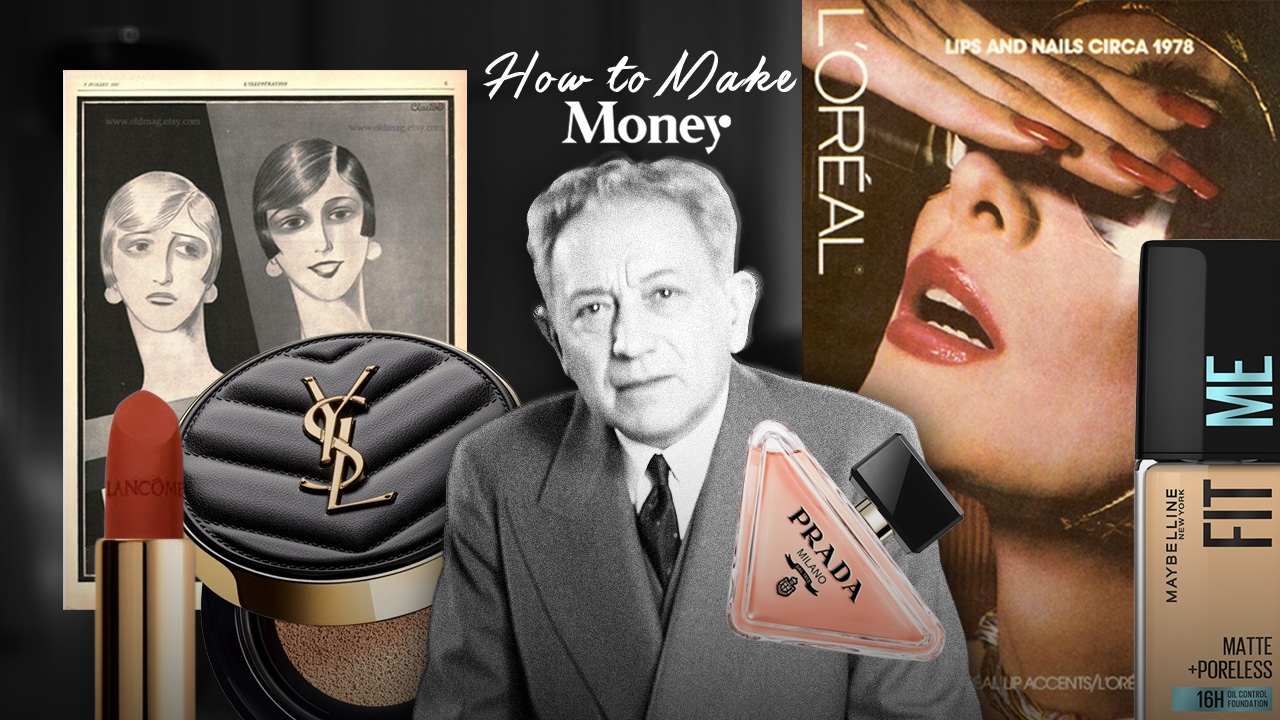
Cosmetics, skincare, and beauty products have become essential items for people of all genders and ages as self-care gains importance. Whether inexpensive, high-priced, designer brands, counter brands, or items found in convenience stores, these products have become routine purchases for everyone, leading toprojectionsthat the beauty product market will reach a value of $940 million by 2030, growing annually by 7.7%.
Did you know there is one beauty brand whose products cover the entire spectrum—from easily accessible brands like Garnier and Maybelline, professional lines like Kérastase, specialized skincare such as La Roche-Posay and CeraVe, to luxury brands like Lancôme, Kiehl’s, Miu Miu, and Prada? All these products belong to the “L’Oréal” group.
L’Oréal Group has a business history spanning over a century, starting with hair coloring products developed from the founder’s chemical expertise that transformed the beauty industry. Today, L’Oréal stands as the world’s leading beauty company, with a market value reaching $232 billion.
This article from Thairath Money’sHow to Make Moneycolumn explores L’Oréal—a beauty business rooted in scientific knowledge, which has built an empire through memorable marketing and strategies to diversify its product portfolio to meet every consumer need.
L’Oréal was founded in 1909 by French chemist Eugène Schueller, who graduated from the Paris Institute of Chemistry in 1904. He met a hairdresser and learned that hair coloring was trending in Paris, but existing dyes were ineffective and hazardous, failing to meet consumer needs.

Driven by his chemist’s spirit, Schueller improved the hair dye formula, and in 1907 introduced a groundbreaking innovation in beauty: a harmless hair dye product named “L'Auréale” meaning "aura of light," named after the then-famous hairdresser Auréole. This name later evolved into “L’Oréal” as it is known today.
By 1909, the Société Française des Teintures Inoffensives pour Cheveux (French Society for Harmless Hair Dyes) was established as a center to develop and research beauty products for women, starting with hair dye and expanding into other beauty categories, all centered on scientific innovation.
By 1912, just a few years after its founding, L’Oréal expanded beyond France to markets in Austria, Italy, and the Netherlands, offering hair dye, hair care, skincare, and cosmetics. In 1934, it launched a soap-free shampoo, and in 1935 introduced Ambre Solaire, the first sun oil that became a market hit.
L’Oréal followed founder Eugène Schueller’s path of developing products grounded in science and innovation. It went public on the Paris stock exchange (Euronext Paris) in 1963, becoming one of the most successful beauty companies in history.
After Schueller’s death in 1957, François Dalle, a trusted associate who had worked with L’Oréal for over a decade, became chairman and CEO. He led the company’s global expansion and devised strategies that made L’Oréal the world’s largest beauty company today.
Dalle’s core strategy was acquiring other brands. Starting in the 1960s, L’Oréal acquired Lancôme in 1964, along with Garnier, Vichy, and Biotherm. It expanded into men’s products to serve new customers seeking skincare, partnered with Ralph Lauren, and entered the U.S. market to broaden its business and cater to a diverse clientele.

Currently, L’Oréal Groupe owns over 40 brands covering luxury products like Prada and Cacharel perfumes, YSL, Miu Miu, skincare brands Kiehl’s and Biotherm, and cosmetics like Urban Decay and IT Cosmetics. It includes professional lines such as Shu Uemura, Kérastase, and L’Oréal Professional Paris, medical skincare brands like La Roche-Posay, CeraVe, Vichy, and accessible consumer products like Garnier, Maybelline, NYX, and Niely. These four segments form the core revenue drivers for the company.

L’Oréal is also a pioneering beauty company in advertising, successfully leveraging media since Eugène Schueller’s era. Recognizing advertising’s role in emotionally connecting with consumers, L’Oréal began newspaper ads in 1910, later moving into beauty magazines and television. Today, it employs comprehensive media strategies across digital platforms, TV, print, and outdoor advertising to reach consumers throughout daily life.
L’Oréal’s advertising strategies are as diverse as its product portfolio. Its communications are tailored not only globally but also finely tuned to the culture and preferences of each country, an approach known as global-local. This method preserves the global brand identity while embracing local market differences harmoniously.

From its inception to the present, L’Oréal’s core has been to be a true “innovation company” in every aspect, allocating substantial annual budgets to research and innovation. For example, in 2019, it invested approximately €985 million and established numerous research centers worldwide.
In 2015, L’Oréal was recognized byFast Companyas one of the 50 most innovative companies globally, the only beauty company to receive this honor.

With AI technology impacting every industry, the Beauty Tech trend has grown rapidly. L’Oréal was among the first to seriously engage in this field, launching personalized services for customers and AI-powered at-home beauty care systems under its latest slogan, “Beauty for Each,” catering to the unique beauty needs of individuals.
L’Oréal also operates an Open Innovation program inviting startups to collaborate on developing beauty technologies. This approach prepares L’Oréal for the future and keeps it ahead in the industry, while startups benefit from accelerated growth through partnership with the world’s top beauty brand.
Currently, according toCompany Market Cap,L’Oréal is the world’s largest beauty company with a market capitalization exceeding $231.97 billion. It operates in over 150 countries worldwide, including Europe, North America, Asia-Pacific, Latin America, Africa, and the Middle East.
Sources: L’Oréal [1][2][3][4][5],Quartr,,The Strategy Story,,Business Insider.
Follow Thairath Money’s Facebook page at the link -https://www.facebook.com/ThairathMoney