

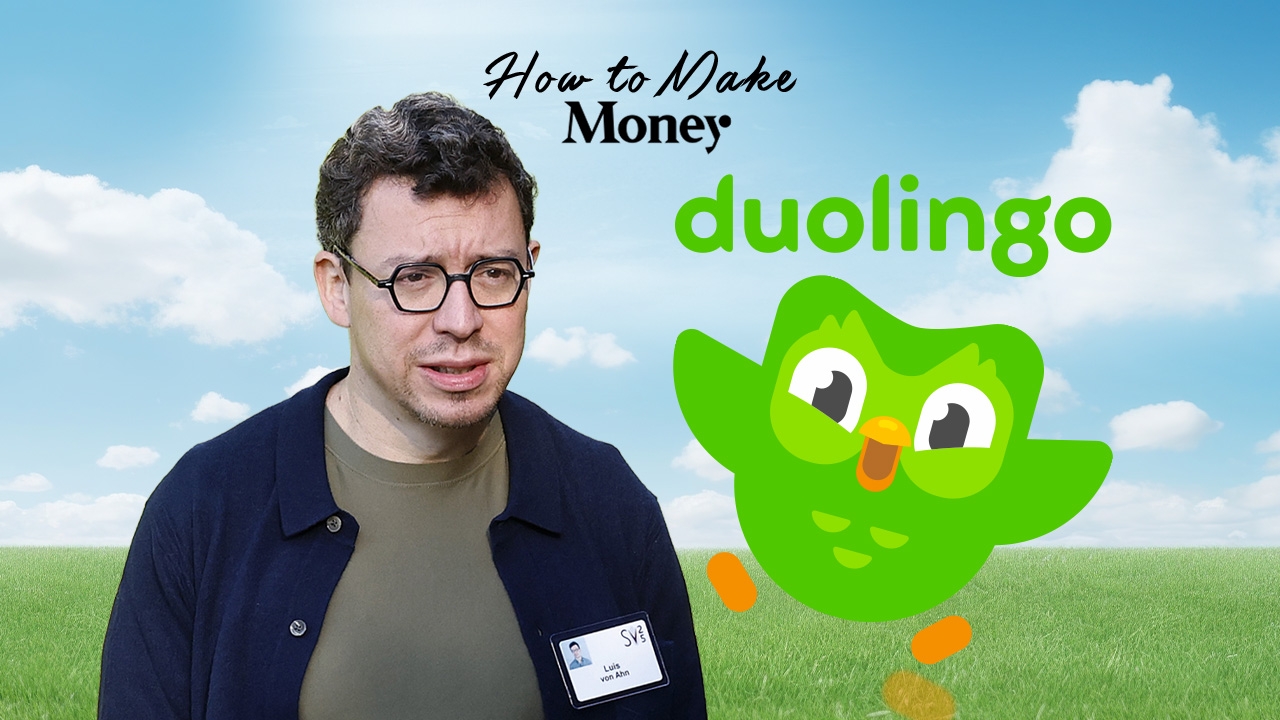
When it comes to language learning applications, the first name that often comes to mind is Duolingo which is known not only for its mischievous green owl mascot but also as an easy-to-use app offering fun language lessons. Many users are so hooked that they log in daily, accumulating thousands of consecutive learning days.
Behind Duolingo's growth stands Luis von Ahn. Many may recognize his name as the developer of CAPTCHA—the distorted characters users type to verify they are human when accessing websites. After selling this technology to a major tech company, he turned to creating a language learning app that anyone could access for free.
This idea stems from his childhood experiences witnessing educational inequality: those who had language skills, like himself, generally had better life opportunities. Coming from Guatemala, just south of Mexico, where there was no English proficiency testing, only wealthy families could afford to send their children abroad for exams. He saw a vast gap in a world where education should be accessible to all.
This article from Thairath Money'sHow to Make Moneycolumn takes an in-depth look at Luis von Ahn's journey from childhood to becoming a brilliant thinker and billionaire who, after changing the internet once, continues to transform the world by bringing education to everyone.
Luis von Ahn, was born on 19 August 1978. He grew up in Guatemala City during a civil war, witnessing hardship and inequality—not only in living conditions but also in education, where wealthier people accessed better opportunities.
His mother was a strong role model, one of the first women in the country to graduate in medicine. She dedicated herself to ensuring he grew up in a good environment to access quality education.
"Those with money always have better access to education, including myself, who received excellent education, while many others couldn't even learn to read or write," Luis von Ahn said.
Another clear example of inequality he saw was the language barrier. He shared that to take an English proficiency test, he had to pay a large fee and travel to El Salvador because Guatemala lacked testing centers. This posed a huge obstacle for those without financial means to cross borders just to take an exam.
These experiences formed the foundation of his mission to close educational gaps. He believes that people with language skills who can take exams and attend quality schools greatly benefit their countries. He wanted others to have the same access to learning opportunities he had.
Additionally, his mother introduced him to technology early on. By age 8, he had his own Commodore 64 computer and was already creating simple computer games by age 10.
With a strong foundation in language and technology, he went to the United States in 2000 for higher education, enrolling at Duke University to study science with a mathematics focus. By 2005, he earned a Ph.D. in computer science from Carnegie Mellon University.
during his doctoral studies, worked on a thesis about Human Computation—an innovative concept combining human brainpower with computers to solve problems beyond current capabilities. He also had interests in cryptography and steganography, the art of hiding information within images.
Luis von Ahn's notable work began around 2000 when, collaborating with Manuel Blum, he developed what is now known as "CAPTCHA" an acronym for Completely Automated Public Turing test to tell Computers and Humans Apart. CAPTCHA became a groundbreaking internet security measure to separate humans from computer programs or bots. It usually appears as simple tasks like typing distorted letters or selecting images.
The success of this invention brought him widespread recognition. In 2006, shortly after completing his Ph.D., he joined Carnegie Mellon's computer science faculty. During this time, he developed an online game called "ESP Game," which had players categorize images. This game became the foundation for Google's Image Search technology, as Google licensed it and turned it into the Google Image Labeler we use today.
Luis von Ahn further advanced CAPTCHA into "reCAPTCHA," a simpler system allowing users to verify they're human by clicking "I'm not a robot." Google acquired this technology in 2009. Afterward, von Ahn focused seriously on his mission to close gaps in education and language access.
came in 2011 when Luis von Ahn partnered with Swiss student Severin Hacker to co-found "Duolingo," a language learning app with the straightforward goal of providing free language education accessible to millions worldwide.
" Eventually, we decided to teach languages because English, though neither of us are native speakers, transformed our lives greatly. In many countries, English also increases earning potential," Luis von Ahn said.
However, early development of Duolingo faced challenges. Neither founder was a native speaker, so they experimented with languages they knew well—Spanish for von Ahn and German for Hacker. Although they didn't know the best teaching methods at first, being fluent helped them realize that successful language learning must be fun and keep learners engaged over time.
This approach led to Duolingo's official launch in 2012 with a concept of free and enjoyable language learning. It transformed language education with a gamified app that encourages users to accumulate learning streaks to stay motivated.
By 2022, Duolingo made history as the most popular language learning app, offering over 100 courses in more than 40 languages. It expanded into other areas such as chess, music, and math, serving over 130 million monthly users and 50 million daily. Its user base includes immigrants, expatriates, and high-profile figures like Microsoft founder Bill Gates.
Duolingo also advanced language learning by introducing an online language proficiency test, addressing students in areas without nearby test centers. The test costs a modest $49, takes 45 minutes, and helps close gaps caused by expensive, distant exams. Its results are accepted by institutions worldwide, including Duke, UCLA, Columbia, Dartmouth, New York University, and Yale for admissions.
While Duolingo now offers paid programs, it still provides free access to most users, ensuring widespread, equitable learning opportunities to close global education gaps. In 2024, Duolingo, traded on Nasdaq, grew to a valuation over $9 billion with revenues exceeding $750 million, making Luis von Ahn a billionaire with wealth over $1.1 billion.
Follow the Thairath Money Facebook page at this link -https://www.facebook.com/ThairathMoney