

One of the most popular ride-hailing and food delivery apps, Grab is often pre-installed on users' smartphones. "Grab" Currently in Thailand, Grab dominates the food delivery market according to Momentum Work data. Overall, Grab operates across eight Southeast Asian countries—Thailand, Singapore, Malaysia, Indonesia, Vietnam, the Philippines, Myanmar, and Cambodia—having completed over 20 billion rides and deliveries since launching in Malaysia in 2012.
In 2025, Grab turned profitable for the first time with consecutive profitable quarters. Besides its core ride-hailing and delivery business, its Financial Services sector also showed significant growth.
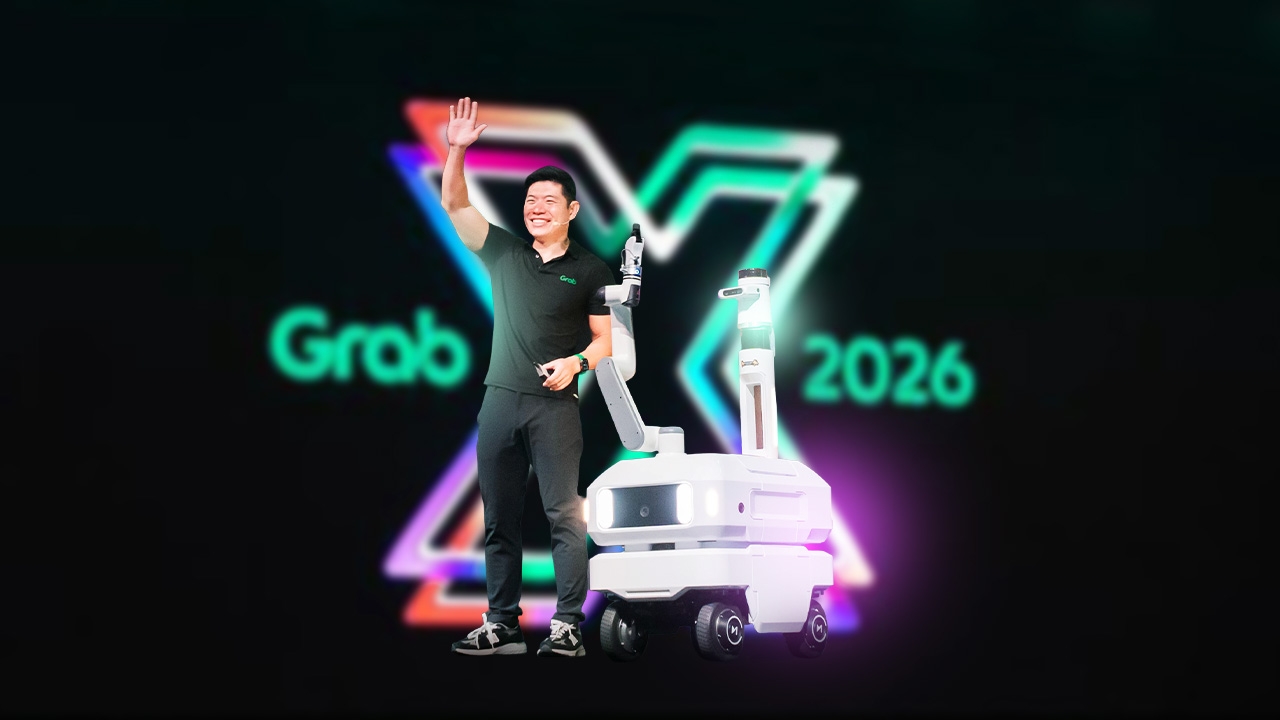
Grab considers itself an innovation-focused organization and plans to maintain sustained profitability. In the AI era, it is integrating AI strategies prominently. Thairath Money reporters attended the event "GrabX 2026" held in Jakarta, Indonesia, on 8 April, where Grab launched many new products under the theme "Your Everyday Guide." It aims to be more than just a ride-hailing or delivery service, evolving beyond a super app to become a "trusted companion" in every step of users' lives. This reveals the next chapter for Grab, especially as AI increasingly influences all aspects of life.
This article from Thairath Money'sHow to Make Moneycolumn delves into Grab's business model in the AI-driven era. From a small startup offering taxi services, it has grown into a multi-service app holding vast data. What will Grab become next as it advances into a full-fledged tech giant?
Grab began with two Harvard classmates who wanted to develop their home region, Southeast Asia. "Anthony Tan" and "Tan Hooi Ling" met in a business class studying Business at the Base of the Pyramid (BBOP), focusing on building profitable businesses that also help society.
They aimed to solve local problems, including the safety concerns of women, children, and the elderly using taxis. In 2012, they co-founded the startup "MyTeksi" to make taxi-hailing safer and easier, initially funded with $25,000 from a university competition.

Grab's growth was rapid. In 2013, it rebranded as "GrabTaxi" aiming to provide services similar to Uber in the US, quickly expanding to Singapore, the Philippines, and Thailand, adapting to local lifestyles and becoming a leading taxi-hailing service.
In 2014, the growing startup rebranded again as "Grab" with a new strategy to offer more than just taxis, adding services like GrabBike and GrabCar to compete with Uber in Southeast Asia, establishing itself as a top player in ASEAN.
Grab continued launching new products almost yearly: GrabExpress (2016) for parcel delivery, GrabPay (2016) digital wallet, establishing Grab Financial Group for financial services, and GrabMart (2019) for grocery shopping.
A major milestone came in 2018 when Grab acquired Uber Southeast Asia, which struggled with local markets. This acquisition solidified Grab's dominance in Southeast Asia.
Following that, Grab officially launched GrabFood, a food delivery service similar to Uber Eats, integrating Uber's food service with Grab's platform. This shift marked Grab's transformation into a "Superapp" by consolidating all its services into one app.
In 2021, Grab went public on Nasdaq via the largest SPAC deal in the US market, reaching a $40 billion valuation and raising over $4.5 billion. However, the following year saw a stock decline due to weaker-than-expected performance and ongoing unprofitability.
Grab's business expansion also focuses on financial services. In 2022, it launched GrabFin, offering more than just a payment wallet, including insurance, loans, and investment products.
By 2026, Grab continually introduced new features to keep users engaged. Thairath Money attended "GrabX 2026" which showcased innovations focused on AI, elevating the super app using Grab's vast data to become "Your (Intelligent) Everyday Guide" a smart companion supporting users at every life step.

"Grab adheres to the principle AI-First, with Heart—using advanced technology to solve real problems for everyday people so no one is left behind in the AI era," Grab Group CEO Anthony Tan said on stage.
Since 2025, Grab has been focusing on AI with products like Mine, an AI assistant for merchants, and this year launched Coach, an AI assistant for drivers. "This acts as a thinking partner that helps increase earnings and manage tasks, allowing drivers to focus on the road," Tan added.
Behind all this development, Anthony Tan calls it "Grab Intelligence Layer" —an intelligent framework powering features related to safety, finance, and efficiency. Grab absorbs all AI token costs to provide free access to partners. "AI shouldn't be a luxury only for those who can pay,"
Tan said. "Instead of letting the gap widen between tech experts and the underprivileged, we use our intelligent framework to connect them."
This reflects Grab's founding philosophy of building a business that also supports society. Philipp Kendal, Chief Product Officer, presented new AI-powered features and products that leverage Grab's data to create innovations benefiting consumers, riders, drivers, and merchants more comprehensively.
This year, Grab organizes its products into three main categories addressing every life step: For Local Life, For Effortless Travel, and For Business Empowerment. Some features build on existing ones, while others reveal Grab's new business directions.

For Local Life:
For Effortless Travel:
For Business Empowerment:
Grab also bridges digital and physical worlds by introducing Carri, a robot aimed at last-mile delivery tasks similar to Amazon's approach, assisting both restaurants and riders.
Drivers typically lose about 10% of income waiting or walking to pick up orders. Carri helps by collecting food from stores and delivering it to designated points for riders to pick up, potentially expanding to last-mile home delivery to enhance driver safety and reduce energy costs.

"Carri, our friend, isn't here to replace drivers but to be a superhuman extension for them,"
Anthony Tan said. "We're transforming it by giving software hands and eyes, bringing our intelligence layer from the cloud to the streets." This signals Grab's expansion into software products, possibly a key future business model amid the AI landscape.
Before leaving the stage, Anthony Tan hinted that next year's GrabX will be held in Taiwan as Grab expands beyond Southeast Asia, following its $600 million acquisition of Foodpanda Taiwan.
Source: Grab [1][2][3][4],CNBC,,Time,,Entrepreneur,,History Timelines,,SBR,,Elluminati,,Tech in Asia.
Follow Thairath Money's Facebook page here -https://www.facebook.com/ThairathMoney