

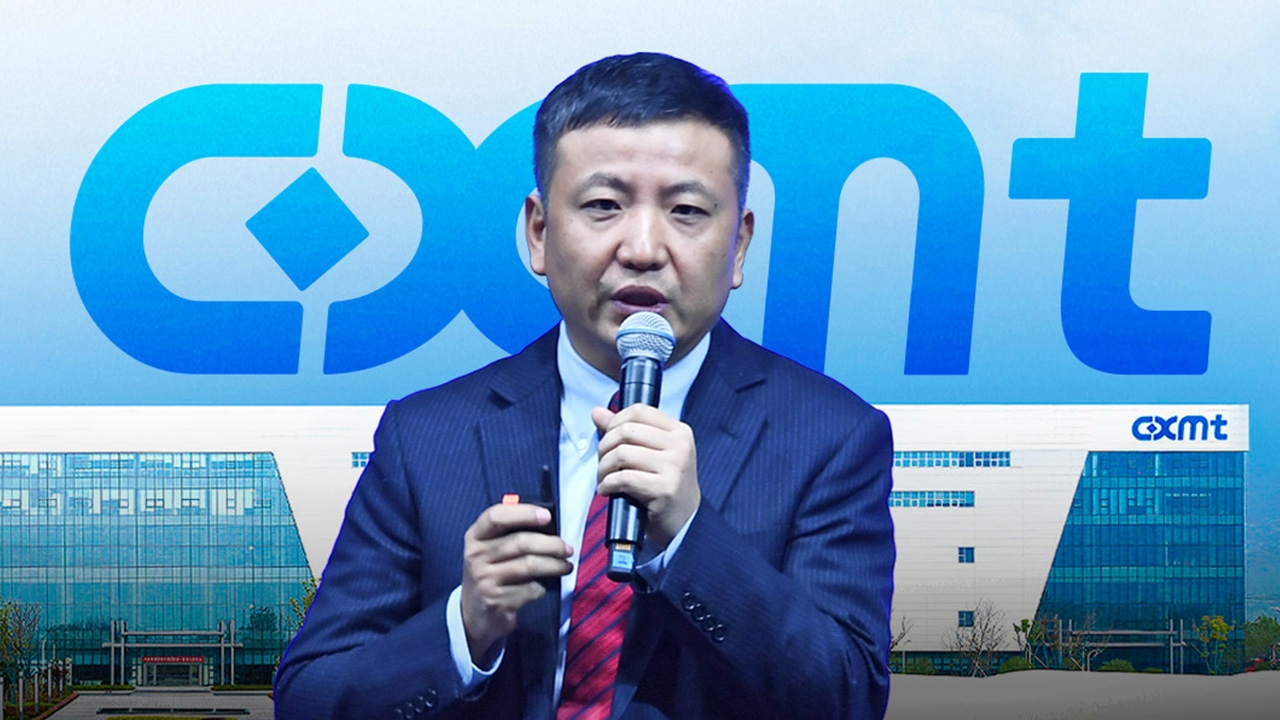
ChangXin Memory Technologies, or CXMT, is a Chinese chip manufacturer that has grown into a giant both domestically and globally. It recently went public on the Shanghai Stock Exchange, making history as China's biggest tech IPO and raising over 8.5 billion U.S. dollars.
CXMT's rising fame is not only due to this landmark IPO but also reports that Apple decided to test CXMT's DRAM memory chips in devices sold in China, while pushing the U.S. to ease restrictions on Chinese chips amid a global memory shortage crisis.
CXMT is renowned as China's major domestic DRAM chip manufacturer backed by the government. It was selected as the country’s "champion" to challenge the three major global memory chip producers: South Korea's Samsung Electronics and SK Hynix, and the U.S.'s Micron Technology. CXMT has succeeded, currently ranking as the world's fourth-largest DRAM producer.
Behind this monumental success is Zhu Yiming, who has been passionate about chips for over 20 years. Starting his company from scratch, he led it to be listed on two stock exchanges in China.
This company is Zhu Yiming's second founded enterprise. Within just 10 years, CXMT became a key chip manufacturer in the country. This article from Thairath Money's columnHow to Make Moneydelves into the story of China's new billionaire Zhu Yiming, a thinker, developer, and technologist who benefited from the AI boom and has always believed that "China must build its own chip industry," a goal he helped realize.
Zhu Yiming was born in July 1972 in Funing County, Yancheng City, Jiangsu Province, China. However, little personal information about him is publicly available. His educational background shows he graduated with a bachelor's degree in physics from Tsinghua University in 1994.
He then pursued a master's degree at the same institution. While studying, he often spent his free time in Zhongguancun, China's tech industry hub, taking programming jobs from small tech firms. Remarkably, he earned up to 300,000 yuan annually, while the average Chinese income then was about 10,000 yuan per year.
This experience exposed him to the rapid growth of software and hardware markets and sparked his special interest in chips. He realized China still relied heavily on foreign chips, prompting him to question whether China could become self-reliant in semiconductors.
When he chose to pursue a master's degree, he shifted focus from theoretical research to seriously studying Integrated Circuits (IC). However, university teaching was theory-heavy, so he felt it was insufficient to deeply understand industrial chip manufacturing processes.
Around that time, he decided to gain practical experience by working in the chip industry. After graduation, he earned another master's degree at Stony Brook University in New York and later worked in Silicon Valley, the world’s leading tech hub.
He began as an engineer at iPolicy Networks, then advanced to project manager at Monolithic System Technologies, a leader in developing various memory types produced with logic process chip fabrication. This experience was key to building his semiconductor expertise.
In 2004, he returned to Beijing with strong conviction that "China must build its own chip industry."
He brought with him a patent for Static Random-Access Memory (SRAM) technology and initial capital of only 100,000 U.S. dollars to establish Xinji Jiayi, which later became GigaDevice, a fabless chip design company specializing in memory chips.
Under his leadership, GigaDevice became the first Chinese company to develop high-speed memory chips for mobile devices, helping fill a critical gap in the domestic semiconductor industry.
By 2009, after weathering the financial crisis, GigaDevice grew steadily and succeeded in industrial-scale SPI NOR Flash production. In 2010, it commercially produced flash memory chips ranging from 512K to 32M and sold over 100 million memory chips annually.
In 2013, a pivotal moment occurred when Zhu Yiming pushed GigaDevice to launch the GD32 microcontroller unit (MCU) series, the first Chinese MCUs developed on ARM Cortex-M architecture.
They followed with Cortex-M4 MCUs and aggressively entered the Internet of Things (IoT) sector, expanding from memory chip manufacturing to developing semiconductors for smart devices across industries, successfully advancing the domestic chip market.
In 2016, he led GigaDevice to list on the Shanghai Stock Exchange Main Board, marking the first company to evolve from startup to major domestic chip industry player, a foundation that later extended to CXMT.
After successfully taking GigaDevice public, in the same year Zhu founded ChangXin Technology (CXMT) to focus on semiconductor memory technology, partnering with the Hefei government to build the company.
Unlike GigaDevice, which designs chips and outsources manufacturing, CXMT’s model encompasses design and in-house chip production from start to finish, requiring massive investment in semiconductor fabrication plants and technology development over many years.
In 2018, he resigned from GigaDevice to fully devote himself to CXMT, declaring that he would "not take a salary until the company turns a profit."
One year later, CXMT successfully produced its self-developed DRAM chips, marking the first time mainland China had a DRAM manufacturer capable of competing globally in a market long dominated by foreign producers.
In the initial years after founding and producing its own chips, CXMT faced continuous losses. Nevertheless, it received government support amounting to several billion U.S. dollars.
The situation turned around as AI-driven demand for memory chips surged worldwide, causing prices and sales to soar. In the first quarter of 2026, revenue rose 719% year-on-year, reaching 50.8 billion yuan.
More than seven years after Zhu vowed not to take a salary until profitability, Reuters reported that CXMT’s revenue in the first half of 2026 could exceed 110 to 120 billion yuan—almost double the 61.8 billion yuan earned in 2025.
Besides Zhu Yiming and CXMT, the city of Hefei gained attention for its investment and support of CXMT from the start. Although less globally known than Beijing or Shanghai, a SemiAnalysis report in June described Hefei as a prime example of China’s "Patient Capital" concept—investment willing to wait long-term for returns and tolerate losses better than typical investors.
This government funding gave Zhu enough capital to expand CXMT. SemiAnalysis also noted CXMT acquired numerous patents from Qimonda, a German chip company that collapsed during the 2008 global financial crisis, forming a key foundation for its DRAM development.
Furthermore, CXMT had resources to attract engineers worldwide, bringing knowledge and experience to advance its technology. After the IPO, Hefei’s government became one of CXMT’s largest shareholders, holding over 30% through locally owned companies and entities.
Bloomberg Billionaires Index reported Zhu Yiming's wealth surged nearly 300% to 13.9 billion U.S. dollars after CXMT’s stock debuted on the Shanghai Stock Exchange on Monday, 27 July 2026.
This increase mainly came from his company shares, including unvested shares, making him one of the billionaires who gained enormous wealth from AI technology as the company became mainland China's most valuable.
However, he pledged again, offering about 40% of his shares—over 767.9 million shares worth more than 5.6 billion U.S. dollars—to employees to retain talent, and confirmed he will not sell his own shares for 10 years after the IPO.
From a chip design startup to a full-scale chip manufacturer, Zhu Yiming led two companies he founded to public listings, becoming vital national enterprises—one of which is a major Asian tech giant advancing globally.
Related articles:
According to Forbes on 9 August 2026, Zhu Yiming’s net worth reached 15.2 billion U.S. dollars. CXMT’s market value stood around 487 billion U.S. dollars, ranking as the fourth-largest DRAM manufacturer with about 8% market share, behind Samsung (38%), SK Hynix (29%), and Micron (22%).
Follow Thairath Money Facebook page at the link below -https://www.facebook.com/ThairathMoney