

After CP AXTRA officially launched “Happitat” at Bangna Kilometer 7 on 21 Aug 2024 GMT+7, the retail scene in eastern Bangkok has heated up again, especially with the nearby mixed-use project “MEGA City” undergoing its first expansion in 14 years.
Similarly, The Mall Group's Bangkok Mall, a large mixed-use development spanning over 100 rai, is under construction and aims to open in 2028 GMT+7.
These three projects illustrate the intensifying competition in Thailand’s retail sector. From a past focus on having the largest mall, the challenge now is to create destinations that keep visitors longer, increase spending, and integrate hotels, offices, residences, food, entertainment, and experiences.
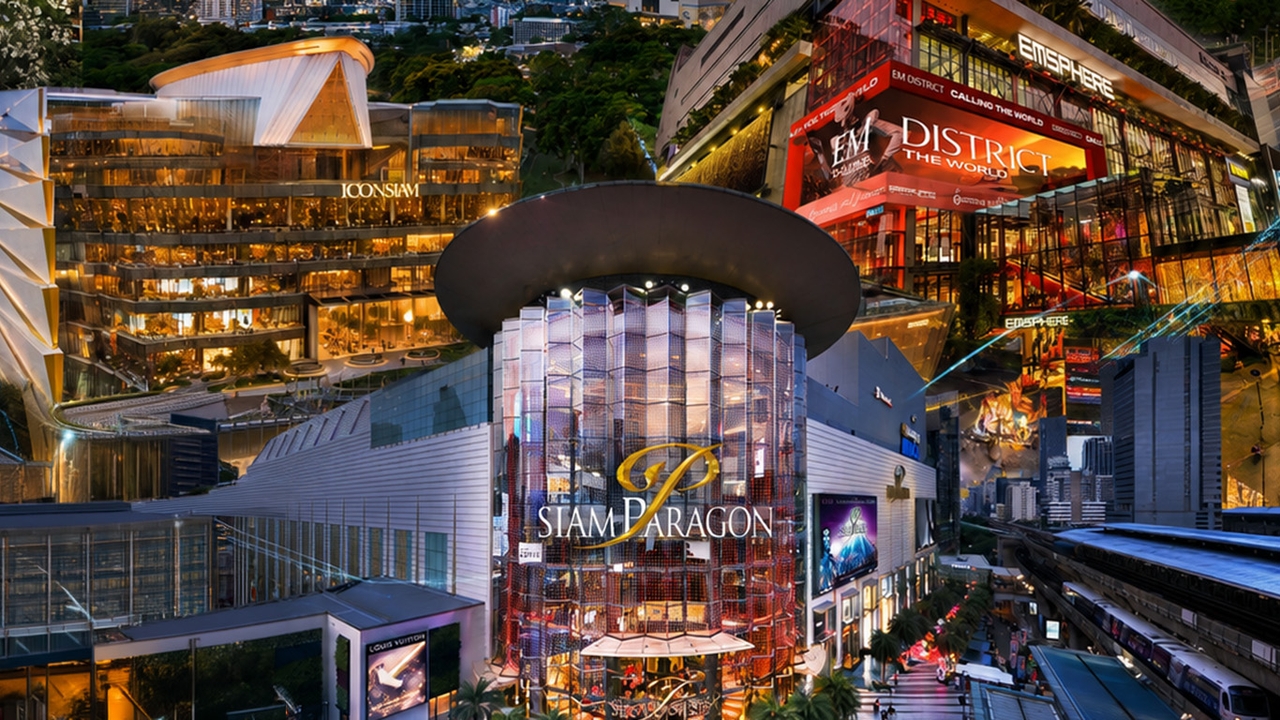
Looking deeper into Thailand’s retail market reveals that few players have the power to create such large landmarks. Behind well-known malls like CentralWorld, Siam Paragon, ICONSIAM, Emporium, EmQuartier, One Bangkok, as well as Lotus’s, Makro, and Happitat, lie business groups and family empires with decades of experience, capital, land, and extensive business networks.
Thairath Money explores the five key investment groups playing major roles in Thailand’s retail business, from their origins and landmark projects to their latest moves reshaping the retail landscape.

When discussing the most frequently encountered retail giant in daily life, CP Group and the Chearavanont family are unavoidable names. CP’s retail empire did not grow solely from large shopping centers but extends from 7-Eleven convenience stores, wholesale business Makro, to Lotus’s supermarkets, connecting with consumers from small daily purchases to major family shopping.
A key turning point occurred when CP expanded its retail portfolio through Makro and Lotus’s, making them core businesses under CP Axtra. Retail development has shifted from mere product sales to creating spaces combining food, lifestyle, and experiences. Recently, Happitat in Bangna is noteworthy as another step in CP’s retail strategy, designed as a large Lifestyle Destination beyond just leased retail space.
CP’s advantage lies in its diverse retail formats, from convenience stores and wholesale to supermarkets and large-scale destinations.
The story of the Chirathivat family began with a small family business before "Tiang Chirathivat" and "Samrit Chirathivat" led a serious expansion into retail.
In 1947, they started Central Trading and in 1956 opened Central Department Store at Wang Burapha. They expanded into real estate development through Central Pattana in 1980 and launched Central Plaza Ladprao in 1983.
This marked Central’s transition from being simply a mall owner to creating lifestyle hubs, pairing malls with offices, hotels, and commercial spaces.
From Central Ladprao to CentralWorld, Central Embassy, and a network of malls nationwide, Central combines retail and real estate development. Their empire continues to grow with new mixed-use projects in central Siam and a project under development on Phahonyothin Road.
Central Group builds a nationwide mall network and complements it with various retail businesses to strengthen the ecosystem.
While Central builds a large mall network across the country, The Mall Group, owned by the Amphan family, focuses on establishing high-potential commercial hubs and tailoring brands to customer segments.
The Mall began business in 1981 and elevated its portfolio with Emporium in 1997, marking the start of building “districts” rather than just individual malls.
From Emporium to EmQuartier and EmSphere, they formed the EM District in central Sukhumvit. The Mall Group is also a joint investor in Siam Paragon alongside Siam Piwat.
Their next major project is Bangkok Mall in Bangna, a mixed-use development over 100 rai including retail, hotels, offices, residences, and event spaces. The shopping mall is scheduled for completion in Q4 2027 GMT+7, with full service in 2028 GMT+7, aiming to create another “city” on Bangkok’s eastern side.
The Mall Group’s mall management strategy advances toward building districts and mixed-use projects to increase surrounding land value.
Though the names Charoen and Wanna Sirivadhanabhakdi may not appear on every mall consumers visit, TCC Group is one of the investors holding vast prime properties. Starting small in 1960, it has expanded into beverages, trade, real estate, finance, and agriculture.
In retail, key assets include BJC and Big C, while in real estate, TCC Assets, AWC, and Frasers Property (Thailand) are crucial arms developing large projects. The most visible recent example is One Bangkok, a 104-rai mixed-use project on Rama IV Road launched in 2024 GMT+7.
Thus, TCC exemplifies a group combining land, real estate, retail, and hotels into a large business ecosystem, especially with strong national-scale development led by AWC.
Key Moves
Their strategy leverages assets and diverse businesses to build long-term value from prime locations.
Lastly, Siam Piwat stands out for building Bangkok’s image through “experiences.” Its origins trace to Bangkok Inter-Continental Hotel Company founded in 1959 by General Chalermchai Charuwat. Starting with the Siam Intercontinental Hotel and the development of Siam Center mall in 1973, which the company claims as Thailand’s first international-standard shopping center. Currently, Chodathip Jutrakul (Charuwat) serves as Group CEO.
Siam Piwat’s ownership structure differs from others, being a consortium of leading business partners and financial institutions, including MBK, institutional shareholders, the Charuwat family (Chodathip Jutrakul and relatives), and major financial and family business groups.
From Siam Center to Siam Discovery, Siam Paragon, and co-developing ICONSIAM on the Chao Phraya River, the company plays a vital role in creating destinations that attract both Thais and tourists, especially ICONSIAM, a joint project with Siam Piwat, MQDC, and CP Group.
This group focuses on creating unique destinations, enhancing value through brands, shops, art, food, and experiences.
What is striking about today’s Thai retail business is that the question is no longer “Which mall is the largest?” but rather how each group addresses the same challenge differently. CP has a retail network from convenience stores to large destinations; Central builds an ecosystem nationwide through malls and retail businesses; The Mall moves from malls to creating districts; TCC combines land, real estate, hotels, and retail into mixed-use ecosystems; Siam Piwat builds experience-driven destinations that shape the city’s image.
All this unfolds in a market facing challenges in purchasing power and the domestic economy. Investing in large projects means more than expanding retail space; it’s a bet on whether a location can continuously attract people, spending, and real estate value. Bangna may increasingly reveal this competitive game.
Read business news, marketing strategies, and exclusive interviews with Thairath Money to help you "Manage Finances Well for a Better Life" athttps://www.thairath.co.th/money/business_marketing
Follow the Facebook page: Thairath Money at this linkhttps://www.facebook.com/ThairathMoney