

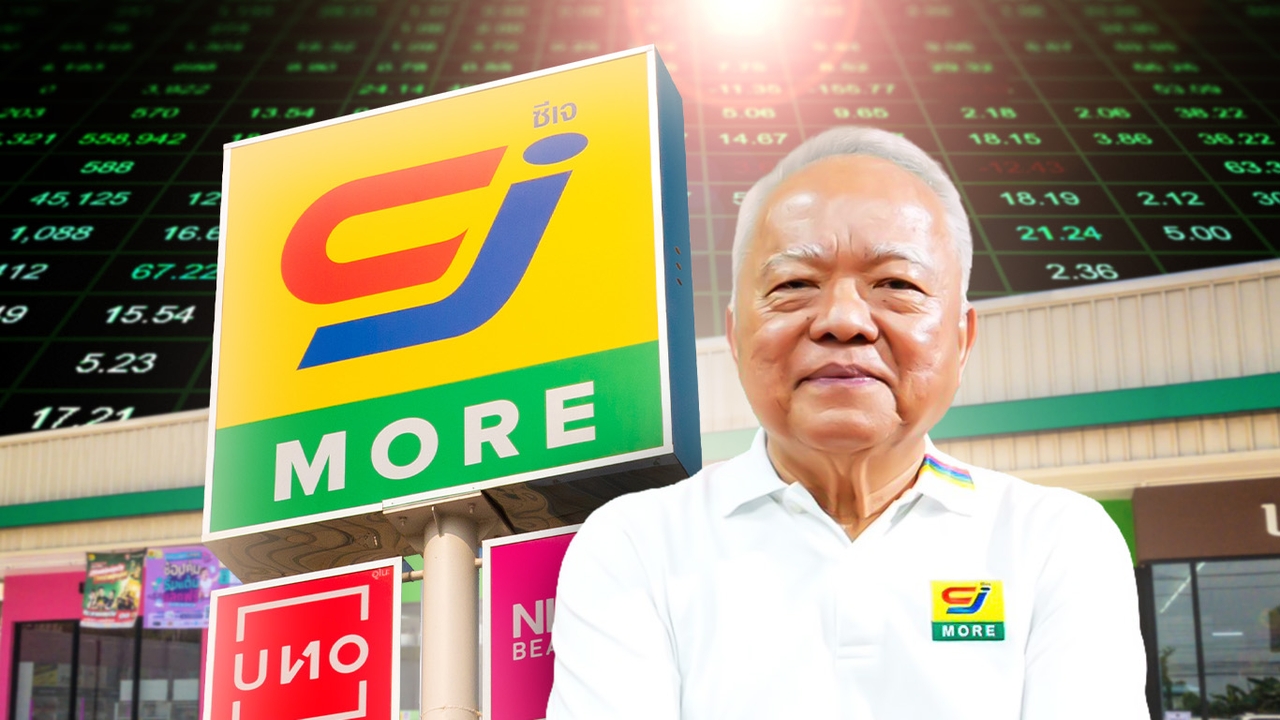
More than a decade ago, anyone attempting to build a new retail chain to compete with the market leaders would likely have been told it was "too late." At that time, major convenience store chains were present on almost every street corner, backed by capital, prime locations, logistics systems, bargaining power with manufacturers, and millions of customers. Meanwhile, provincial retail spaces were already occupied by hypermarkets, supermarkets, and local shops.
However, in 2013, Sathien Sathienthamma, one of the founders of Carabao Dang, decided to take a major stake in CJ Express, a local retail business that began as a two-unit store in Ratchaburi province. This marked a new gamble at over 60 years old for Sathien in a market where few believed there was room left for new players.
Over a decade later, CJ MORE is approaching its revenue target of 80 billion baht by 2026, operating about 2,100 branches across 60 provinces, and boasting around 11 million members. The company aims for sales to reach 100 billion baht in 2027 before going public by 2029.
This raises many questions about how CJ MORE achieved such growth and what Sathien saw in a market widely considered saturated that led to his success.
CJ's origins trace back to 2005 under the name P.S.D. Rak Thai Co., Ltd., founded by Wit Sasolaksanannot, who started with a small two-unit wholesale and retail store in Ratchaburi selling consumer goods at affordable prices, later expanding into western regions.
When Sathien began seriously directing the business in 2013, he did not immediately challenge the dominant convenience stores. Competing on the same playing field would leave CJ at a disadvantage. Instead, Sathien identified a gap between typical convenience stores and hypermarkets.
Convenience stores excel in location and speed but typically stock small-sized, higher unit-price household items. Hypermarkets offer a full range of products at lower prices but are often located far from district and subdistrict communities.
CJ positioned itself as a neighborhood store with more space and a fuller product range, allowing customers to shop for the entire family's needs, with parking, and a value proposition comparable to visiting a large mall. If major players sell "convenience," CJ MORE sells "completeness" for the whole household.
This explains why CJ MORE does not need branches on every street corner but becomes a community destination for purchasing food, daily necessities, cosmetics, coffee, household items, or pet supplies all at once.
Behind CJ MORE's growth is Sathien's philosophy of "taking one bite at a time, building one city at a time." Instead of starting in Bangkok or major cities with high rents and intense competition, CJ built its base in Ratchaburi, then expanded to western and central provinces, smaller districts, subdistricts, and suburban residential areas.
These locations allowed CJ to rent larger spaces at reasonable costs, design stores with wide fronts and parking, and stock more products than typical convenience stores. This aligns with rural family shopping habits, where people tend to drive and buy multiple household items in one trip.
CJ thus avoided competing for prime locations against market leaders, instead strengthening positions in areas where big players could not fully serve. Each branch became a stronghold before expanding to neighboring districts or provinces, reducing transport costs, increasing bargaining power with manufacturers, and embedding the CJ brand into daily life locally.
This is Sathien's "city surrounded by forest" strategy—securing outer areas firmly before gradually moving into larger markets.
This approach mirrors the lessons he applied when building Carabao Dang amid an energy drink market dominated by large brands, eventually making Carabao Dang a top player nationally.
Another turning point came around 2020 when CJ Express upgraded its model to CJ MORE, embracing the concept of "more than a supermarket." The store interior was divided to include new businesses and product categories such as BAO CAFÉ coffee shops, NINE BEAUTY cosmetics, A-HOME household goods, as well as fashion, toys, and pet products.
Adding these brands meant more than just expanding product lines; it provided reasons for every family member to visit. Mothers could shop for household essentials, children pick snacks and toys, fathers buy coffee, and others choose cosmetics or pet food—all in one place.
With increased reasons to visit, both customer frequency and purchase value per bill rose. Beauty products, coffee, and certain household items yield higher profit margins than basic consumer goods, boosting company revenue and profit. CJ MORE gradually evolved from a retail store into a Mini Community Mall serving local neighborhoods.
Simultaneously, the company organizes concerts, super fairs, and recently the "CJ STAR Local Excellence" project, connecting stores to local people by selecting local entrepreneurs' products, improving standards and packaging, and providing shelf space across branches. This community understanding offers a competitive advantage that large retail chains may find harder to replicate at local levels.
Over a decade, Sathien's gamble has yielded clear results. The company reported revenue of 7.887 billion baht and net profit of 165 million baht in 2016, growing to 79.766 billion baht in revenue and 4.955 billion baht in net profit by 2025. This represents over a tenfold increase in revenue and nearly thirtyfold growth in profit within about ten years.
The company targets 80 billion baht in sales for 2026 and 100 billion baht for 2027, aiming to expand branches from around 2,100 currently to 2,500 by year-end and approximately 3,200 by 2027.
The next goal is to operate over 5,000 branches by 2029, the same year Sathien plans to list CJ MORE on the stock exchange.
From a business once too small to be considered a competitor, CJ MORE is now attracting attention from multiple capital markets including Thailand, Hong Kong, Singapore, and the U.S. Nasdaq, though no decision has been made on the listing venue.
Listing abroad could facilitate greater capital raising, but a key challenge remains whether investors in those markets understand and appreciate CJ MORE's business model. Despite its large customer base in Thailand, the company has not yet established a clear presence overseas.
CJ MORE must demonstrate whether the 100-billion baht revenue target will come from increasing branch numbers, strengthening existing stores, or whether the subsidiary businesses can generate sufficient profit to offset expansion costs.
In retail, opening many stores is not the hardest part; the greater challenge is making each store profitable, retaining customers, and sustaining profits as the network scales up.
Read business news, marketing strategies, and exclusive interviews with ThairathMoney to help you "Better Finance, Better Life" at https://www.thairath.co.th/money/business_marketing
Follow the Facebook page: Thairath Money at https://www.facebook.com/ThairathMoney