

If we exclude Bangkok, the economic center packed with jobs and opportunities, and ask which other Thai city has the potential to fully define itself as a “metropolis,” the first and most weighty name that comes to mind today is undoubtedly “Phuket.”
Currently, “Phuket Island” is moving beyond its image as the “Andaman Pearl,” a globally renowned seaside resort, to become a Self-Sustaining International Destination — a metropolis capable of fully supporting itself economically, socially, educationally, medically, and in quality of life.
This transformation became more evident after the COVID-19 era when Phuket turned into a relocation destination for high-quality residents worldwide (Family Relocation). This is reflected by a 51% surge in the number of international schools on the island within just three years. Today, 19 international schools operate there, serving over 5,000 students from more than 50 nationalities.
This figure serves as an indicator that foreigners are no longer visiting Phuket solely for temporary tourism but are bringing their families and settling down permanently.

Thairath Money conducted a field survey on Phuket’s latest economic and real estate pulse, including an interview with Phumchai Matthayomphapipanyo, Managing Director of Southern Project Development at Sansiri Public Company Limited, the leading player who has been steadily operating on the island for 15 years (since 2011).
He has witnessed the island’s development and changes from the era of classic tourism to the present day, when Phuket faces both "enormous opportunities" and "risks that cannot be overlooked."
Currently, Phuket’s various areas have distinctly defined characteristics in terms of tourism and residential appeal.
This location diversity aligns with the new tenant group of “digital nomads” who supplement general tourists. This group has strong purchasing power, seeks residences suitable for working from anywhere, requires comprehensive amenities, and has transformed the rental market for large condominiums in Phuket into a highly lucrative investment.
Data from Sansiri’s team reveals that condominiums of about 49 square meters in prime locations can command normal rental rates of 45,000 – 60,000 baht per month. Meanwhile, 60-square-meter (two-bedroom) units can reach 120,000 – 150,000 baht monthly during high season.
During major global events such as the EDC Thailand 2026 music festival, daily rental rates for these units are fully booked at elevated prices of 15,000 – 20,000 baht per night. Such impressive returns are attracting fierce investment interest from Bangkok and international investors.
However, the undeniable spotlight on Phuket currently shines brightest on the Cherng Talay – Bang Tao area, dubbed the Luxury Lifestyle Corridor, which is vibrant and growing rapidly. It boasts high-end infrastructure including Porto de Phuket, Boat Avenue, leading international schools such as HeadStart and Kajonkiet, and is home to Sansiri’s community hub, "The Society."
Sansiri executives note that market data from Savills Thailand and surveys by CBRE along with Sansiri Market Insight concur that pool villas in Cherng Talay are rare assets yielding rental returns of 6-7% annually with an average occupancy rate of 70%.
The strong rental and sale prices have made land in Cherng Talay increasingly scarce, turning it into a battleground where local developers, major Bangkok investors, and multinational capital fiercely launch new projects.

As Phuket’s number one brand planning to launch seven projects in 2026 and aiming to double its portfolio from 40 billion to 80 billion baht within five years (by 2030), Sansiri has decided to introduce its first pool villa collection in 42 years, named “THE TALES,” valued at 1.4 billion baht within a private community limited to 27 units.
Strategically notable is not only the world-class design but also the “cost management insight” that Phumchai openly reveals as the key reason Sansiri has sustained itself for 15 years amid competitors disappearing over cycles.

Sansiri’s executive points to a market pitfall where many developers set "over-speculative" selling prices, inflating land acquisition costs and specifications excessively, causing bloated cost structures. When the market slows and sales stall, projects face liquidity issues. Sansiri’s approach is to assess actual market buying power first, then calculate backward to acceptable land and construction costs, enabling reasonable and competitive pricing.
"Costs arise from pricing perception: if your selling prices are unrealistic and too high, you buy expensive land and your costs inflate, distorting the project. But if you price according to what customers can afford and match costs accordingly, the project can truly succeed."
A classic construction challenge on Phuket is labor shortage and competition for skilled workers during high season, leading to uncontrolled wage hikes (e.g., tile-setting wages rising from 250 to 400 baht per square meter). Sansiri addresses this by using precast concrete components manufactured at its own Bangkok factory and shipped to Phuket. Though transport costs add 10-12%, this expense is "highly worthwhile" because it ensures precise construction timelines, consistent quality standards, and decisively eliminates local labor crisis risks.

Most Phuket pool villa projects are sold off-plan, forcing foreign buyers to bear risks of substandard construction, delayed completion, or unmet specifications. Sansiri chooses to complete construction before sale (Ready to Move In), allowing customers to see the actual environment and inspect home quality before payment.
Additionally, projects are fully registered under the Land Allocation Act with clearly divided titles, common areas, and legally compliant wastewater treatment, unlike typical villas that often avoid such allocation. Confidence is further boosted by comprehensive after-sales service "Sansiri Service Phuket" via Plus Property, covering maintenance, security through LIV-24, and one-stop rental management.
"Foreign buyers’ pain points are homes not matching promises and timeline delays. By building completed homes for inspection before purchase, which is rare in Phuket, we provide the confidence needed for immediate decision-making."
Another key indication that Phuket is becoming a global stage is the shift in buyer demographics. Phumchai shares insightful sales trends that Phuket’s real estate market no longer relies on or is dominated by any single nationality as in the past.
Previously, foreign buyers mainly concentrated among Chinese and Russians. Since COVID-19, the market has expanded noticeably into a multinational profile. While Russians remain present, their market absorption has nearly saturated over the past 2–3 years.

New growing buyer groups replacing and expanding are Russian-speaking countries such as Kazakhstan, Eastern European buyers like Poles, various European countries, and Americans.
This nationality diversity results from geopolitical forces and the need for safety and investment security. Sansiri proactively responds by expanding its International Sales Team, capable in multiple languages including English, Russian, and Chinese, with 7 of 23 Phuket sales staff dedicated to deeply understanding and targeting foreign customer behavior.
"The market today no longer relies on any single nationality. It has become very multinational. Russians who bought heavily have slowed, but neighboring countries like Kazakhstan, Poland, Europe, and America have significantly supplemented demand. This diversification supports long-term stability of Phuket’s real estate because we no longer rely on putting all eggs in one basket."

Phuket’s transition is not solely driven by tourism but by the actual groundbreaking of megaprojects from both government and global corporate giants launching continuously.
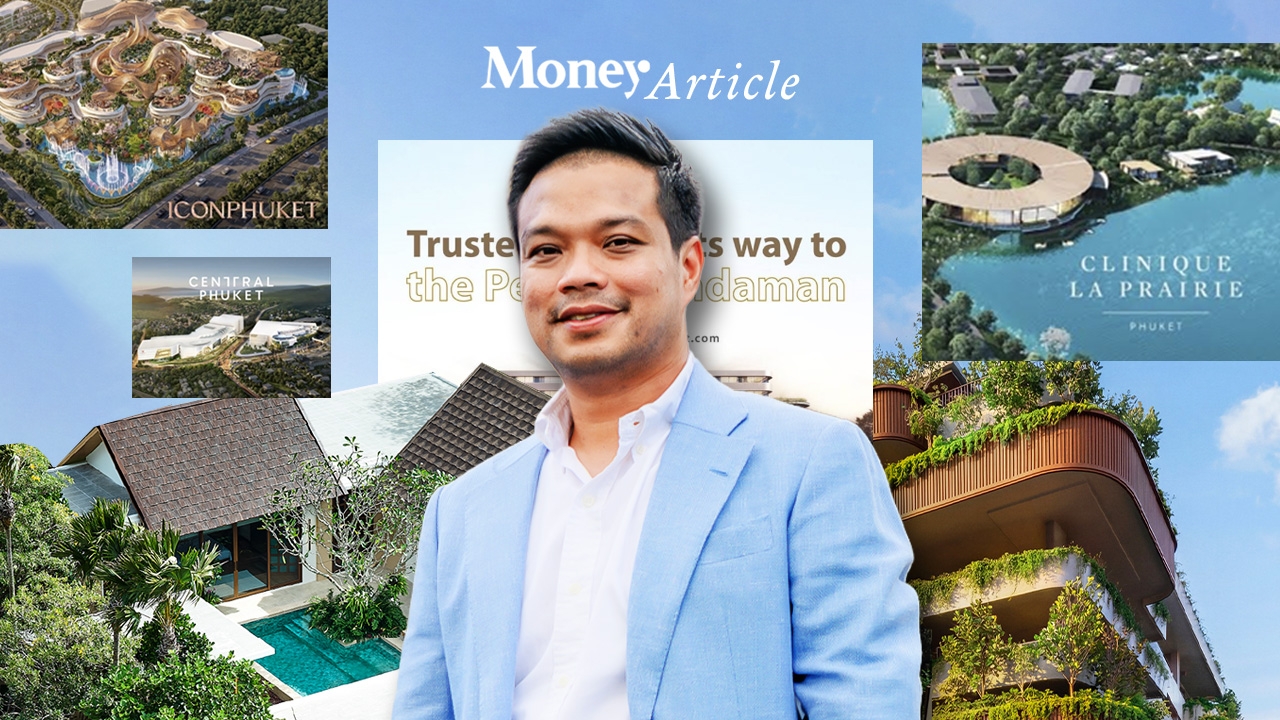
On the lifestyle and retail front, Phuket prepares to open the iconic ICONPHUKET mall in 2029 alongside a 7 billion baht investment to expand Central Phuket’s area by 40%, as well as new community malls and mixed-use developments like Synthesis Ark Phuket and POP Phuket to serve affluent residents.
Simultaneously, Phuket is elevating itself as a full-fledged Regional Wellness Hub, anchored by leading hospitals and health clinics such as Bumrungrad International Hospital Phuket opening in 2027, Prince of Songkla University Medical Campus in 2030, premium facilities like Clinique La Prairie’s Health Resort, Vajira Phuket International Radiology Center, and expanding Bangkok Hospital branches.
The influx of megaprojects also drives major transport network reforms for seamless island connectivity, from the nearly 4-kilometer Kathu-Patong expressway scheduled for 2031, the 30-kilometer New City-Koh Kaew-Kathu expressway, to direct airport access roads, multi-level intersections at Koh Kaew, and accelerated expansion of Phuket International Airport with five additional aircraft stands to accommodate global direct flights.
Beyond transport infrastructure, world-class education and service sectors are expanding prominently, with top international schools planning new campuses such as Glenalmond College in 2026 and North London Collegiate School in 2028.
Luxury hotel chains including The Ritz-Carlton, W Hotels, JW Marriott, Hyatt Regency, Radisson BLU, MGallery, Moxy, and voco are flocking to establish a presence, alongside hosting global events like the EDC Thailand 2026 music festival. These are the real gears transforming Phuket into a fully international central city.
Read business news, marketing strategies, and exclusive interviews with ThairathMoney to help you "Better Finances, Better Life" athttps://www.thairath.co.th/money/business_marketing
Follow the Facebook page: Thairath Money at the link belowhttps:// www.facebook.com/ThairathMoney