

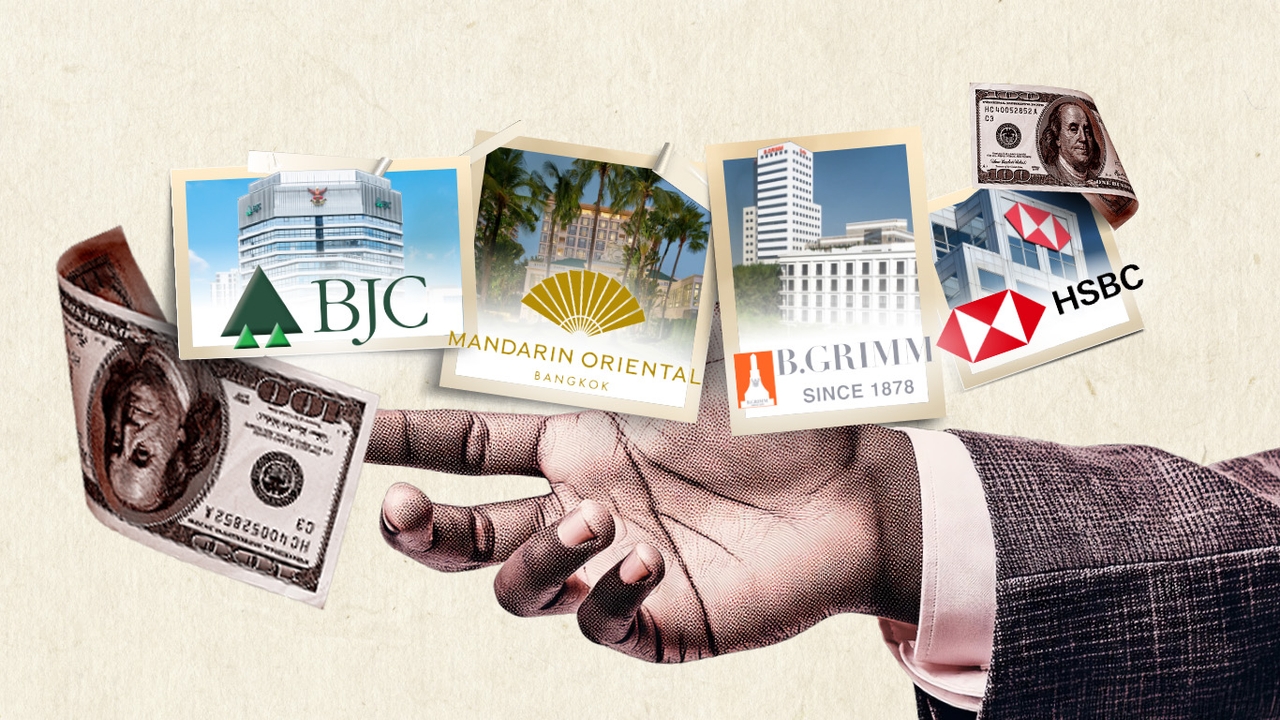
Over 100 to 150 years ago, when Thailand was still called "Siam" and transitioning to a modern economy under the reign of King Rama V, a key driver of the Thai economy was the influx of foreign capital from Europe, the United States, and major Asian trade centers.
During that period, Siam increasingly connected with the global economy as international trade expanded, opening opportunities for foreign companies to operate as traders, importers, financial service providers, and investors in various ventures.
Interestingly, many foreign companies that entered during that era did not disappear over time but instead grew and adapted alongside the Thai economy.
Thairath Money revisits nine renowned businesses founded on foreign capital with more than 100 years of history in Thailand, illustrating the role of foreign investment in Thailand’s economic development and why these businesses have endured across centuries.

The origins of Mandarin Oriental Bangkok trace back to 1876 when The Oriental opened in Bangkok to serve travelers, merchants, and foreigners arriving in Siam via waterways.
The hotel was initially connected to European entrepreneurs, especially Danish capital, before evolving into a luxury hotel with international renown and later joining the Mandarin Oriental group, which has roots in Hong Kong.
Over 150 years, the hotel has been part of Bangkok’s history and mirrors the growth of Thailand’s tourism industry, evolving from hosting early foreign visitors to becoming a premier destination for global premium travelers.
B.Grimm is among the oldest companies in Thailand, beginning in 1878 as Siam Dispensary, a pharmacy founded by German Bernhard Grimm and Austrian Erwin Müller to sell Western medicines and medical supplies in Siam.
The company later expanded from trading into infrastructure development, contributing to major projects such as the Rangsit canal excavation, as well as machinery and industrial equipment, before moving into energy and power generation.
Today, B.Grimm operates diverse businesses, notably B.Grimm Power as a major private electricity producer, reflecting its transition from meeting Siam’s basic needs to supporting modern economic and industrial infrastructure.
Berli Jucker, or BJC, began in 1882 as a trading business by Swiss entrepreneurs in Siam, involved in rice, teak, and industrial goods trade, integral to the export economy of that time.
As Thailand’s economy shifted from agricultural exports to domestic production and consumption, BJC adapted by distributing consumer goods, producing packaging, and expanding retail networks.
A major milestone was the acquisition of Big C in 2016, positioning BJC as one of Thailand’s largest retail and consumer goods groups.
Although now under Thai ownership, BJC’s foreign capital origins remain a key part of its history, demonstrating the shift from international trading company to a business reaching consumers nationwide.
HSBC, The Hongkong and Shanghai Banking Corporation, originated in Hong Kong under British rule and expanded into Siam in 1888, becoming the first foreign commercial bank to operate in Thailand.
During Siam’s economic expansion fueled by international trade, HSBC played a crucial role providing financial services to merchants and foreign companies, supporting import-export transactions, especially in rice, Siam’s main export.
Notably, HSBC was once authorized to issue banknotes circulating in Siam before the country fully developed its own currency and central banking system.
Today, HSBC continues operations in Thailand, focusing on corporate banking, international trade, and connecting Thai businesses to global financial networks.
Singer, the American sewing machine brand, entered the Thai market in 1889, at a time when sewing machines were vital technology for garment production both domestically and commercially.
Singer distinguished itself by introducing an installment sales system, enabling consumers to purchase expensive products without paying the full amount upfront; this model began in Thailand in 1925.
The company expanded into home appliances and household goods, building sales networks reaching provincial customers, and later ventured into consumer credit and financial services.
Currently, Singer Thailand is listed on the Thai stock exchange with ownership differing from its original American parent, yet it remains emblematic of foreign businesses contributing to retail innovation and consumer finance in Thailand.
Shell began in Thailand in 1892 by importing kerosene into Siam aboard the oil tanker SS Murex, part of an oil trade business rooted in Britain.
At that time, kerosene was a crucial fuel for lighting before energy demand grew alongside transportation, industry, and urban development.
Shell later expanded into fuel, lubricants, and other energy products, developing a network of service stations that became a familiar brand to Thais.
Over 130 years, Shell exemplifies a foreign energy company growing with Thailand’s energy needs—from lighting fuel to energy infrastructure essential for the economy.
Nestlé, the Swiss food and beverage company, is recorded marketing in Siam as early as 1893 with advertisements for sweetened condensed milk Milkmaid in the Bangkok Times newspaper.
This marks the arrival of foreign consumer goods during a period when the Siamese market began embracing new products and consumption patterns.
Nestlé later transitioned from importation to establishing local production bases for familiar products like Bear Brand milk, Milo, Nescafé, and pet food.
Today, Thailand is a key regional base for Nestlé, with manufacturing, distribution, and product development tailored to local consumer needs.
Standard Chartered traces back to British banking, with its predecessor Chartered Bank of India, Australia and China operating in Siam since 1894.
In the late 19th century, Siam’s economy increasingly depended on international trade, especially rice exports and industrial imports, making banking, payments, and currency exchange critical.
Standard Chartered was among the foreign banks supporting Siam’s trade and financial systems, later expanding services alongside Thailand’s economic development; today it focuses on corporate clients, financial institutions, and international transactions, linking Thailand to global financial markets.
DKSH, a Swiss trading company, began operations in Thailand in 1906 under Diethelm & Co., initially importing goods, machinery, and technology into Siam before gradually expanding with the country’s economic growth.
As Thailand transitioned to an industrial economy and modern consumer market, DKSH shifted from a traditional trading company to a Market Expansion Services provider, covering import, marketing, sales, distribution, and after-sales services.
Currently, DKSH acts as an intermediary linking global brands and manufacturers to retail networks, hospitals, factories, and consumers in Thailand, serving multiple sectors including consumer goods, health products, industrial materials, and technology.
These nine companies clearly began with different focuses—some supporting international trade, others introducing new products and technology to Siam, and participating in developing finance, energy, and infrastructure vital to the Thai economy.
However, not all have retained their original ownership structures or nationalities; some transitioned to Thai ownership while others underwent mergers and restructurings throughout their histories.
Their continued existence reflects not only business longevity but also the history of economic transition and integration into Thailand’s economy.
For business news, marketing strategies, and exclusive interviews, visit ThairathMoney to help you "Live well with good finance." https://www.thairath.co.th/money/business_marketing
Follow the Facebook page: Thairath Money at this link https:// www.facebook.com/ThairathMoney