

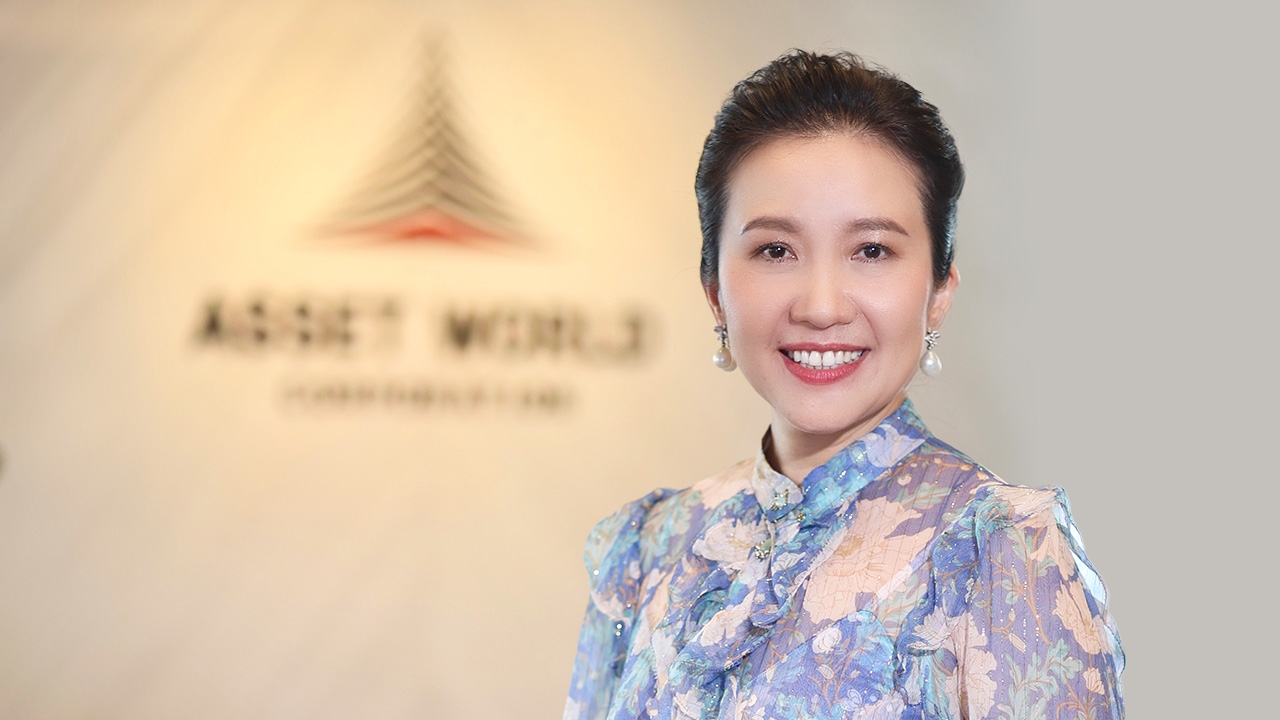
In 2019, Asset World Corp (AWC) created a sensation in Thailand's capital market by raising about 48 billion baht through an IPO before listing on the Stock Exchange on 10 October that year. The size of this deal put AWC in the spotlight as the owner of one of the country's largest real estate portfolios.
Seven years later, Wallapa Traisorat, CEO and Managing Director of AWC, is preparing to reintroduce the company's asset portfolio to the capital market—this time through AWR, a Real Estate Investment Trust (REIT). She revealed the detailed plan first to Thairath Money.

The striking point is AWC's figures: an initial asset base of about 50 billion baht and a goal to expand the portfolio to 100 billion baht within 3-5 years. If realized, AWR could become one of the largest REITs in Thailand. However, size alone is not the main issue; the more interesting question is why a company with significant assets already in hand would create another REIT. This marks the start of this special interview.
Wallapa explained that the concept she inherited from her father, Charoen Sirivadhanabhakdi, was to hold land for long-term value creation. She described the older generation as asset accumulators, while the second generation, including herself, is tasked with developing those assets.
This idea explains AWC's direction well and aligns with Thailand's land price growth of 9-14% annually. AWC repurposes land and buildings in key locations to meet lifestyle and tourism needs, ranging from hotels and office buildings to projects creating new destinations.
However, as the portfolio grows, challenges evolve. A single land plot may appreciate over the long term, but every new project requires investment and time. The REIT becomes another strategic tool for AWC.
The mechanism involves AWC developing and enhancing assets, and once these assets begin operations and generate income, they can be transferred into AWR, allowing AWC to recycle capital for new project development.
This cycle that Wallapa aims to establish is not just about increasing portfolio size but about enabling completed assets to fund future projects. This approach aligns with the role of REITs as a capital-raising channel for income-generating real estate investment.
AWC's ambition to expand its hundred-billion-baht empire will not come at the cost of excessive financial risk; rather, it will be based on strict global financial discipline.

“Besides investing, AWC places great importance on maintaining financial stability. Today, we manage a D/E Ratio around 0.9, aiming to reduce it to 0.6, which is the global real estate industry standard. From learning and working with CapitaLand in Singapore, we found that sustainable growth and crisis resilience in real estate require a stable financial foundation. This is a key mechanism to show investors that we can create and grow continuously throughout the value journey.”
Wallapa described their relationship as “siblings”: AWC takes on the tougher tasks of site selection, design, investment, construction, partnerships, and generating initial revenue, while AWR focuses on investing in assets that have completed development and are generating operational income.
“We see AWC and AWR as siblings working together. AWC is the older sister who develops projects and earns development returns. AWR is the younger sister who holds quality income-generating assets to provide stable dividends alongside asset appreciation. One day, AWR's portfolio size will grow from 50 billion to 100 billion baht and may surpass AWC’s value.”

From the company's perspective, this structure allows AWC to convert developed assets into capital for new growth rounds and reflect the true value of projects. From investors' perspective, the REIT opens opportunities to invest in a real estate portfolio without buying entire buildings or hotels, allowing retail investors to own stakes in world-class hotels.
According to Wallapa's disclosed plan, AWR will consider an initial asset pool of five projects with a total value not exceeding 50 billion baht from AWC's portfolio. The aim is to include both commercial and hotel assets before scaling the portfolio to 100 billion baht over 3-5 years.
“We carefully selected from AWC’s 62 projects to balance risk with a 50:50 split between Commercial and Hospitality assets in major tourist cities such as Bangkok, Pattaya, Samui, Phuket, and Krabi, with EBITDA growth rates historically between 20-40%.”
She emphasized investing in Freehold assets—full ownership—which allows the REIT to hold properties long-term, unlike leasehold rights with limited terms. However, Freehold status does not guarantee unit price or dividend growth; outcomes depend on purchase price, debt, financing costs, and actual income from each asset.
This is why AWR's story must shift focus from “how large the portfolio is” to “whether each asset generates sufficient income relative to its cost,” especially since hotels’ revenues fluctuate with tourism conditions, unlike leased buildings with contract rents. It appears this equation was factored in from the start.

If holding land in prime locations is the starting point, Wallapa must next figure out how to attract people to use the space fully and generate consistent income year-round. Part of the answer lies in “selecting partners.”
Wallapa said AWC works with nine global hotel chains, representing over 200 brands (such as Marriott, IHG, Hilton, Hyatt, Banyan Tree, Okura, Nobu). These networks bring a global customer base exceeding 800 million. The reason these top brands join AWC’s portfolio isn’t just location but a Win-Win strategy.
“If there are things we're not expert at or others can do better, we won't do everything ourselves. Instead, we invite the best partners to collaborate so we can grow faster and further together.”

In this model, AWC invests and develops the spaces, while partners bring their brand, service expertise, and customer base to enhance projects. Hotels may coexist with restaurants, workspaces, or wellness services, giving a property multiple reasons for people to visit beyond overnight stays.
Examples include bringing Nobu to enhance dining experiences, developing EA Rooftop at The Empire, and working with Obayashi to find ways to control dust in project areas. Purchasing goods and crafts from local communities for hotel use also reflects the idea of creating value that connects back to the people in the area.
“Global partners have extended their brands to landmarks in Thailand’s most prime locations, with AWC as the investor, developer, and lifestyle component architect without constraints, allowing partners to avoid development risk.”

When asked about the most challenging projects, Wallapa did not single out any building but pointed to three projects where AWC must create new destinations, each with distinct challenges.
These three projects reflect AWC’s approach: using location as a base and bringing partners to create new reasons for people to visit and spend time. If successful, assets can generate higher revenues and become stable income-generating properties that AWR will seek in the future.
Aquatique District, Lanna Tiik, and Wong Nakorn Kasem are only part of AWC’s expansion plan, which includes a 100 billion baht investment budget from 2026 to 2030 to grow luxury hotel and real estate portfolios in Thailand and abroad, with brands like Fairmont, Ritz-Carlton, and Nobu in the pipeline.

By 2030, the company aims to operate 35 hotels with 9,312 rooms under 21 brands and push total assets beyond 300 billion baht, compared to 208.3 billion baht as of 30 June 2026—targeting an asset increase of over 90 billion baht in about four years.
AWC has already proven it can bring a large real estate portfolio to the capital market with the 48 billion baht IPO in 2019. This time, the challenge is different, as AWR must prove the quality of income, asset purchase prices, and portfolio expansion ability while protecting unit holders' interests.
The plan to establish a hundred-billion-baht REIT carries deeper meaning than adding a new name to Thailand's capital market. It represents an effort to create a system where AWC develops and AWR holds income-producing assets, allowing land and buildings to cycle into successive project generations.
Finally, when asked to define her business identity, the architect and financial leader behind this hundred-billion-baht real estate empire smiled and said briefly:
“We are fortunate to have the opportunity to build a better future with everyone, creating value and delivering happiness. The buildings we create will stand for hundreds of years, but more importantly, we build value and growth opportunities for new generations, communities, and the country's economy sustainably.”
The launch of the AWR Trust is therefore not just about raising capital on the stock market but about "refining Thai assets" into a machine that reflects true value. It proves that when artistic vision, respect for land heritage, and global financial discipline converge, the outcome will not only transform Thailand's real estate industry but also generate stable returns for all Thai people for a long time.


Read stock and investment news with Thairath Money to help you "Good Finance, Good Life" athttps://www.thairath.co.th/money/investment
Follow the Facebook page: Thairath Money at this linkhttps://www.facebook.com/ThairathMoney