

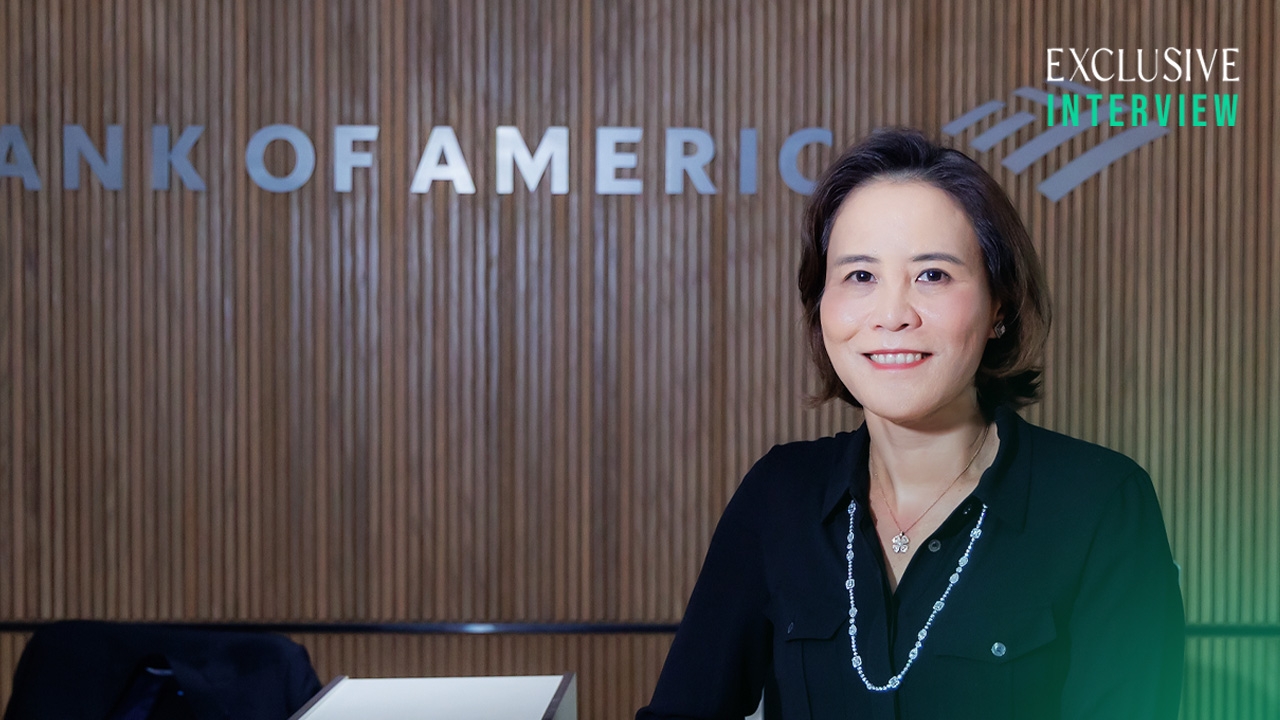
Thairath Money special interview: Orakanya Piboontham, CEO of Bank of America (Thailand branch). She is the driving force behind the Thailand private sector roadshow accompanying Prime Minister Anutin Charnvirakul's delegation meeting investors in New York such as PIMCO, Google, , Microsoft in September., continuing with the 2026 IMF-World Bank Group Annual Meetings held from 12–18 October 2026, an event that gathers finance ministers, central bank governors, bankers, and financiers worldwide in Thailand simultaneously.Orakanya once again played host, leading a delegation of over 100 Bank of America team members to organize a side event in Thailand during the 2026 IMF-WBG Annual Meeting.
However, after the initial enthusiasm and praise for Thailand faded, questions remain: Following these events, will foreign investment and interest in Thailand increase, and to what extent? What will the overall Thai economy look like? A discussion with a seasoned foreign banker in Thailand was held in anticipation of the approaching year 2026 to prepare for expected futures.
Three years of preparation to keep Thailand on the world's radar.
Interest in Thailand following the Prime Minister's roadshow at the UN General Assembly in New York in September, followed by the IMF-World Bank Group meeting in Bangkok in mid-October, resulted from a mix of urgent and long-term preparations.

But it is normal for the IMF-World Bank Group's annual meetings to be held in Washington, D.C. every year, and outside the U.S. every three years. After the previous meeting in Morocco, it was immediately announced that the next venue would be Thailand.That marked the start of the three-year preparation. During the meeting, she observed significant interest in Thailand, evidenced by over 100 Bank of America personnel traveling from abroad to Thailand for the event, compared to the usual 50-60 attendees for office meetings.Hotel rooms were insufficient, requiring distribution across multiple hotels. At the Bank of America event, over 300 international delegates attended meetings, more than usual, necessitating the exclusive use of the entire 8th floor of The Ritz-Carlton as meeting rooms.
"The IMF-World Bank annual meeting is a major financial institution event where many global banks network, as it gathers finance professionals altogether. But will investment funds flow into Thailand immediately? Not foreign direct investment per se, but this event showcases Thailand's readiness—in infrastructure, hospitality, and public transport—and everyone expressed their admiration," Orakanya said.
American capital has never disappeared, but what follows is Business Review.As CEO of Bank of America in Thailand, serving major clients and financial institutions, Orakanya explained her role has two sides: Thai businesses investing abroad and foreign businesses investing in Thailand.Previously, senior government officials asked her where American investors had gone, as the Top 3 of the Board of Investment's list in the past 3-4 years did not include the U.S.
Orakanya firmly responded that many American investors have invested heavily in Thailand and remain active. Most investments last year were in data centers and semiconductors, not only from the U.S. but also Europe, India, and Taiwan, attracted by Thailand's industry potential. The September New York roadshow on data center investment incentives received significant investor interest.She advises building on Thailand's strengths in 3-4 industries without trying to do everything.When asked where investment flows will go in the next 3-5 years besides data centers, Orakanya said Thailand's strategy is on the right track. Thailand excels in electronics, automotive, food, and hospitality, so she supports government efforts to build on these.Automotive can evolve into electric vehicles, electronics into semiconductors, and Thailand is the best in food.She added that many U.S. companies consider Thailand the best destination for the food industry.
However, these companies are already in Thailand; if they want to expand, they compare with Indonesia and Vietnam. She recommends the BOI conduct regular Business Reviews with these businesses to keep updated on their needs and decision factors."Thailand should focus on becoming an Advanced Manufacturing Hub and Regional Service Center Hub. That is enough. Focus on 4-5 industries to build on existing strengths, not scatter efforts. The global investment money exists; it depends on whether Thailand is ready to accept investment conditions," Orakanya reflected.She noted that Thai investment promotion agencies tend to attract new investors but do not sufficiently monitor existing ones, who are easier to retain. She gave an example that banks conduct annual Business Reviews with clients.
Regional Service Centers also have potential given Thai people's traits. Service jobs like HR, accounting, IT, and finance should create employment opportunities. She shared that she sends staff for onboarding and KYC work in Singapore, but many want to return due to Singapore's high living costs and such work can be done in Thailand.
One of her clients, a global energy company, set up a service center in Thailand with 3,000–4,000 employees fluent in 12 languages. These jobs can be done and staffed locally.
Regarding ASEAN, she supports Thailand collaborating with countries like Vietnam and Malaysia to promote regional economic integration and build supply chains that create shared economic value for new industries of the future.
Policy inconsistency is a common investor concern. Orakanya said from meeting finance investors that they seek only three things: Consistency, Certainty, and Efficiency.
Consistency means government policy continuity, which she believes the current government provides. Certainty is infrastructure and legal-financial framework stability, which Thailand has comprehensively.Efficiency relates to ease of doing business, making it simple and straightforward to start operations in Thailand.However, she identified a critical gap: Thailand's shortage of high-skilled labor. She noted Deputy Prime Minister and Minister of Higher Education, Science, Research and Innovation Prof. Dr. Yossanan Wongsawat is pushing this issue strongly.
She emphasized that global investment funds abound and investors are ready to invest, but Thailand, its government, and people must answer: "Are we ready to receive these investments?" Orakanya said.Stock market, foreign capital, and IPOs needing to 'shine'.Asked about the Thai stock market, Orakanya expects Thailand to benefit in the second half of this year from Indonesia's potential downgrade in the MSCI index, leading MSCI Asia index funds to reallocate investments elsewhere, a so-called windfall.
However, she wants to see strong IPOs in Thailand to capitalize on the market's renewed vibrancy. Large IPOs could transform industries; she hinted her bank is involved in multiple deals attracting ongoing interest.She praised the Thai stock market's diversity, unlike foreign markets dominated by a few giants like TSMC in Taiwan or Samsung in South Korea. Thailand has major companies across banking, healthcare, and various industries.Trading volume ranks third in Asia this year, with daily retail investor activity providing liquidity that reassures foreign investors, unlike Singapore's market dominated by institutions and lacking scale.

She supports the BOI to IPO initiative and opening doors for foreign companies to list in Thailand, noting many companies are queued, and one successful IPO encourages others.
Regarding banks, she observes Thai banks and the Bank of Thailand are cautious to avoid a 1997 crisis repeat, which she believes is unlikely now. Attention should be on credit distribution to SMEs.She supports the current Bank of Thailand governor's measures for SMEs but stresses focusing on SMEs that can survive and strengthen, not increasing debt burden.Young labor force and aging society: challenges for Thailand's economy now and future.
From a banking industry perspective and interaction with global investors, Orakanya expresses concern about human resources. As an AMCHAM Thailand board member, she sees many industries lack skilled workers, especially in vocational fields.AMCHAM supports this by providing scholarships for vocational students and collaborating with vocational institutes to prepare workforce for businesses. She urges the government to expand industry-education cooperation models.She cited companies like Western Digital and Seagate running programs with institutions in Nakhon Ratchasima, where students intern and earn while studying and can become employees after graduation.
Another issue is the aging society; about 20% of Thailand's population is now elderly, posing significant future challenges.
She gave an example of a new graduate earning 100,000 baht monthly who, after supporting parents with 20,000 baht each, has 60,000 baht left for rent, transport, food, and taxes. This financial pressure discourages having more children.
When asked if Thailand can become a high-income country in 11 years, she replied it requires mindset change and serious structural reforms, focusing on just four sectors to become an advanced manufacturing and regional service hub.She added, "Don't focus on GDP or numbers. The goal is for everyone to live well and be happy enough," Orakanya said.A banker with an industrial engineering degree and a lifelong career in foreign banks.
Before concluding, Thairath Money asked about Orakanya's background. She shared she graduated from Triam Udom Suksa School and earned a bachelor's in engineering from Chulalongkorn University, initially in civil but switched to industrial engineering.She later studied finance, motivated by observing that engineering jobs paid a two-month bonus, while finance paid up to 24 months, prompting her to learn what finance professionals studied and pursue higher earnings.After graduating, she started in finance at Standard Chartered in Hong Kong as a Management Trainee, then moved to Thailand in 1997, worked at Deutsche Bank, and joined Bank of America over 14 years ago.
Approaching retirement, she plans to keep working and thinking, aiming to help Thailand as a 'conduit' attracting foreign investors, leveraging her lifelong experience accessing policymakers and investment decision-makers.She understands that attracting investors requires creating win-win situations for both sides.Read stock and investment news with Thairath Money for a "Better Financial Life" at https://www.thairath.co.th/money/investment.
Follow the Facebook page Thairath Money at https://www.facebook.com/ThairathMoney.