

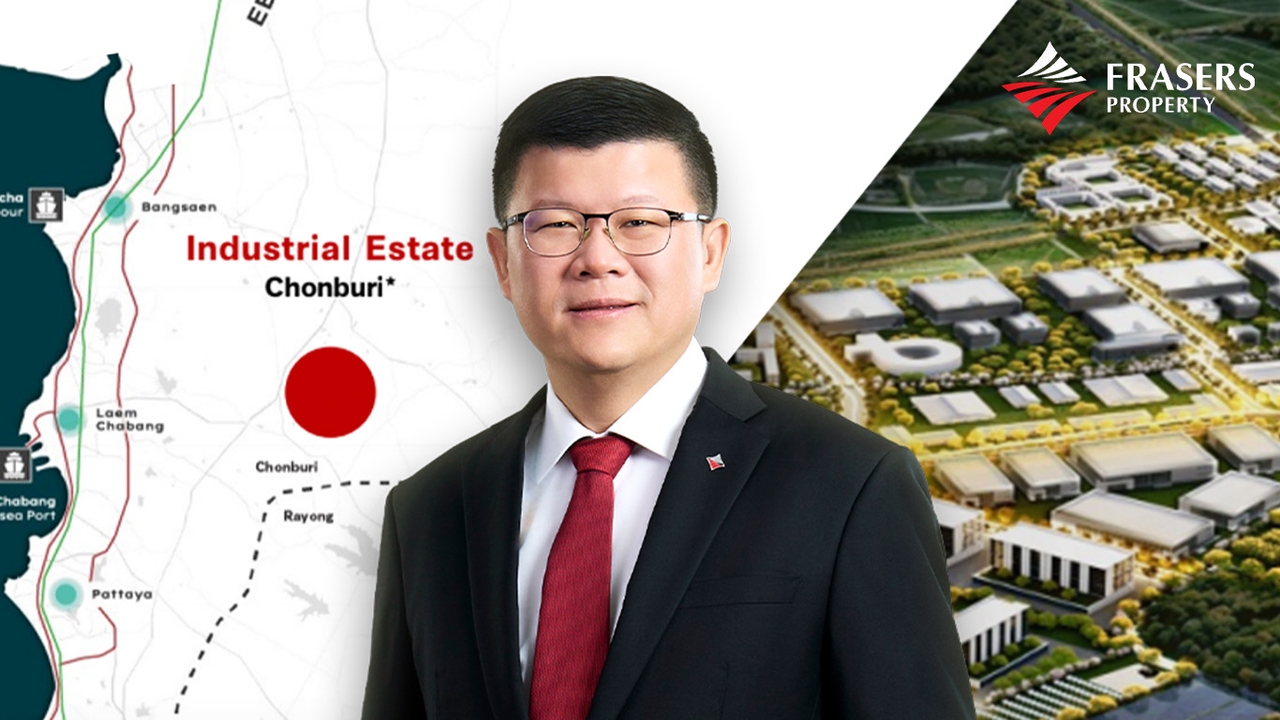
Behind the globally renowned mixed-use development One Bangkok, the name Frasers Property Thailand (FPT) may not be as widely mentioned as the towering skyscrapers and luxury retail along Witthayu and Rama IV Roads.
However, in Thailand's real estate capital game, Fraser's is making a more significant move by shifting focus from "city" developments to "factories and warehouses," including expanding industrial estates. This may be a bigger strategic shift than many realize.

FPT's strength did not emerge overnight but resulted from a strategic merger in 2019 between Tycoon (TICON), the leading factory operator, and Golden Land (GOLD), the top residential and office developer, under the leadership of Panote Siriwattanapong, a key figure in the Frasers Property Limited empire, which held total assets valued at approximately 39.7 billion Singapore dollars as of 30 September 2025.
This merger transformed FPT into Thailand’s first "Integrated Real Estate Platform" holding assets across three core sectors.
With total assets valued at over 93.5 billion baht as of 31 December 2025, FPT operates not just a single business but an interconnected real estate ecosystem that balances revenue streams (Portfolio Balancing).
Despite 2025 being a challenging year for real estate due to trade war fallout and economic slowdown, FPT CEO Hua Tiang Lim revealed the company still posted a net profit exceeding 1.4 billion baht. The key was its distinct business portfolio allocation compared to typical developers.
This strategy reflects the principle that when one sector slows, another supports the company—providing a risk shield that has enabled FPT to endure during a sluggish housing market.

The management stated that the 15.045 billion baht revenue target in 2026 will be driven by four key strategic priorities worth watching.

Regarding why FPT is aggressively acquiring land in the EEC, the answer lies in the "China Plus One" trend over the past four years. Executives observed Chinese investors purchasing and leasing over 13,000 rai in Thailand to circumvent tariffs from trade wars. FPT sees this as an opportunity and is preparing infrastructure to accommodate this shift.
Thus, this is not just about leasing warehouses; FPT appears to be building an ecosystem to support a major global manufacturing base relocation.
The management also believes that within two years, as political stability returns and BOI and FDI capital inflows accelerate, FPT’s business vision will become clearer. They are transforming from a home and office developer into a "nation’s industrial infrastructure" provider, connecting the city center (One Bangkok) to the economic corridor (EEC), shifting from residential real estate to a key engine driving Thailand’s next economic phase.

Follow market news with Thairath Money at
Follow the Facebook page: Thairath Money at this linkhttps://www.facebook.com/ThairathMoney