

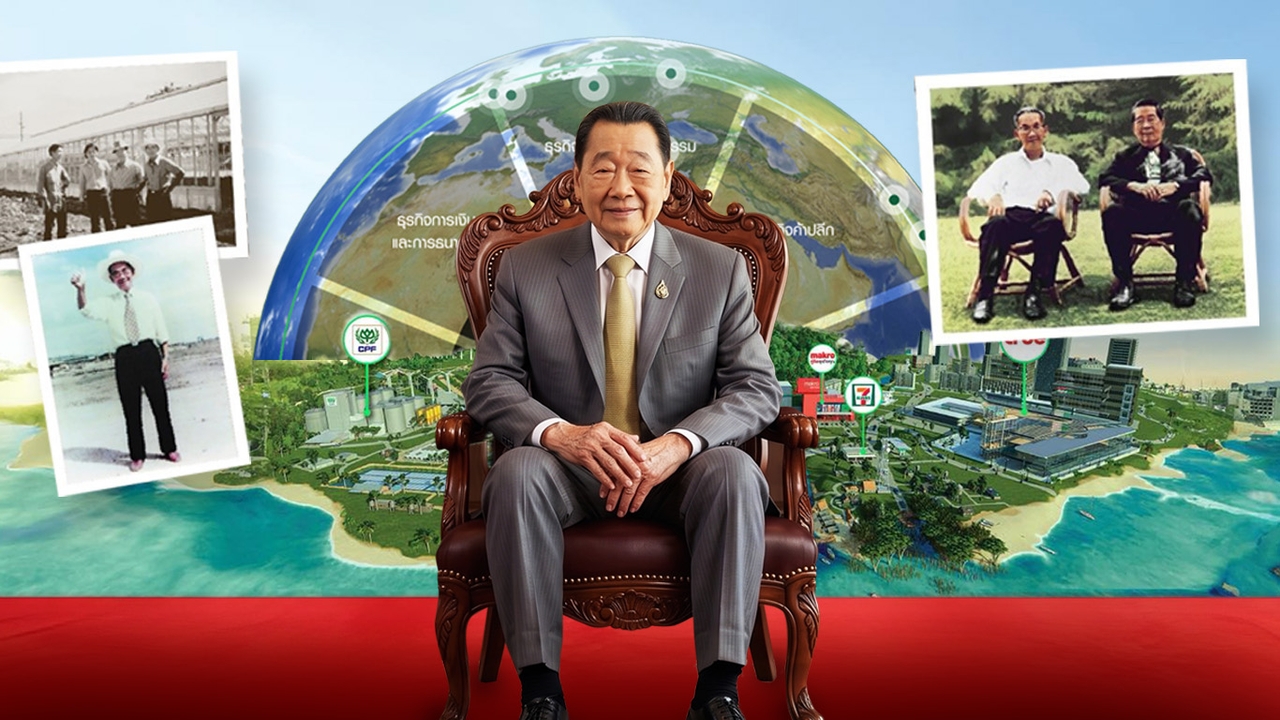
The name "CP" has returned to the spotlight in Thailand's economic and capital market news following recent reports of a major restructuring aimed at advancing the Virtual Bank business. This involves the planned transfer of key assets such as Counter Service, Thai Smart Card, and CP Extra (CPAXT) from CPALL to strengthen future financial ventures.
However, this internal policy has faced criticism because an independent board voted against it, citing governance concerns. This led to a sharp decline in CPALL and CPAXT stock prices, making it a hot topic among investors currently.
This issue raises an important question many are beginning to wonder: why does moving just a few pieces of this corporate puzzle cause such a massive shock and severely impact confidence?
The answer lies in the complex and powerful "structure" of the group, where even a slight shift in one company triggers a chain reaction throughout the tightly interconnected network.
This has prompted society to reconsider just how vast this empire truly is, and which piece of this puzzle the everyday services we use belong to within this structure.
Thairath Money invites everyone to "peek behind the scenes" and examine the real map of this century-old empire, from its founding era at Songwat Road to its status as a global corporation with layers of companies influencing every aspect of Thai people's daily lives.

Charoen Pokphand Group, commonly known as CP, is Thailand's largest private business conglomerate. Its origins trace back not to a high-tech factory but a small vegetable seed shop named "Jia Tai Jueng" on Songwat Road in the early 20th century, founded by the Chearavanont siblings.
The baton was passed to "Jia Swa Thanit Chearavanont," who expanded the integrated agricultural business model into a multinational corporation. He repeatedly ranked among the world's billionaires and is recognized as Thailand's wealthiest individual, possessing assets valued at $19.9 billion or approximately 630 billion baht (according to Forbes' World’s Billionaires 2026 ranking).

CP Group's business extends beyond poultry farms and 7-Eleven stores; it is divided into eight major business lines as follows:
1. Agro-Industry and Food Business (The Foundation of the Empire)
This is the strongest upstream sector, overseeing everything from seeds and animal feed to ready-to-eat meals on the dining table.
2. Retail Business (The Frontline Reaching Everyone)
This business segment is currently in the news for restructuring to support the Virtual Bank.
3. Telecommunications and Communication Business
Not just mobile phones but also digital infrastructure.
4. E-commerce and Digital Business
A key driver toward the new financial world (Fintech).
5. Real Estate and Infrastructure Business
6. Automotive and Industrial Business
Thais may be familiar with MG cars, which are also part of this empire.
7. Pharmaceutical and Medical Business
This sector reflects CP's vision beyond food to encompass "health."
8. Financial and Banking Business
The final puzzle piece currently in the news and a major future direction.
Ultimately, it is evident that CP's "synergistic business model" is not merely about holding multiple businesses but about creating an ecosystem deeply embedded in every facet of Thai people's consumption and lifestyle.
Under the founder's philosophy that in a rapidly changing world, having diverse foundations from upstream (agriculture/food), midstream (industry/logistics), to downstream (retail/digital) is key to building sustainability—not only for the group but also for the country's economic structure.
Therefore, the recent shift of key assets from CPALL to the financial business group, currently a trending topic, is not just about profit figures or stock prices but represents a "significant strategic move" by this giant. The outcome remains to be seen.
Follow Thairath Money's Facebook page at this link:https://www.facebook.com/ThairathMoney