

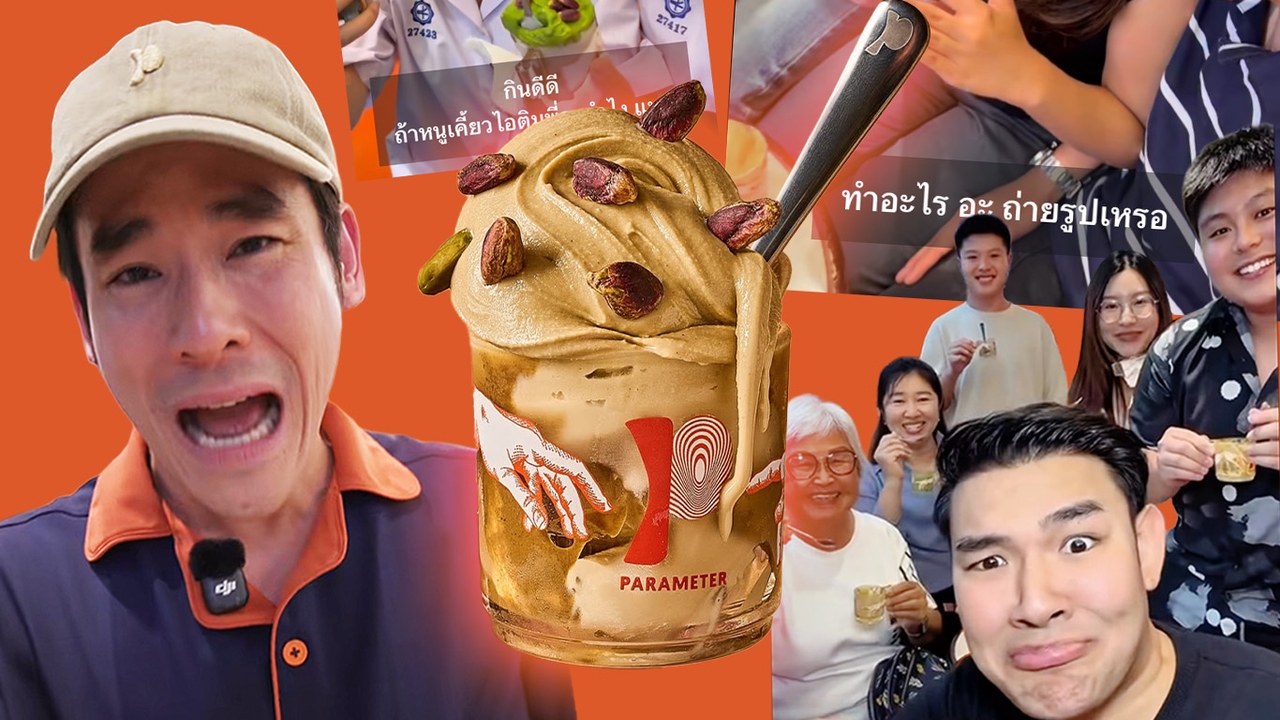
PARAMETER was initially little known.
Today, people are willing to queue to buy gelato priced at 559 baht per cup just to "secretly chew" and "pretend to take photos."
The question is... what happened?
PARAMETER, an ultra-smooth gelato brand, has become a drama epic dominating social feeds for weeks. It launched with prices ranging from 159 to 559 baht per 100 grams cup, with reports that top flavors may reach 700-900 baht in the future.
As soon as the prices were revealed, criticism poured in. Many questioned the "value" of a small 100-gram ice cream cup. The controversy intensified when the brand imposed uncomfortable consumption rules such as "no chewing" and "no prolonged photo-taking," citing that the -7°C temperature could alter the gelato's texture.
However, the drama escalated not just because of the price but due to the brand's communication style. Mentions of consumer "mindset" towards accepting quality goods were interpreted by many as dismissive and oppressive towards those questioning the product. Additionally, there were complaints from consumers alleging broken glass fragments found in the ice cream.
At first glance, everything seemed to be heading towards a "brand crisis."
But the reality was the opposite. The store at Siam Paragon is still packed with queues, including influencers and consumers eager to try it themselves. Some come to create content "secretly chewing" or "pretending to take photos," as if jokingly mocking the viral drama.
What the general public wants to know, beyond "Is the ice cream tasty?", is why a newly launched brand can create such a stir, and why "the more it’s criticized, the better it sells."
Part of the explanation lies in how the "person" is positioned as the "brand." Many mistakenly believe Kris Sripoomseth owns PARAMETER, but corporate records show that PARAMETER Co., Ltd., registered in March 2025 with 5 million baht capital, is 100% owned by Pornpipat Wehappla. Kris serves as the formula developer, chef, and main brand spokesperson.
For a new brand without established recognition, having a famous figure as the "face" is a strategy that reduces credibility-building costs since people remember "people" faster than "logos." When the drama unfolded, the spotlight targeted not just the individual but PARAMETER itself.
However, brand recognition is only half the story. The bigger question is why criticism has not deterred people but instead drawn more customers to the store.
One explanation involves the psychological concept called Information Gap Theory, which suggests that when people receive "incomplete" or conflicting information, their brains become restless and seek answers to close that gap.
In PARAMETER's case, some say the gelato is "worth the price," while others insist it is "too expensive."
The presence of both praise and criticism simultaneously widens the information gap.
Ultimately, many choose the simplest way to resolve their questions: visiting the store and paying to try it themselves.
Thus, the hundreds of baht paid serve not only as payment for gelato but as a "ticket" to find out whether it truly tastes worth the price or is merely famous due to drama.
As people start queuing, the queue itself becomes content.
When this content is shared, curiosity grows.
With increased curiosity, more people want to try it.
This cycle is accelerated by TikTok, Facebook, and review content, turning interest into a chain reaction.
This phenomenon recalls the classic marketing phrase, "There is no such thing as bad publicity as long as people talk about you." In an era where all brands compete for mobile screen space, "attention" is the most valuable asset, often more valuable than advertising budgets. This is especially true for new brands without a strong recognition base, as reflected by PARAMETER’s initial financial losses before becoming a national sensation.
However, this phrase does not apply universally. Another important marketing saying is, "Not all publicity is good publicity," because if drama involves product safety, fraud, or illegal activity, no amount of attention can save the brand.
In PARAMETER's case, the main issue is an unresolved question: "Is it worth the price?" Without a definitive answer, many consumers choose to find out for themselves.
Some go to taste.
Some go to review.
Some go to "secretly chew" and create content.
Some go to "pretend to take photos."
Regardless of the reason, what the brand sold that day was not just gelato but cleverly converted "curiosity" into sales.
Although people still queue at PARAMETER driven by curiosity gaps and social proof, the true challenge begins when society’s curiosity is fully satisfied. Once most consumers have tried it, the real brand metric will not be how many queued during the drama peak, but how many willingly return to repurchase when the online buzz has quieted.
Follow the Facebook page: Thairath Money at this link.https://www.facebook.com/ThairathMoney