

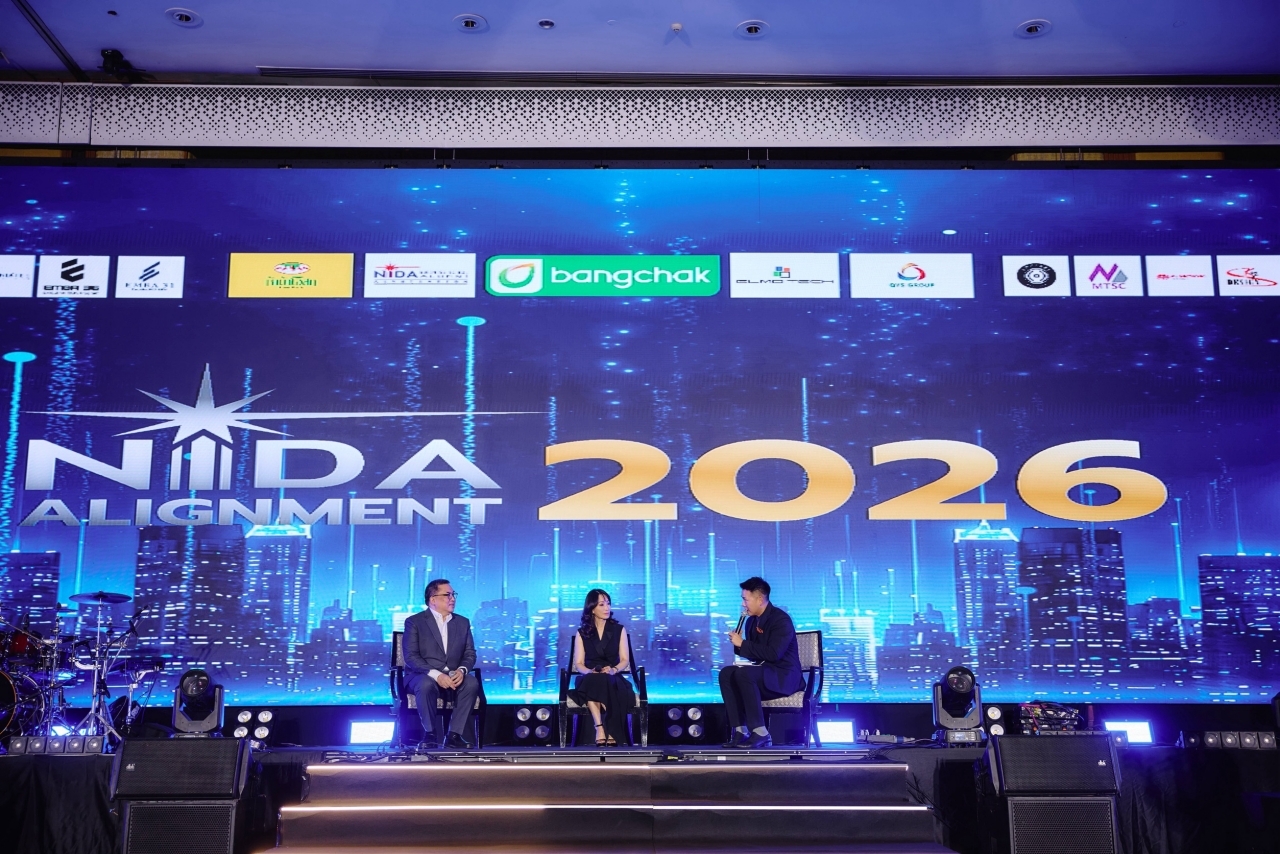
NIDA ALIGNMENT 2026 unites the Executive MBA network to open perspectives on the economy and business, enhancing leadership capabilities toward future transformation.
Reporters stated that Executive MBA students from cohort 37 of the NIDA Business School organized NIDA ALIGNMENT 2026 on 19 Sep 2026, attended by over 200 participants including faculty, alumni, current Executive MBA students from various cohorts, business executives, and honored guests.
This year’s event was held under the theme Connect • Inspire • Transform, aiming to link people across generations, spark ideas and inspiration, and enable knowledge to be applied concretely. NIDA Alignment is an ongoing activity where alumni and current students collaborate across cohorts to exchange experiences and build long-term partnerships. The opening ceremony was chaired by Associate Professor Dr. Wiput Ongskul, Executive MBA Program Director, alongside faculty, representatives of the Business School alumni association, and Executive MBA representatives from multiple cohorts.
Thailand’s economy faces structural challenges but still holds opportunities from new investments.
A highlight of the event was a keynote speech by Dr. Saraphon Tulyasatien, Secretary-General of the Government Pension Fund (GPF), titled “The Current Era of Thailand’s Economy: Present and Future Outlook.”
His lecture portrayed Thailand’s economy as still heavily reliant on the service sector, with overall growth rates relatively low compared to many countries in the region. Thailand must also address an aging population, household debt burdens, global economic uncertainties, and the shift from globalization toward geopolitical fragmentation, where the global economy divides along geopolitical lines.
Another topic highlighted was Thailand’s Two-Speed Economy, reflecting disparities in growth among economic sectors and population groups amid increasing volatility. Nonetheless, Thailand still benefits from rising foreign direct investment; data presented showed that in 2025, total investment reached about 1.36 trillion baht, with a 21% increase in projects and a 66% rise in investment value from the previous year. Investments in digital industries and advanced technologies are expanding, potentially driving new growth engines for the country.
The application of Artificial Intelligence (AI) to boost productivity across infrastructure, manufacturing, business, and marketing sectors was also emphasized as a key opportunity. This accompanies a transition from traditional economic engines toward an economy focused on value creation, investment ecosystems, human capital, efficiency, resilience, and sustainability.

WHA identifies four megatrends and strategic responses for a rapidly changing world.
The event also featured a lecture by Jareepon Jarukornsakul, Chairwoman and CEO of WHA Corporation Public Company Limited, on “Crafting A Vision and Plan for Change.” She addressed understanding global trends, translating vision into action, and leadership roles in guiding organizations through change.
Jareepon outlined four key megatrends: the Human-Machine Hybrid Era combining human potential with AI, robotics, and technology; shifts in world order and geopolitical competition; sustainability and climate crisis challenges; and demographic changes. These trends drive the world into an era of competition and uncertainty.
For Thailand, enhancing competitiveness relies on four pillars: improving policy efficiency and investment facilitation; developing future-ready infrastructure; elevating Thailand’s role in global value chains; and developing human capital and workforce potential. This is alongside the transition from the Old Economy to the New Economy driven by digitalization, environmental friendliness, innovation, and knowledge.
Jareepon also presented WHA Group’s planning approach, considering megatrends, macroeconomics, industry dynamics, customer needs, organizational capabilities, financial strength, competition, and risks before defining four strategic focuses: Extend Leadership, Embrace Technology, Highlight Green Commitment, and Power Up Organization to support sustainable long-term growth.
Regarding leadership, she proposed principles such as Believe in Yourself, Can Do Attitude, Never Stop Learning, and Growth Mindset, along with Think Big, Think Positive, and Think for the Future to help leaders identify opportunities and drive organizations amid change.
After the lectures, participants joined a Key Takeaways & Q&A session linking macroeconomic issues with organizational management, discussing economic outlooks for the next 3–5 years, the role of human capital in competitiveness, shifts in mindset and corporate culture, and characteristics and development paths for future leaders. The session was moderated by Sutiwat Hongpoonpipat, news anchor and MC of Thai News Agency, Channel 9 MCOT HD.
Beyond knowledge exchange, the event included a Networking Dinner where Executive MBA alumni and students from multiple cohorts met to share experiences and explore collaboration opportunities among executives, businesspeople, faculty, and network members. A key moment was the Alignment Handover ceremony, where representatives of cohort 37 passed event organization responsibilities to cohort 38 to continue NIDA Alignment and sustain inter-cohort relationships.
The event was supported by main partners including Bangchak Corporation, NIDA Business School Alumni Association, ELMO TECH, Hamah Osot, and QVS Group, along with over 37 other alumni and partners. It concluded with the AOF PONGSAK Special Concert and Alumni Networking activities.
Thus, NIDA ALIGNMENT 2026 served as a platform to open perspectives on economics and organizational management, as well as to connect knowledge, experience, and the Executive MBA network for further development at individual, organizational, and societal levels.