

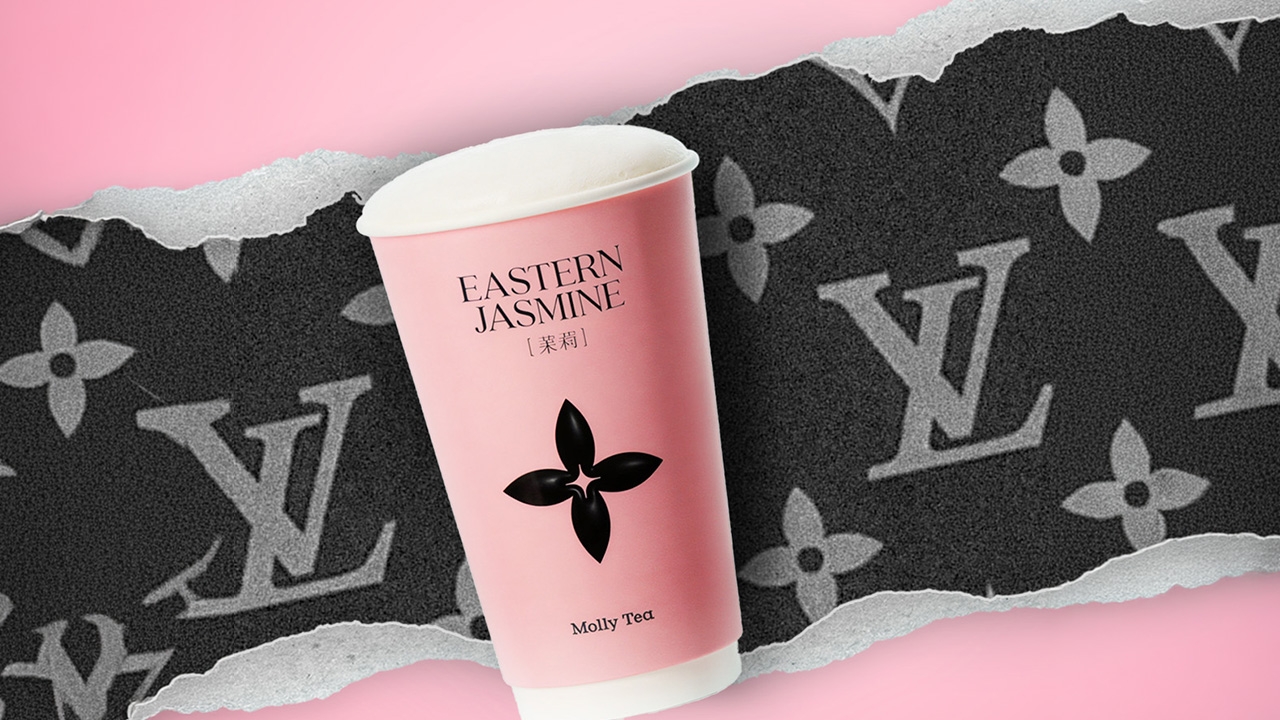
Why would a luxury brand like Louis Vuitton sue a bubble tea shop? The answer lies not only in logo similarity but in protecting the brand equity built over more than a century.
Recently, a Chinese court ruled that Molly Tea, a well-known Chinese bubble tea chain, must pay Louis Vuitton damages totaling 10.3 million yuan (about 1.5 million U.S. dollars or approximately 55 million baht) after finding that Molly Tea's floral logo closely resembled Louis Vuitton’s "Monogram Flower," constituting trademark infringement.

The judgment stated that Shenzhen Mile Catering Management Co., Ltd., Molly Tea’s parent company, and one of its franchise stores in Wuzhong District, Suzhou City, infringed on seven registered trademarks of Louis Vuitton, particularly the four-petal flower pattern (Four-Petal Flower) that closely resembles the Monogram Flower. This is one of Louis Vuitton’s iconic symbols, designed by Georges-Louis Vuitton in 1896 alongside the famous LV monogram and lettering to establish brand identity and prevent counterfeiting at that time.
The pattern consists of two types of flowers: a star-shaped flower with pointed petals and a rounded four-petal flower, which later became key elements of the Louis Vuitton Monogram Canvas used on the brand's bags and leather goods.
Today, the Monogram Flower is not just a decorative pattern but has evolved into collections of luxury jewelry, watches, and accessories, becoming one of the globally recognized symbols instantly associated with Louis Vuitton.
Although the court ordered Molly Tea to pay economic damages of 10 million yuan plus an additional 300,000 yuan in legal fees, totaling 10.3 million yuan within 10 days, Molly Tea has stated it will appeal the decision at a higher court to continue the legal process.
The case drew significant attention on China’s Weibo platform, with many users debating the degree of similarity between Molly Tea’s logo and Louis Vuitton’s Monogram Flower, while others noted the two companies operate in different sectors—beverages and fashion—arguing it unlikely to cause consumer confusion.
There were also questions about the origin of Louis Vuitton’s Monogram Flower, with some opinions suggesting the design may have been inspired by traditional Chinese art and patterns, while intellectual property experts noted the legal framework involved:
Although cultural elements are public domain, once registered as a trademark, Chinese law follows the principle First-to-File, meaning the first registrant gains priority rights, allowing trademark owners to protect their marks even if they originate from traditional art.

intellectual property experts observe that in today’s era,brand equityhas become a vital business asset, so trademark protection extends beyond counterfeit prevention to include safeguarding the entire brand identity,
including logos, patterns, colors, shapes, or design elements that help consumers recognize the brand. Use of similar symbols that might lead consumers to believe there is an association with the original brand can result in legal disputes, even if the businesses operate in different industries.
Louis Vuitton’s Monogram Flower is recognized as a “well-known trademark,” which in many countries including China enjoys broader protection beyond the registered goods or services.
That means even if the two companies do not compete in the same market, use of similar logos or patterns that might cause consumers to believe the brands are related or diminish the original brand's distinctiveness can lead to legal action by the trademark owner.
This concept aligns with the legal principle known as Trademark Dilution,which differs from typical trademark infringement cases that focus on consumer confusion over product origin.
Trademark Dilution protects the “distinctiveness” and “brand equity,” especially for globally famous brands. The law recognizes that widespread use of similar marks by businesses in various industries can weaken the association between the symbol and the brand owner, causing the trademark to lose its uniqueness.
Trademark Dilution has two main forms:
In the Louis Vuitton vs. Molly Tea case, the court mainly considered trademark infringement, but Louis Vuitton’s decision to sue a bubble tea shop clearly reflects the Trademark Dilution principle: protecting the Monogram Flower’s distinctiveness from being diluted by use in unrelated industries.
This explains why global luxury brands often pursue legal action seriously even against non-direct competitors—they are protecting not only product sales but also design elements that create brand recognition, such as monogram patterns, shapes, colors, or symbols that define brand identity and value, assets cultivated over decades or even more than a century.
Over recent years, Louis Vuitton has been one of the most active companies in trademark litigation in the fashion industry, such as suing My Other Bag, a canvas bag maker that printed parodies of Louis Vuitton bags. Although a U.S. court eventually ruled against Louis Vuitton, viewing the work as parody unlikely to confuse consumers, the case showed the brand’s seriousness in protecting its trademarks.
Another case involved Louis Vuitton suing Hyundai Motor Company after the South Korean automaker used a pattern resembling Louis Vuitton’s monogram in a brief Super Bowl commercial. Both parties eventually settled out of court.
Trademark disputes are common not only in high-end fashion but also in other sectors. For example, Chanel opposed Huawei’s logo registration in Europe, claiming it resembled Chanel’s Double C logo, but the European Union court found the overall shape and consumer perception sufficiently different and dismissed Chanel’s opposition.
Similarly, Apple opposed registration of the Prepear app’s pear-shaped logo, arguing it could cause confusion with Apple’s apple logo. Although the parties eventually settled, the case sparked global debate about the scope of trademark protection.
In Thailand, a notable case involved the dispute between China’s Luckin Coffee and a Thai operator in 2022 after the latter used the name Luckin Coffee with a deer-head logo, brand colors, store decoration, and packaging closely resembling the original, differing only in the deer logo’s orientation.
The dispute lasted several years because the Thai company, Royal 50R Group, claimed prior trademark registration in Thailand under the First-to-File principle, which is central to trademark law in many countries.
However, in 2025, Thailand’s Central Intellectual Property and International Trade Court ruled that China’s Luckin Coffee had superior rights to the trademark and logo, revoked Royal 50R’s trademark, prohibited use of the Luckin Coffee name in English and Chinese, and ordered payment of damages and legal fees exceeding 46 million baht, one of the highest trademark damage awards in Thailand.
Although the facts differ, both the Luckin Coffee and Louis Vuitton cases illustrate a key global business trend: competition extends beyond products and services into intellectual property, especially trademarks, which are not just source indicators but valuable business assets foundational to consumer trust and long-term brand equity.
Source information SCMP , China Daily , The Fashion Law , WorldTrademarkReview , INTA
Click to read the "BrandStory" column
Follow the Facebook page: Thairath Money at this link -