

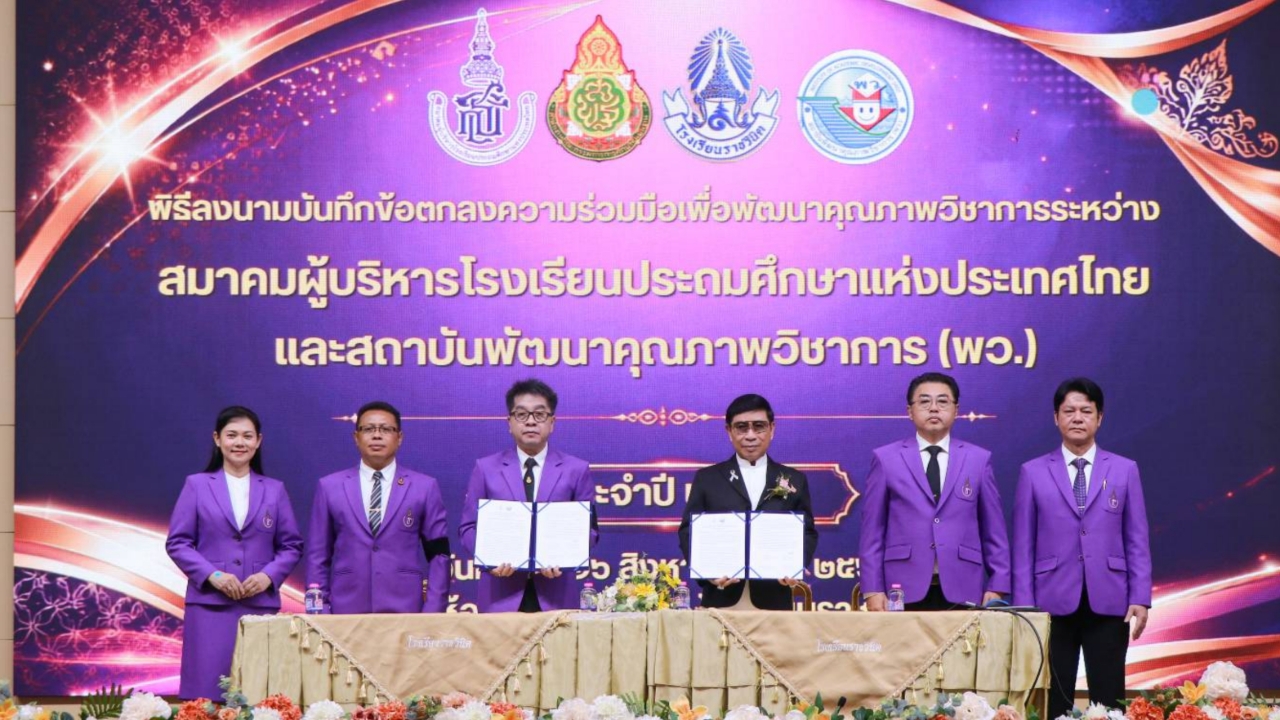
The Primary School Administrators’ Association of Thailand (PSAA) and the Institute for Academic Quality Development (PWA) signed a Memorandum of Understanding (MOU) to raise academic standards, develop leadership among administrators, and promote Active Learning through the systematic higher-order thinking process known as GPAS 5 Steps. This collaboration extends beyond teaching techniques, aiming to cultivate children who think critically, solve problems, think before acting, and coexist with others amid major social challenges such as violence, risky behaviors, and the impact of the online world.
Dr. Pichet Phophakdee, Secretary-General of the Basic Education Commission (OBEC), said Active Learning should not only mean hands-on activities but must train children to think systematically, understand causes and effects, and consider impacts on themselves, peers, and society before making decisions.
Particularly regarding youth violence, the 'Think Twice' concept—careful consideration before action—is a vital skill that education must genuinely instill. At the same time, teachers and administrators must model reason, morality, and self-restraint, transforming teachers’ roles from knowledge transmitters into coaches who help students think independently and find answers themselves.
If Active Learning extends to innovation creation, children will not just learn to pass exams but can apply their ideas to create practical works, develop business opportunities, or even advance toward patent registration in the future.
Dr. Proporn Kaewchat, President of the Primary School Administrators’ Association of Thailand, stated this MOU aims primarily to ensure knowledge does not remain with administrators but is systematically passed to teachers and students. This includes curriculum analysis, lesson planning, and managing Active Learning through GPAS 5 Steps, where children are trained to research, analyze, build knowledge, practice, present, and exchange ideas.
It also involves guiding and assessing their own learning. The challenge for today’s education is not merely whether children remember answers but how they think and handle problems without ready answers. The association, with a network of over 10,000 schools, aims to expand this approach to schools of all sizes, adhering to the principle of leaving no one behind and tailoring it to each local context.
Dr. Saksin Rojcharanrom, Chairman of PWA’s Executive Board, said GPAS 5 Steps focuses on developing higher-order thinking and internal strength in children. Today, children face not only classroom challenges but also information overload, social trends, temptations, pressures, and rapid disappointments. Education must go beyond increasing knowledge to create children who are discerning, think before believing or acting, and make reasoned decisions.
When administrators understand the process, teachers can design learning experiences, and students receive continuous thinking training, classrooms become places not just for passing on knowledge but for practicing thinking and life skills. The focus shifts from 'What did students learn?' to more important questions: 'Can students think critically when facing problems? Can they pause and think before acting in anger? And in a changing world, do they have the resilience to make their own decisions?' If education truly develops children’s thinking, Active Learning with GPAS 5 Steps may not only improve academic performance but also help children live well and avoid violence as their first solution.

Building a Volunteer Network Mr. Pornchai Chamnanyont, village headman of Klong Krok Village 10, Pawa Subdistrict, Kaeng Hang Maeo District, Chanthaburi Province, received AI CCTV cameras and wild elephant monitoring equipment from Viriyah Insurance Public Company Limited. The handover was represented by Mr. Nattapong Boonyen, Assistant Managing Director, and Mr. Pongtiwa Krisanpan, Operations Manager for Region 3 (Eastern Region) of the Claims Operations Center.
The event took place in cooperation with Associate Professor Porphan Suttiwatthana, Acting President of Rambhai Barni Rajabhat University, as part of the 2nd Eastern Region Wild Elephant Volunteer Network activity to enhance early warning systems against wild elephants. This helps officials prevent risks promptly by replacing old equipment worn from two years of use at the Klong Krok Watershed Management Unit, Village 10, Pawa Subdistrict, Kaeng Hang Maeo District, Chanthaburi Province.

On this occasion, over 300 Viriyah volunteers also created three artificial salt licks and planted trees in the Khao Ang Rue Nai Wildlife Sanctuary area, covering border areas of five provinces: Chachoengsao, Sa Kaeo, Chanthaburi, Rayong, and Chonburi. This effort aims to restore natural resources, the habitat of diverse wildlife, to enhance biodiversity. The Eastern Wild Elephant Volunteer Network is one activity under the Sustainable Elephant Conservation project.
The company has continuously operated this project since 2020 to improve the quality of life for Thai elephants. It remains committed to promoting environmental conservation and wild elephant care through collaboration with multiple sectors, aiming to conserve natural resources and wildlife, reduce human-wildlife conflicts, and create lasting value for society, communities, and the environment.

Supply Chain Transformation The Department of International Trade Promotion (DITP), Ministry of Commerce, collaborated with RX Biotech (Thailand) Co., Ltd. to launch “TILOG – LOGISTIX 2026,” the official exhibition of warehouse management, cargo handling, transportation technologies, logistics services, IT logistics, and e-logistics. This year's event features 149 companies showcasing 485 brands from 25 countries under the theme “Empowering Global Trade with Generative Supply Chains.” It is held from 19–21 August 2026, 10:00–18:00, at Hall 98, BITEC Bangna, with an expected attendance of no fewer than 7,500 visitors.