

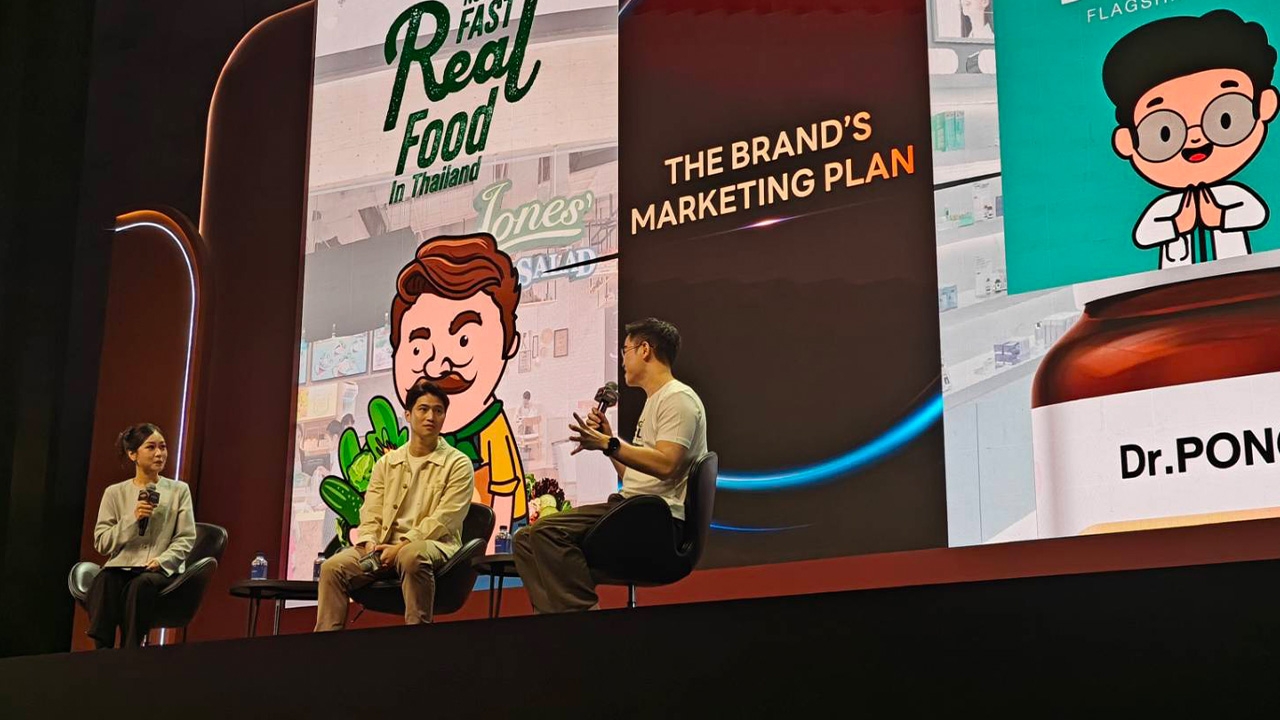
To build a sustainable business today, one must accept that scaling a business doesn’t happen by luck but requires systems ready to support growth. This was highlighted at the Investman SUMMIT 2026 in the session "The Scaling Up Playbook: How to Grow Your Brand." The topic focused on expanding business size and brand growth.

Dr. Yuwapong Sutthinun, CEO and Founder of Dr.PONG, , and Ariya Kamphilo, CEO and Founder of Jones' Salad shared their brand journeys from inception to reaching revenues hitting the billion-baht mark.
Neither brand started with a billion-baht sales goal from day one but built a strong foundation and found distinct points of differentiation.
For Dr.PONG, the start came from seeing an opportunity to disrupt distribution channels during the rise of e-commerce and online platforms. Traditionally, skincare products sold via Modern Trade bear a gross profit (GP) of up to 40%, which limits the actual product cost.
Dr.PONG chose to reinvest that 40% GP margin back into the product by developing formulas and increasing extract costs to achieve the highest quality at a reasonable price — something multinational brands typically avoid. This value is immediately recognized by consumers, driving rapid online growth.
Jones' Salad began modestly in a food court space just over 10 square meters, initially aiming only to sell fresh vegetables. The pivotal shift was finding their Unique Selling Point (USP) by defining themselves as "Fast Real Food," a market position previously unclaimed. This filled a gap between common fast food and hard-to-find real food, giving the brand a clear and distinct direction away from competitors.
As the business grew, the brand's character needed to align with consumer behavior. Jones' Salad developed the "Uncle Jones" character to connect directly with consumers through educational health cartoons on Facebook.
At that time, some posts reached over 100,000 shares. In today’s era with platforms like TikTok and the short video trend, the brand cleverly integrates products into content—for example, creating a blue sky-themed smoothie menu that shares scientific knowledge about light and sky, followed by an invitation to try the "On The Farm" menu, linking knowledge to actual products.
Dr.PONG adapted its strategy clearly through growth stages: starting with ingredient focus, moving to clinical test results, and then to delivery systems for skin absorption.
They learned that as the brand grows, communication must be simple. After launching billboards with international presenter Kim Seon-ho, they found 30% to 40% of consumers mistakenly thought the brand was Korean. This showed that consumers only focus for 3 to 5 seconds, so branding and messaging must be straightforward. Even brand name confusion between “Pong” and “Dr.PONG” was accepted as a sign of closeness with customers rather than corrected.
Both brands emphasize measuring marketing success by real results. Dr.PONG sees sales as the best teacher, with no sympathy for complicated tactics. Effective marketing starts with products that align with megatrends like health and fitness, using numerical performance metrics mainly via TikTok and influencers online.
Jones' Salad ensures new products reinforce core brand values of taste, value, and health. Innovations like Salad Wraps, rolling entire salads into easy-to-eat fast food forms, or blended salad smoothies turning whole salads into rich, tasty drinks, consistently drive strong sales.
However, growth brings challenges. Jones' Salad faced service delays during busy times, contradicting their Fast Food concept. They addressed this by providing riders with water to reduce stress, intensifying staff training, scheduling shifts by skill level during peak hours, and developing automated ordering systems.
Dr.PONG encountered issues such as a vitamin C serum with a sulfur-like odor from glutathione addition; the brand managed expectations by providing transparent advance information. For a deodorant spray with clogged nozzles due to high extract concentration, they improved product replacement and claims processes for customer convenience, empowering front-line staff to make immediate decisions without lengthy approvals.
As business grows from tens to hundreds of millions, reaching the billion-baht level, back-end systems become crucial drivers.
For Jones' Salad, managing 5 to 20 branches is the toughest phase for a restaurant business as owners cannot oversee every detail. The brand thus established quality control systems and hired professionals to maintain cleanliness and standards.
Their production capacity evolved from a condominium kitchen to shop houses, and finally investing in a large central kitchen to support over 10 new branches annually across provinces. They also carefully studied regulations such as the FDA’s 50-horsepower machinery limit and air conditioning power counting by the Department of Industrial Works to plan compliant long-term investments.
Dr.PONG views the current era as a golden opportunity for scaling, as infrastructure like logistics and e-commerce unlock limitations of shelf space and sales teams. In the skincare market valued at 200 billion baht, with 10,000 new brands, the average market share per brand is about 20 million baht. Achieving 10 million baht in sales is possible by targeting niche markets.
However, scaling requires strict product quality control. Dr.PONG operates an internal system called Dr.PONG OCD to randomly test extract concentrations—such as vitamin C—over 20 times monthly to ensure top standards.
Both brands focus on maximizing internal capabilities and leveraging technology for cost management. Jones' Salad controls costs by defining clear customer segments and eliminating unnecessary items, also developing their own salad dressing formulas in the central kitchen to differentiate and reduce long-term costs.
Dr.PONG conducts deep raw material research with institutions like NANOTEC to produce the ZIAMOZOME™ extract domestically, cutting expensive foreign import costs by hundreds or thousands of times. They also export this extract to factories and brands in South Korea as B2B products.
Both executives advise entrepreneurs today that "small players have the greatest opportunity" thanks to technology, digital tools, and AI filling gaps in data, business model analysis, and planning. Entrepreneurs no longer need to be hindered by labor shortages as before. With clear goals, effective use of available data, and serious execution, brands can grow steadily and smoothly in expanding markets.