

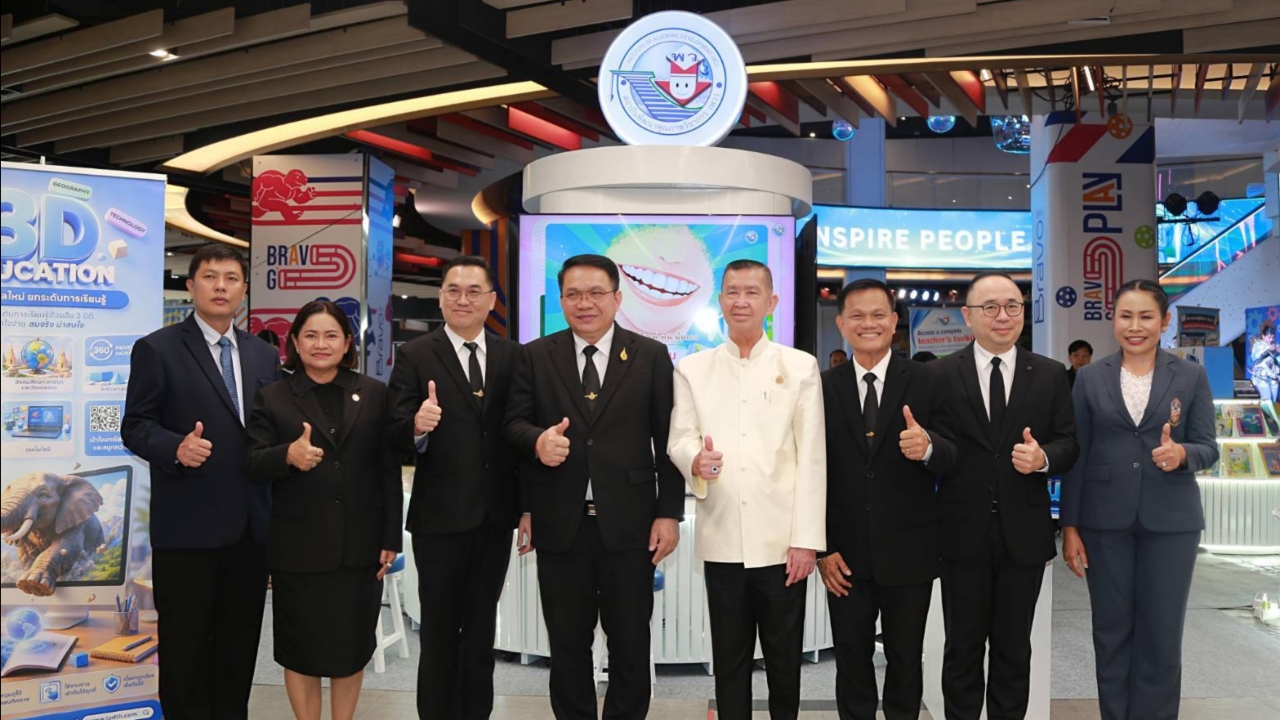
Dr. Pichet Pho-phakdee, Secretary-General of the Education Council, said the Ministry of Education, under Minister Prasert Chanruangthong, prioritizes applying AI at all levels—from central agencies and educational zones to schools—adapting to each area’s context within the “All for Education” framework that invites all sectors to collaboratively develop education.
The collaboration between the Association of School Administrators under the Bangkok Primary Education Service Area Office and the Institute for Academic Quality Development (PWA), formalized through a memorandum of understanding (MOU), establishes a network to enhance education quality across 31 schools. This exemplifies how national policies translate into practical school-level implementation, starting with preparing administrators and teachers before extending to students.
AI does not replace teachers but serves as a tool to assist them. When linked with Active Learning, AI helps create more opportunities for students to participate in designing their learning. Meanwhile, teachers shift their role from merely providing answers to becoming coaches and mentors who encourage children to think, research, and innovate.
However, the key challenge is not just enabling children to use AI skillfully but teaching them to verify information, analyze, reflect, and make their own decisions. If education uses AI only to find answers, students may miss out on practicing critical thinking, which is central to learning.
There are ethical risks concerning the creation of data or virtual images that may infringe others’ rights, as well as the improper use of technology. Therefore, cooperation among administrators, teachers, parents, and communities is essential, along with promoting professional learning communities (PLC) to exchange best practices and innovate within schools.
Mr. Paisan Rojsaranrom, Vice Chairman of the Institute for Academic Quality Development (PWA), stated that the union of 31 schools presents a vital opportunity to systematically advance education. The PWA Institute is ready to provide a network of trainers and experts in learning innovation and AI to support schools, introducing the “PW Plus” approach to link development from upstream to downstream stages.
The core of this cooperation is applying knowledge, technology, and innovation beneficially to each school, especially integrating AI into learning management. This enables teachers to design activities that promote higher-order thinking and improve learner quality to keep pace with global changes. Implementing GPAS 5 Steps alongside AI technology aims to elevate students from information recipients to creators of knowledge and work, a key direction in developing learner competencies for the modern world.
Mr. Kriangsak Yodsarn, Director of the Bangkok Primary Education Service Area Office, said that current education development cannot be carried out by government agencies alone. It requires partnerships both domestically and internationally to integrate knowledge, technology, and innovation into the education system.
This MOU’s crucial starting point is human resource development, particularly administrators and teachers who are the main drivers of improving learning quality before passing results on to students in actual classrooms.
Mr. Watcharavee Theeradechchoti, Director of Sainamtip School and Chairman of the School Administrators Association, reflected that the success of this collaboration is measured not by signing documents but by changes within classrooms. School leaders must shift their mindset from organizational managers to learning and change leaders, supporting, supervising, and creating environments where teachers can continuously apply technology, Active Learning, and GPAS 5 Steps to develop students.
He also pointed out that another challenge is building technological resilience in children. Schools, teachers, parents, and communities must jointly promote AI use with awareness, enabling children to control technology rather than letting it dictate their learning behaviors. Feedback from school administrators emphasizes that AI classroom reform must begin with developing teachers and school management systems.
Ms. Kamaitorn Chaichanyu, Director of Phayathai School, said administrators must lead in introducing technology into schools before expanding development to teachers and staff, linking AI with curricula and learning activities tailored to each school’s context. This approach must balance cost-effectiveness, morality, and ethics while preventing children from becoming overly dependent on technology.
Dr. Paradee Phangsanga, Director of Wat Amarintharam School, noted that cooperation with the PWA Institute enriches the academic network for schools under the Bangkok Primary Education Service Area Office, especially those located in temple areas that already have support networks for resources and equipment but still need new knowledge and innovation to elevate learning management.
Previously, schools in the network have continuously emphasized upskilling and reskilling teachers, updating knowledge every four months to keep pace with technology and curriculum changes. Having the PWA Institute as an academic partner presents an opportunity to systematically develop curricula and knowledge for teachers and sustain progress across all 31 schools.
This collaboration reflects a new direction for Thai education, viewing AI not merely as an additional classroom technology but as an opportunity to redesign the entire learning process. Policy agencies set the direction, educational zones drive implementation, the PWA Institute supports knowledge and innovation, school administrators lead change, and teachers create learning experiences for students.
From the collaboration of 31 schools in Bangkok, the primary goal is not only to create AI-equipped classrooms but to build classrooms where students use AI critically, think analytically, solve problems, take action, and innovate independently. The future of education depends not on how much students use AI but on how AI enables Thai students to think more deeply, create more, and use knowledge to transform their world.
: Mr. Sara Lamsam, CEO of Muang Thai Life Assurance Public Company Limited (MTL), revealed that technology now plays a crucial role in daily life, from information searches to news tracking. The company is committed to developing services focused on customers’ needs and benefits under the concept of MTL Trusted Lifetime Partner, offering comprehensive financial planning for long and stable living (Longevity) by enhancing the 'Muang Thai UL Plus' website to provide faster, more transparent access to product performance data.
The revamped Muang Thai UL Plus website improves policyholders’ and interested users’ experience by offering easy, comprehensive information. Users can access it via muangthai.co.th by selecting Universal Life insurance and then 'Muang Thai UL Plus'.
Users can view policy performance data from the first policy year to the present, with tools to calculate past performance by specifying the purchase month and year. The system then calculates and displays average or annualized returns, allowing immediate approximate performance checks without manually searching tables. The site also offers video tutorials and product detail explanations to help customers learn more.
Muang Thai Life Assurance focuses on customer care through diverse products and services designed for comprehensive financial planning, especially lifelong financial security (Wealthspan). 'Muang Thai UL Plus' is a universal life insurance product with guaranteed minimum investment returns: 4% in the first year and 1% annually from the second year onward. It offers high life coverage up to age 99(1) and flexible premium payments.
Premiums start at just 10,000 baht annually, with options to pay additional savings or increase health coverage. Policyholders can partially withdraw investment funds or pause premium payments to suit life stages. It also offers valuable tax deduction benefits of up to 100,000 baht.
This product suits those seeking a long-term financial tool for savings, life coverage, and growth potential through investment, with guaranteed minimum returns limiting downside risk, alongside tax deduction benefits.
