

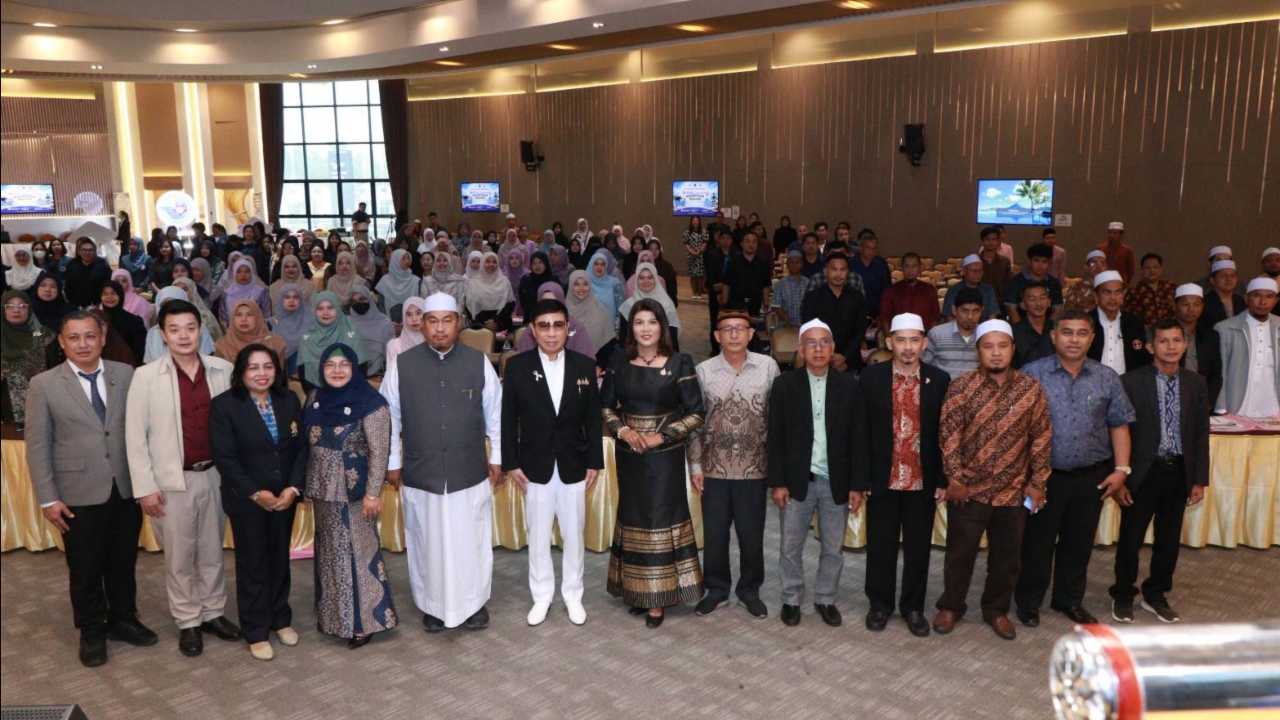
Mr. Akkharanat Kankittinan, Deputy Minister of Education, presided over the project opening via an online system, promoting the concept of education for employment to prepare Songkhla’s youth as global citizens with skills ready to compete in the AI and digital economy.
Songkhla boasts outstanding potential through border trade connections with Malaysia and ASEAN, linguistic diversity, halal food industry, and cultural capital. Education must go beyond textbooks by linking knowledge with local professions and economy, such as community product development, packaging design, and online trading in foreign languages, enabling children to create real economic opportunities.
Dr. Saksin Rojsaranrom, Chairman of the Institute for Academic Quality Development (IAQD), revealed that field visits to all five provinces showed strong enthusiasm among administrators and teachers to seriously improve education quality. However, the key challenge is not the number trained but ensuring all schools effectively implement the learning process systemically.
The private school network plans to expand the impact from administrators and academic teachers to all teaching staff, aiming for consistent learning management without fragmentation or isolated teacher efforts.
Dr. Saksin pointed out that Thailand’s education problem is not just the curriculum itself, but the understanding and ability to apply it—including learning standards, indicators, teaching processes, and realistic assessments. Without teachers grasping these core processes, even a good curriculum cannot produce quality outcomes.
The GPAS 5 Steps process was designed as a tool to develop students’ higher-order thinking—not just studying for exams but to analyze, solve problems, create knowledge, and independently innovate. Some schools have developed research-based projects through this process that attracted attention from other school networks.
The IAQD also announced a key five-year goal to systematically strengthen academic capacity in Thai schools, enhancing competitiveness with neighbors like Malaysia and Indonesia, before expanding the GPAS 5 Steps development approach to other interested Asian countries.
Dr. Bussarin Nakubon, Director of the Songkhla Private Education Office, reflected that private schools face the major challenge of building parental confidence, making education quality unavoidable—especially shifting from traditional teaching to classrooms where students actively participate and learn by doing.
This training attracted great interest from private schools, many requesting to send more teachers than allocated, reflecting serious commitment to teacher capacity development. The long-term goal goes beyond academic achievement to developing students’ understanding of religious and cultural differences for peaceful coexistence in a multicultural society.
Meanwhile, Mr. Roset Benhalhana, President of the Songkhla Tadika Association and Vice President of the Islamic Private School Network in the five southern border provinces, emphasized it is time to shift teachers’ roles from content transmitters to designers of learning experiences, giving students opportunities to think, experiment, and practice.
The GPAS 5 Steps process can be applied across all subjects, including science, English, and core courses, so students develop thinking, practical, and communication skills simultaneously—not just theoretical learning but applying knowledge in real life.
The conclusion of this mission in Songkhla marks not the end of training in the five southern border provinces but the start of an important test: whether the GPAS 5 Steps approach will translate from workshop knowledge to actual improvements in classroom learning quality, progressing toward the goal of elevating Thai education to compete internationally.

Welcoming the Cold Season Cherilon (CHERILON), a brand of hosiery and lingerie products, advances the success of its thermal stockings by launching a new collection for the international travel season. The brand enhances products to meet diverse consumer needs by adding sizes for plus-size women and open-toe designs to offer more choices for wearing and mixing with shoes and fashion outfits, reinforcing the concept “Become the Real You,” aimed at empowering women to confidently enjoy dressing in their own style.