

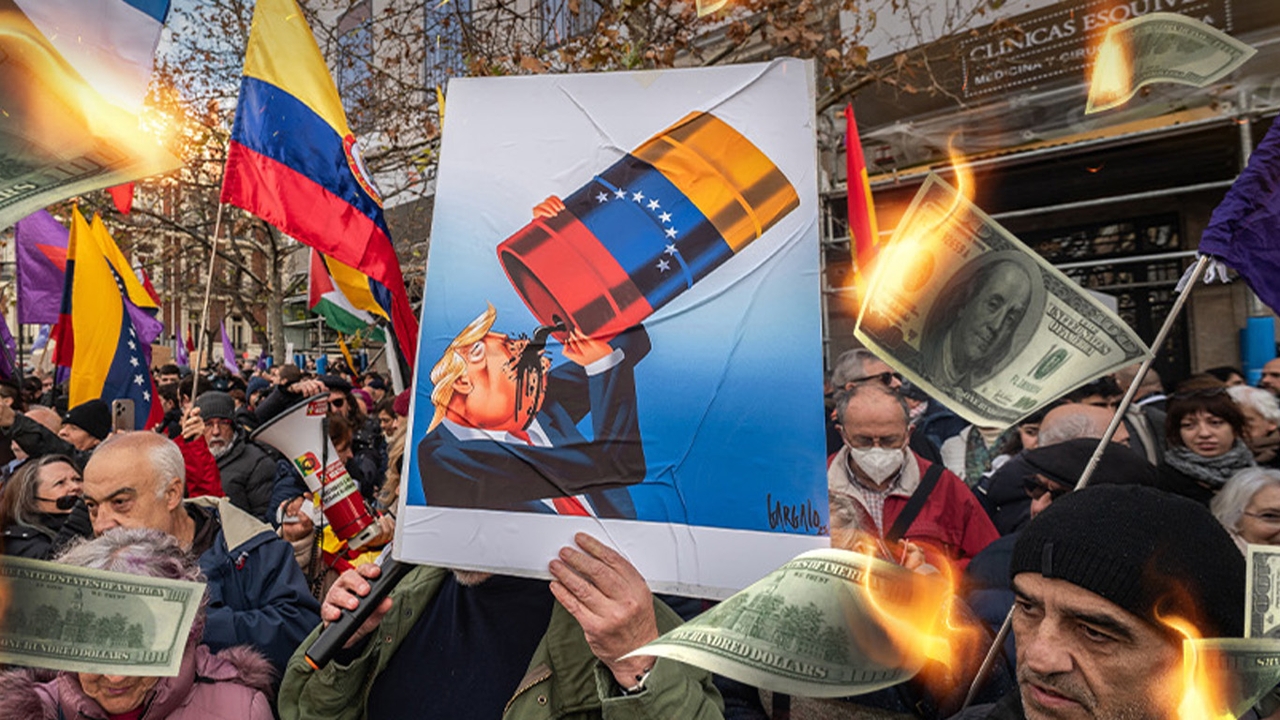
The latest confrontation between the United States and Venezuela is not merely a routine security or international political operation; rather, it reflects a red line that the US does not want any country to cross — the effort to reduce the monopoly power of the US dollar in the energy market, which shakes the foundations of trade and political power in the global system.
Venezuela, as one of the countries with the largest oil reserves in the world, has become a testing ground demonstrating the costs—economic, political, and security-related—of challenging the financial dominance of the US dollar.
Behind this tension is a series of interconnected moves, from shifting to the yuan and alternative currencies, to using stablecoins in energy trade, approaching the BRICS group, and discussing a new global financial order. All these are interpreted as part of the De-Dollarization process, which threatens not only economies but directly challenges the strategic power of the United States.
Assistant Professor Dr. Manoch Ari, a political science lecturer at the Faculty of Social Sciences, Srinakharinwirot University (SWU), illustrates why "oil" is directly linked to the survival of the US dollar. These two elements have been intertwined for so long that they gave rise to the system known as the "Petrodollar" (Petrodollar), a mechanism that propelled the United States to world superpower status and is a key reason behind the US attacking Venezuela to maintain its influence.
Assistant Professor Dr. Manoch explains that these two issues have long been linked. Looking back at the world trade and financial order of the past, it is clear that the strength of the US dollar grew alongside the rise of the US as a superpower.
After World War II, the United States established a global financial system called the Bretton Woods System, which pegged the US dollar to gold and other world currencies to the US dollar, making the dollar the center of the global financial system.
However, this system ended in the early 1970s when the US decided to sever the dollar's gold backing, leading to a floating currency era. Subsequently, the US created a new guarantee for its currency by linking the dollar to "oil."
A pivotal change occurred after the 1973 oil crisis, caused by the war between Israel and Arab countries known as the Yom Kippur War, where the US and Western nations supported Israel, angering Arab nations who then declared an oil embargo and raised prices sharply, severely impacting Western economies. In response, the US adopted three main strategies:
Since then, global oil trade has been conducted in US dollars, forcing countries to hold dollars for oil transactions. This sustained massive demand for the dollar and preserved the financial power of the US; as long as oil is priced in dollars, the currency continues to dominate the global economic system.
Assistant Professor Dr. Manoch continues, saying that the global geopolitical landscape has changed significantly. The world is no longer unipolar. Led by China and Russia, there are clear challenges to US power, especially in finance and currency. For example, China and Russia promote trade in currencies other than the US dollar, such as the yuan, ruble, or local currencies.
This process directly affects the dollar and has led many countries to seek alternatives, resulting in the formation of the BRICS group, a cooperation among five major emerging economies: Brazil, Russia, India, China, and South Africa, aiming to strengthen economic, political, diplomatic ties and counterbalance Western powers. They have pursued new financial and trade orders and are developing new currencies for the future.
Regarding the special operation to attack Venezuela ordered by President Donald Trump on 3 January, Assistant Professor Dr. Manoch believes the main reason for US intervention is not only to control Venezuela’s oil and supply chains but to "block China's influence" and "prevent the weakening of the Petrodollar system," which is the core of US power. Venezuela, with its massive oil reserves, has clearly indicated its De-Dollarization efforts,
including reliance on Russia and China, especially China as Venezuela's top oil buyer, and in many cases using other currencies like yuan, euro, ruble, or cryptocurrencies instead of the US dollar, as well as developing direct payment channels with China, bypassing international payment systems such as SWIFT.
These moves reflect efforts to reduce dependence on US dollar payments directly, making Venezuela a key concern for the US, especially considering Venezuela is in Latin America, which the US regards as its "backyard."
Assistant Professor Dr. Manoch notes strong similarities with the "Libya case" during Muammar Gaddafi’s leadership, who tried to establish a new financial system, including the idea of an African gold-backed common currency called the "Gold Dinar" for oil trade to reduce the dollar’s influence in Africa. Ultimately, he was overthrown, which many analysts believe was largely due to his challenge to the US dollar system.
In Venezuela’s case, although it did not attempt to create a new financial system directly, it is trying to survive US sanctions by using alternative currencies, joining new alliances like BRICS, and allying with countries leading the global De-Dollarization process.
The US justification for its operations in Venezuela involves drug trafficking and terrorism, which in reality have little connection to oil. However, this pretext provides the US with a "legal cover" to use military force without congressional approval under special anti-terrorism laws.
Assistant Professor Dr. Manoch views the use of military force as a hard power tool, typically a last resort. If other options existed, the US would avoid this approach. This reflects that the Petrodollar system is under severe pressure, declining, and may signal that "oil" is the last pillar supporting the dollar in the current global order.
"The US may have no other choice in competing with China and Russia and thus must use this method to prop up the Petrodollar system. Despite the negative image of aggression, the result is a display of military might, precision, and rapid action to send a warning—‘to kill the chicken to scare the monkey’—to deter other countries from following Venezuela’s path."
This incursion into Venezuela reflects not only US military power but also the fragility of the financial influence that the US has long dominated globally.
The real power of the US dollar lies not only in being a reserve currency but in controlling global payment systems like SWIFT, intermediary banks, and international clearing systems. This allows the US to sanction countries within these frameworks, prompting many nations to develop alternative payment methods to protect themselves and reduce reliance on the dollar reserve.
For example, China’s Cross-Border Interbank Payment System (CIPS) serves as key infrastructure for transferring funds and settling accounts in yuan (RMB). Meanwhile, groups like BRICS are considered experimental grounds for a new global system. The more alternatives available, the weaker US sanctions become.
A worrying phenomenon is the "domino effect" that may occur in Latin America, where many countries are leaning toward BRICS. Countries rich in natural resources, whether oil, minerals, or gold, stand at a critical crossroads of the new world order.
Assistant Professor Dr. Manoch says many countries are not outright abandoning the dollar but rather pursuing a balancing strategy — using the dollar alongside alternative currencies without tying themselves solely to the US, while expanding relations with China and Russia to enhance bargaining power. A clear example is Middle Eastern countries, which once relied almost entirely on the US but now neither sever ties nor fully entrust their future to the US alone.
However, those seeking to escape the dollar must ensure security guarantees. The key lesson from Venezuela is that challenging the dollar system equates to challenging US security power. Anyone attempting to exit the dollar system must be prepared for political, economic, and security shocks.
These phenomena are not distant. The expanding role of BRICS, promotion of the yuan in energy markets, and efforts to diminish the Petrodollar system indicate that the question is no longer if the world will move toward De-Dollarization, but how other countries will position themselves when this financial shift becomes a major security issue among great powers.
Read more
Follow the Facebook page: Thairath Money at this link -