

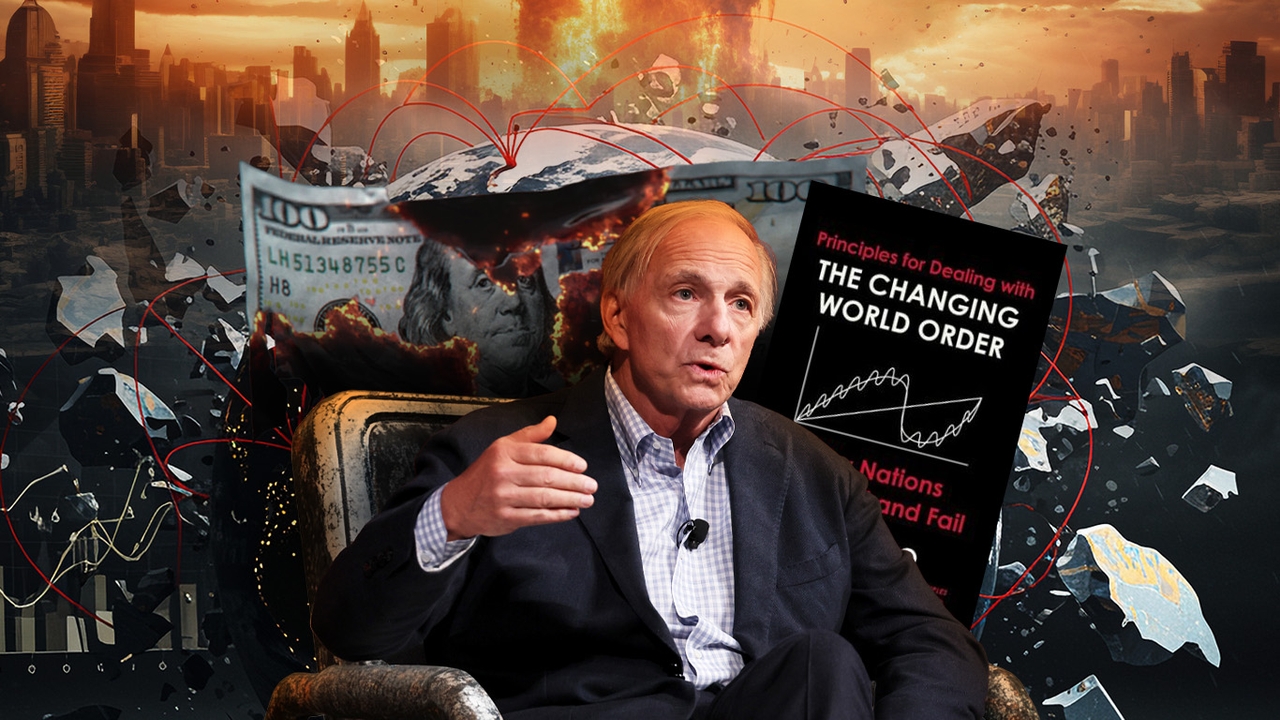
Recently, leaders of major powers have spoken in unprecedented agreement that the "world order" that has been upheld since 1945 has ended. At global forums such as the 2026 World Economic Forum and the Munich Security Conference, European and U.S. leaders have clearly stated that the world is entering a new era marked by great power competition.
German Chancellor Friedrich Merz declared, "The world order that has existed for decades no longer exists." French President Emmanuel Macron warned, "Europe must prepare for war because the old security structure is obsolete." Meanwhile, U.S. Secretary of State Marco Rubio affirmed, "The old world is gone," and we are entering a new geopolitical era.
But these voices are not only from politicians. Recently, Ray Dalio, billionaire investor and founder of Bridgewater Associates, one of the largest hedge funds globally, also confirmed the same direction, stating that the post-World War II world order has definitely collapsed.
From Dalio's perspective, the world is entering the final stage of the Big Cycle, the "sixth phase" or "period of disorder." This involves clashes among great powers and competition to set new global rules. This framework is taken from his famous book"Principles for Dealing with the Changing World Order,"where he explains international relations and the mechanics of world order by dividing the cycle into six phases.
When political and financial leaders agree on this issue, the key question now is not whether the world is changing, but how much this transition will disrupt the global economic and financial systems going forward.
"The Big Cycle of External Order and Disorder," Dalio explains that the world is now entering phase six, a time of chaos because universal rules cannot be effectively enforced. International organizations lack power, and great powers confront each other directly. Organizations like the UN will fail due to insufficient authority and funding compared to major powers. When interests conflict, the more powerful countries dictate the rules.
Dalio states that global dynamics are driven more by the "law of the jungle" than international law. Even if organizations claim to be above states, if major powers like the U.S. or China hold superior power, these bodies cannot truly govern global direction. There is no international police or courts to enforce penalties; ultimately, those with greater power set the rules.
These rules involve exerting power to pressure opponents through five interconnected forms of war:
Dalio cites the case study of the 1930s and World War II era, when the global depression caused internal crises in nearly every country, empowering populist authoritarian leaders such as the Nazis in Germany. Hitler adopted nationalist policies, canceled foreign debt payments, and printed large sums to build the military. Though risky, the economy initially rebounded with full employment and a soaring stock market.
Similarly, the militarist faction in Japan faced comparable conditions. Exports dropped nearly 50% between 1929-1931, the country went bankrupt, abandoned the gold standard, suffered currency devaluation, political chaos, and rising nationalism and militarism. Japan began invading neighbors and expanding power in China and Asia to seize resources.
Meanwhile, after 1929, American banks faced severe bad debts, reduced global lending, and the economy contracted, leading to protectionist policies like the 1930 Smoot-Hawley Tariff Act, which worsened the global downturn. Raising tariffs during economic downturns was common but lowered global efficiency and fueled trade wars.
Soon after, the U.S. enacted Lend-Lease to supply arms to Britain, the Soviet Union, and China, while sanctioning Japan, especially by cutting oil exports that accounted for 80% of Japanese usage. Japan faced a dire choice: expand to secure energy or confront the U.S., which led to the 1941 Pearl Harbor attack and full-scale World War II.
Dalio’s examples illustrate how the convergence of three major cycles — money and credit, domestic disorder, and international disorder — pressures nations to adopt harsh economic and political policies to protect national interests and survival, often resulting in mutual distrust (Prisoner’s Dilemma).
These dynamics triggered world wars and laid the foundation for a new world order, paralleling current conditions and possible future events, especially with the U.S. and China engaged in economic warfare that could escalate to military conflict.

If the world is entering the sixth phase of Dalio’s Big Cycle, the question arises: what financial scenarios might unfold? We can outline five broad scenarios:
In phase six, the line between economics and military blurs. Finance becomes the frontline before actual shooting wars.
The world shifts from prioritizing maximum efficiency to prioritizing maximum security, which is much costlier. Military spending, relocating production, and protecting industries raise long-term national costs.
As trust in the global financial system erodes, the unified global finance system fractures into camps: Western financial systems, China’s system, and other trade groups. The dollar faces greater challenges.
Historical lessons show stock markets won’t move solely by economic fundamentals but by a nation’s chances of victory or defeat in various battlefields.
In an era of risky fiat currencies, tangible assets essential for state survival become most valuable.
In short, as the U.S.-centered old world order wanes, the global financial system will fundamentally change. The previously dollar-reliant system, free trade without barriers, and tightly linked global supply chains are giving way to a divided world.
Finance will be weaponized more frequently. Sanctions, payment system exclusions, and reserve freezes will become standard tools of great powers. Meanwhile, capital flows will be more cautious. Countries will accumulate gold, diversify reserves, and reduce reliance on any single currency.
We may witness a multipolar financial system. The dollar remains important but no longer monopolizes. China will promote the yuan, and developing countries may create alternative payment mechanisms. Governments must enhance strategic security amid volatile inflation and turbulent capital markets, a challenge to navigate during this transition.
Dalio concludes that the surviving countries won’t necessarily be the richest, but the most resilient — maintaining domestic production capacity and public trust in their systems. If great powers persist in destructive competition, global finance will fracture with permanent geopolitical risks. But if they choose negotiation and win-win cooperation, a new cycle may arise without major war.
Follow the Thairath Money Facebook page at this link -