

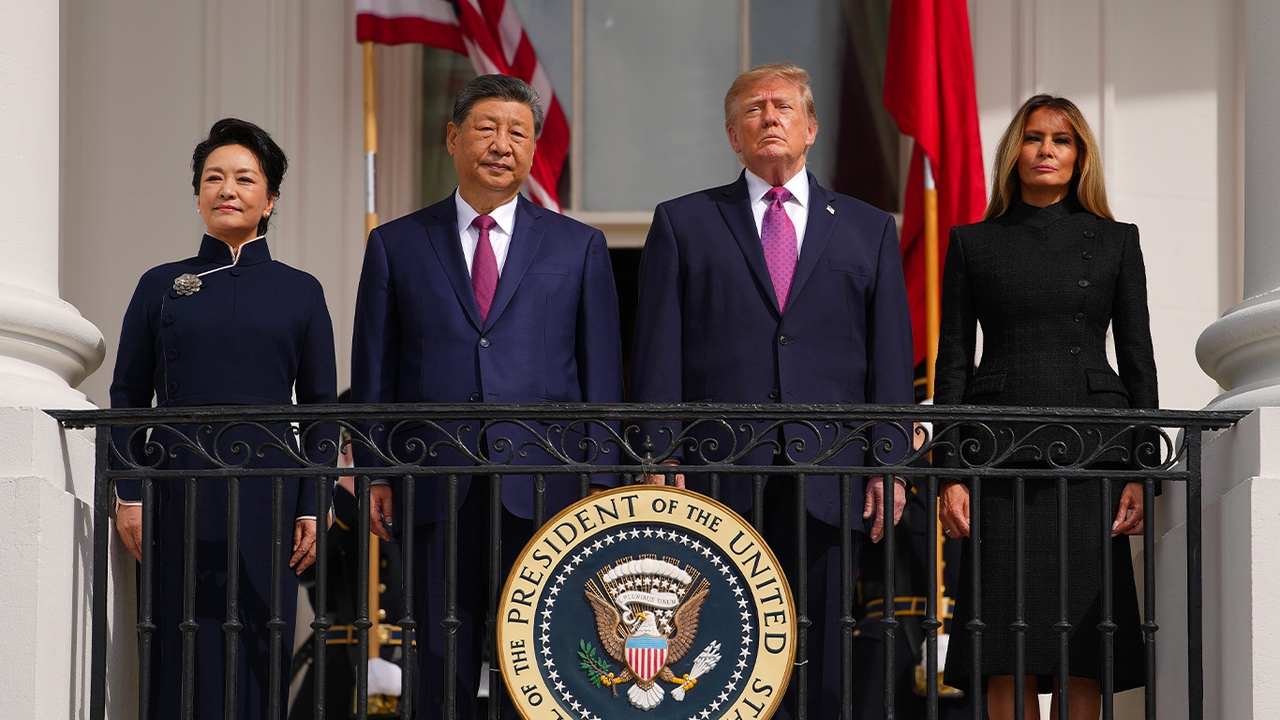
China's President Xi Jinpingreturned to the White House amid a pivotal moment in U.S.-China relations.
His visit from 23 to 25 September 2026 marked Xi's second State Visit to the U.S., welcomed with great ceremony, including former President Donald Trump personally greeting him at Joint Base Andrews—a rare protocol for foreign leaders.
On 24 September, both leaders attended the State Arrival Ceremony and the official White House welcome, followed by high-level discussions and a State Dinner that brought together technology leaders and U.S. financial market executives in one event.
Although the summit did not conclude with a major agreement to end the conflict between the two powers, it sent important signals to the global economy, financial markets, and the technology sector.
The core outcome was extending the trade truce until 10 January 2027, providing time for both sides to negotiate outstanding issues such as tariffs, U.S. product purchases, rare earth minerals, and technology restrictions. This time, AI was elevated as a key area for cooperation to manage risks alongside competition for leadership.

The most notable topic during talks was President Xi invoking the "Thucydides Trap" concept—highlighting the risk that competition between great powers could escalate into military conflict and potentially war.
This concept describes the danger when an established power confronts a rising power, with rivalry potentially leading to conflict. Currently, China is expanding its economic and technological influence, while the U.S. remains the established power dominating global economy, technology, and security.
Xi emphasized that both the U.S. and China benefit from cooperation and lose from confrontation. He proposed regular military communications and the development of crisis communication and prevention mechanisms to build conditions that avoid conflict.
Trump referenced the shared history between the two nations to underscore the potential for cooperation, stating that the U.S. and China could achieve much together based on shared interests. He cited their World War II alliance against Japan as an example.
Economically, the most tangible result was the agreement to extend the trade truce by two months, from the original November deadline to 10 January 2027.
U.S. Treasury Secretary Scott Bessent noted that this extension gives both sides more time to find economic solutions. For businesses, the outcome reflects a familiar situation: tariffs remain low in the short term, but companies must still operate amid policy uncertainties that could change. For financial markets, the extension may reduce short-term risks as global companies adjust supply chains and evaluate trade policies.
However, while it reduces the immediate threat of a renewed trade war, it does not mean the economic and technological conflicts will end right away. This truce is not a permanent agreement, as key issues remain unresolved—tariffs, U.S. agricultural purchases, rare earth exports, technology access, and chip and semiconductor restrictions.
AI became a prominent topic reflecting the complexity of U.S.-China relations, as both leaders expressed differing perspectives.
On one hand, both countries are fiercely competing to lead in AI. The U.S. is restricting access to advanced software and manufacturing equipment to slow China's development of cutting-edge technology, while Chinese companies are accelerating their AI models and infrastructure to close the gap. On the other hand, both recognize the need for communication channels regarding AI safety.
Prior to the meeting, U.S. officials proposed establishing a notification mechanism between the two countries for AI-related events with national security implications, as well as discussions on transparency and risks of AI misuse.
Xi stated that as leading AI nations, the U.S. and China must jointly manage the growth of this technology. Both countries can advance AI discussions and collaborate to prevent misuse, presenting an intriguing scenario where they compete to create the most powerful AI while seeking ways to prevent it from exacerbating tensions.

The State Dinner at the White House highlighted the role of technology and capital, as Trump invited Silicon Valley leaders and U.S. financial market executives to join Xi Jinping in one event.
Tech leaders included Jensen Huang of Nvidia, Tim Cook of Apple, Lisa Su of AMD, Sam Altman of OpenAI, Sundar Pichai of Google, along with executives from Meta, Microsoft, Amazon, and Tesla. On the financial side were Jamie Dimon of JPMorgan, Jane Fraser of Citigroup, David Solomon of Goldman Sachs, and Stephen Schwarzman of Blackstone.
Notably, Jensen Huang and Lisa Su represent industries directly affected by U.S. chip export controls. Nvidia must manage its relationship between the Chinese market and U.S. technology restrictions. This seating arrangement underscored that AI is not just a Silicon Valley issue but involves capital, markets, and national strategy, all connected closely with publicly traded companies.

Overall, the meeting between Donald Trump and Xi Jinping reflects a new pattern in the relationship between the two powers, aiming to set boundaries that allow competition to proceed without escalating into severe conflict.
In a world where the U.S. and Chinese economies are interconnected, AI technology depends on global capital and supply chains, and companies like Nvidia, Apple, AMD, Microsoft, and Google, along with major financial institutions, have stakes in the direction of both countries. The key question going forward is whether the two nations can compete in AI, chips, and technology without letting rivalry turn into a global conflict.

Follow economic news and government policy with ThairathMoney for "Better Finance, Better Life" at
https://www.thairath.co.th/money/economics/thai_economics
Follow Facebook page: Thairath Money at this link https:// www.facebook.com/ThairathMoney