

The growth of AI may become a major challenge for fiscal systems worldwide, even though the technology boosts economic productivity, lowers business operation costs, and creates new investment opportunities.
However, if governments continue relying on traditional tax structures that depend mainly on labor income, while economic value gradually shifts toward capital, technology, and large AI companies, there is a risk that government tax revenues will decline even as budgetary demands rise.
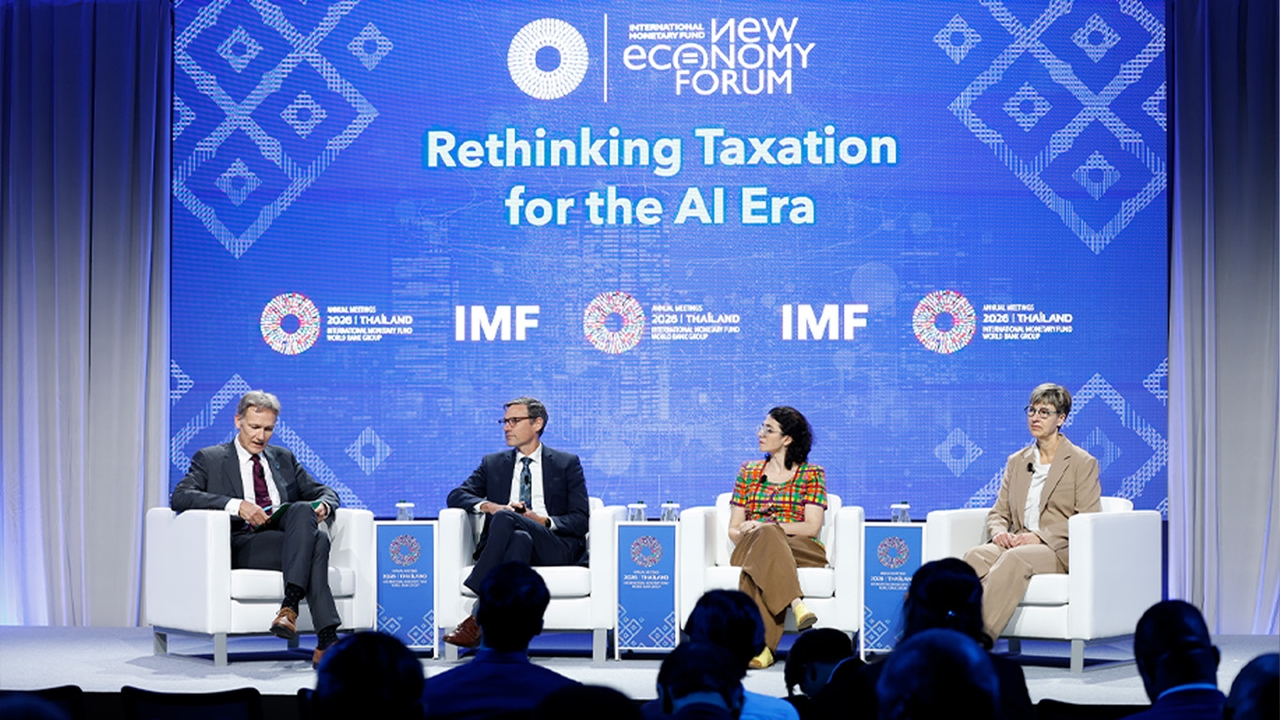
This issue was raised for discussion at the New Economy Forum: Rethinking Taxation for the AI Era, held during the IMF-World Bank Annual Meetings 2026, with Ruud De Mooij, IMF Deputy Director for Fiscal Affairs, moderating the session.
The forum included Adrian Brown, founder and CEO of Windfall Trust; Ioana Marinescu, public policy professor at the University of Pennsylvania; and Miranda Stewart, tax law professor at New York University and the University of Melbourne, who exchanged views on the future of taxation in the AI era.
The key point of the discussion is that governments worldwide need to begin assessing fiscal risks in advance and reviewing tax structures to align with the changing economy.
Adrian Brown, founder and CEO of Windfall Trust, noted that AI can help the economy grow even if government tax revenues fall, because many countries, especially developed ones, rely heavily on labor income taxes.
If AI reduces employment and wages, this tax base will be pressured, while returns from capital and profits of technology companies may not be taxed at the same level.
Additionally, AI industry profits tend to concentrate in large companies and certain countries; if profits are shifted abroad, governments in labor market-affected countries may lose tax revenue opportunities.
Meanwhile, AI could lower prices of goods and services or create free-to-access services, further pressuring tax bases from certain consumption categories.
On the other hand, increased unemployment may force governments to spend more on social support. Brown revealed that simulations in developed economies show that if 30% of global labor productivity is replaced by AI within 10 years, government revenues could decline by about 3-4%, rising to 8% when factoring in profit shifting abroad. Combined with rising welfare costs, fiscal pressure could reach double digits.
He therefore proposed that governments start conducting Fiscal Stress Tests to evaluate how tax and welfare systems can handle revenue drops and expenditure increases without waiting for clear AI impacts.
Ioana Marinescu, public policy professor at the University of Pennsylvania, pointed out that AI taxes could be a temporary tool to help workers unable to retrain or reskill, but if employment decline is a long-term problem, slowing AI alone won't suffice; governments must broaden tax bases and improve social protections simultaneously.
She suggested taxing AI imports such as chips and processing power could slow technology adoption and spread employment impacts over a longer time, though this would slow economic growth.
Taxing AI usage, like a Token Tax, might delay business adoption, but modeling she presented showed peak unemployment levels would be similar, just delayed, with economic benefits of AI postponed as well.
. Miranda Stewart, tax law professor at New York University and the University of Melbourne, believes governments could consider taxing AI services similarly to other digital services, requiring legal reforms to clearly identify transactions, taxpayers, and tax liability points.
However, taxing AI is not a one-size-fits-all solution; slowing technology may ease labor impacts but also delays economic gains from AI.
Brown emphasized that governments should revisit existing tax structures, especially disparities between labor income and capital returns. If labor taxes are disproportionately higher, it may encourage businesses to invest in automation to replace workers. Governments should consider existing tools like capital income tax, wealth tax, consumption tax, and inheritance tax to balance revenue bases more evenly.
Another notable issue is the policy contradiction where governments promote AI investment through tax incentives while simultaneously worrying about AI accelerating labor displacement.
Marinescu noted that many countries compete to attract AI and data center investments via tax breaks, and if AI investments receive greater incentives than general investments, automation transitions may accelerate, boosting productivity and economic benefits but increasing labor pressure.
. Stewart stated that corporate income tax remains important, especially as AI profits concentrate in multinational companies and certain countries. Governments must enhance international cooperation to revisit rules on taxing profits in digital business chains, including value from users, data, and consumer markets, to prevent economic returns escaping tax bases.
Stewart observed that the challenge of taxing AI companies goes beyond profit taxation to identifying sources of returns from intangible assets like software, algorithms, data, and intellectual property, which can create immense value but complicate international tax rights.
International cooperation is increasingly vital through OECD tax discussions and the UN tax convention framework to determine how countries hosting users, data, or consumer markets should appropriately tax digital company profits and reduce risks of profit or IP shifting to low-tax jurisdictions.
. Stewart also proposed that governments consider appropriately pricing resources essential for AI inputs such as energy, water, and land, which are key costs for data centers.
This approach reflects that AI-era tax design must consider social and environmental costs, not just labor income and corporate profits.
The key takeaway from this discussion is that governments must prepare for the possibility that AI will shrink tax bases from labor and certain consumption types while increasing the importance of capital and technology profits.
Response strategies include reviewing labor and capital taxes, taxing AI services, enhancing international cooperation, and improving tax authority efficiency.
Simultaneously, governments should reassess tax incentives used to attract AI investments to avoid excessive labor pressure and prepare retraining and welfare systems to help people adapt, especially those who may struggle to reenter the labor market.
The goal is not to stop AI but to build economic and fiscal systems that can benefit from the technology while maintaining sufficient government revenue to support citizens long-term.
Read economic and policy news with ThairathMoney to help you "Better Finance, Better Life" athttps://www.thairath.co.th/money/economics/thai_economics
Follow the Facebook page: Thairath Money at this linkhttps://www.facebook.com/ThairathMoney