

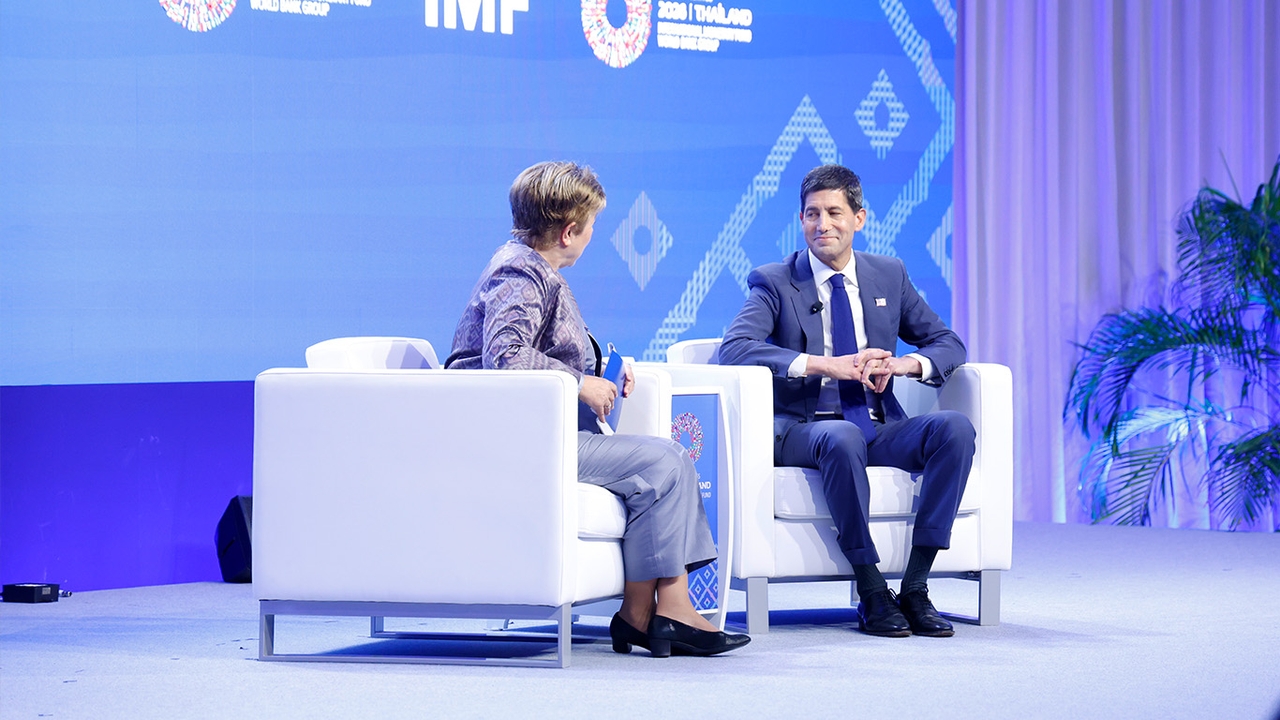
Worldwide attention focused on the MD’s Fireside Chat with Federal Reserve Chairman Kevin Warsh, held between Kristalina Georgieva, Managing Director of the International Monetary Fund (IMF), and Kevin Warsh, Chairman of the U.S. Federal Reserve (Fed), during the IMF-World Bank Annual Meetings 2026 today.
The discussion reflected perspectives on the global economic direction amid geopolitical uncertainties, inflationary pressures, and a significant acceleration in AI technology investment.
. Kevin Warsh believes the global economy is transitioning from an era when many countries worried about structurally low growth to one of accelerating investment accompanied by inflation challenges, which central banks must closely monitor.
Kevin Warsh stated that economic assessments should not rely too heavily on past data, since reported figures often reflect situations that have already occurred.
Policy makers must evaluate current realities—including output, employment, and inflation—while also considering future risks to ensure policies align with evolving conditions.
Regarding recent economic conditions, he observed that the overall situation aligns with Federal Reserve expectations, highlighting key points:
The Federal Reserve prioritizes price stability and has previously reduced monetary policy easing but emphasized it will not pre-commit to decisions for upcoming meetings this year.
Kevin Warsh said the emergence of AI technology may be one of the most significant economic changes for both the U.S. and global economies during his lifetime, requiring serious, careful, and responsible consideration.
He explained that AI’s economic impact does not occur uniformly; initially, investment in AI technology may drive demand for goods, services, capital, and resources before productivity and capacity benefits become clear.
This timing mismatch could cause inflationary pressures during the transition, though AI has long-term potential to boost productivity and economic growth.
At the same time, Warsh noted that AI’s near-term impact on the labor market remains uncertain and needs monitoring, especially over the next 12–18 months, as it is unclear how technological changes will affect employment and which businesses and workers will benefit most.
Beyond economic impacts, Warsh sees AI potentially transforming central bank operations by enabling new analytical tools that process diverse economic data sources, improving policymakers’ ability to evaluate emerging trends.
However, Warsh warned the path toward a more productive economy will not always be smooth, as business, labor, and economic system adjustments may not happen simultaneously.
Therefore, he stressed the importance of studying AI’s impact on productivity and employment, noting the establishment of a task force to explore these issues and related policy questions to inform the Federal Open Market Committee’s (FOMC) decisions.
Georgieva observed that AI’s growth requires policymakers to consider the relationship among three key factors: inflationary pressures, risks to financial stability, and future productivity opportunities.
However, Warsh did not specify which factor should be prioritized in all situations but emphasized that central banks must consider possible outcomes from multiple scenarios, especially impacts on core goals of price stability, full employment, and financial system risks.
The private sector is continuously investing in new technologies, while central banks must assess how such changes might affect the economy and financial stability, including worst-case risks and possible mitigations.
Another key point is that the Fed’s mission is not limited to monetary policy; Warsh noted that about 75% of Fed staff work outside direct monetary policy roles, handling financial institution supervision, regulation, payment systems, and consumer protection.
Warsh believes the Fed’s credibility depends on the functioning of all its components; if any part experiences problems, it could affect overall trust. Therefore, over the next 100 days, he intends to balance all Fed responsibilities rather than focusing solely on interest rate decisions.
Toward the end of the discussion, Warsh noted that many regions worldwide continue to show greater economic resilience than expected 5-6 months ago, despite ongoing geopolitical risks.
However, inflation remains a shared challenge for many countries, and global policymakers remain committed to price stability, leading many central banks to pursue tighter monetary policies in unison, with no country able to avoid addressing inflation.
Regarding the U.S. economy, he expressed confidence it can navigate this transition strongly and build a foundation for sustainable long-term growth, provided policies are well-calibrated to current realities and open to new approaches to manage ongoing changes.
Read stock and investment news with Thairath Money to help you achieve “Good Finances, Good Life” athttps://www.thairath.co.th/money/investment
Follow the Facebook page: Thairath Money at this linkhttps://www.facebook.com/ThairathMoney