

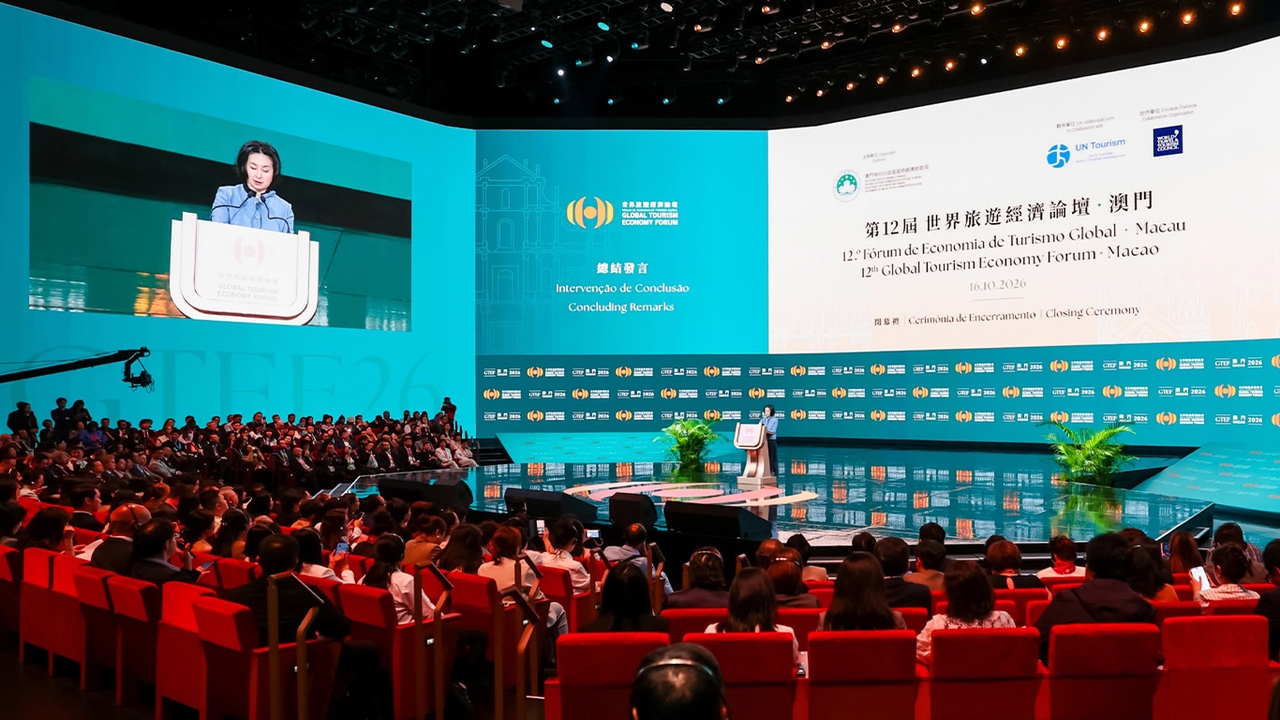
The 12th Global Tourism Economy Forum (GTEF) held in the Macau Special Administrative Region under the theme “Crisis-Resilience-Evolution” was not merely an annual forum but a strategic milestone signaling a major shift in the global tourism industry—from success measured by "tourist numbers" to a focus on "economic value and quality growth."
The key driver of this transformation remains the Asian giant, the People’s Republic of China, using Macau as a springboard to connect the global economy. Meanwhile, Beijing is aggressively expanding visa exemption measures, now covering 50 countries, alongside a 240-hour visa-free transit policy.
This policy allows eligible citizens from designated countries to transit and stay in China for up to 240 hours (10 days) without a visa before continuing to a third country or region, along with removing structural barriers such as digital payment systems for foreigners.
However, the more interesting economic dimension lies in redefining how China attracts foreign direct investment (FDI) in tourism—not merely raising funds for hotels or entertainment venues but positioning foreign investors as marketing partners from the start to align mutual benefits.
This strategy integrates the power of the Greater Bay Area (GBA) network, connecting nine economic cities in Guangdong Province with Hong Kong and Macau.
Ho Hau Wah, Vice Chairman of the National Committee of the Chinese People’s Political Consultative Conference and Chairman of the Global Tourism Economy Forum, emphasized the significant development of this year’s forum, calling it a landmark in the evolution of GTEF.
Following the great success of the 11th GTEF held in Harbin, Heilongjiang Province, China, from 15–17 December 2025,
this year’s forum builds on that success under the concept “Crisis-Resilience-Evolution: Building a Tourism Economy for an Inclusive Future,” reflecting current global conditions. As an international platform rooted in Macau, GTEF aims to align with the SAR’s overall development direction while driving new momentum for Macau’s economic diversification.

Pansy Ho, Vice President of the China Federation of Industry and Commerce and Vice President and Secretary-General of the Global Tourism Economy Forum (GTEF), stated that modern tourism must move beyond segmented service sales toward delivering "experience-driven tourism" of high value, using technology and AI as infrastructure to facilitate convenience while preserving unique cultural stories and human charm to create sustainable appeal and higher per capita spending.
Furthermore, adapting in the new tourism industry requires higher skills; operators cannot simply rent rooms or drive transport services alone but must evolve into full-service providers. For example, drivers should narrate local history and unique cultural dimensions—elements that basic AI data cannot replace.
Similarly, experiential retail businesses see consumers seeking true value, art, and design stories rather than just trend-driven or limited-edition products. These concepts will be key to gaining future business advantages.
China’s visa policies have become a major focus in the global tourism industry. It began unilateral visa exemptions in 2023 and now covers travelers from 50 countries who can stay up to 30 days for tourism, business, family visits, international exchanges, or transit.
Additionally, China extends 240-hour visa-free transit to enhance convenience and flexibility for international travelers, including countries across Europe, Asia, the Middle East, and Latin America. These measures reflect China’s intention to open further to global tourists and reinforce Macau’s role as a gateway linking China with foreign markets.
Pansy Ho does not see Macau’s success as permanent without effort. She believes Macau must continually develop itself to maintain its position in the global tourism market, investing in culture, service, technology, and international relations.
Equally important is remembering that travelers seek not only convenience but also experiences that evoke feelings and lasting impressions.
For Thailand, as a key strategic partner of China, the developments at GTEF open a major economic opportunity window. China’s regional integration model shows Thailand should not view tourism as a competition for visitors alone but can elevate to a “partnership” with shared destinations.
Building on visa-free agreements and rail connectivity through China’s Belt and Road Initiative (BRI)—a project linking land and rail networks from China to Southeast Asia, Central Asia, and Europe—
Thailand can design long-term cross-border travel packages to attract high-spending tourists from Europe, the Middle East, and America to visit the GBA cities and continue on to Thailand.
Moreover, China’s openness to bilateral joint investment offers a golden opportunity for leading Thai hotel, service, and wellness groups to invest or expand brands in the Chinese market, meeting the growing demand for cultural and health tourism.
Meanwhile, Thailand’s tourism sector must quickly adapt to global trends, shifting from dependence on mass tourists to value-driven tourism by upgrading service workers’ skills to convey cultural experiences that AI cannot replicate, turning visitor numbers into sustainable economic benefits at the grassroots level.
Read more about technology, innovation, and Digital Transformation with ThairathMoney to help you achieve “Better Finance, Better Life” athttps://www.thairath.co.th/money/tech_innovation
Follow the Facebook page Thairath Money at this link -https://www.facebook.com/ThairathMoney