

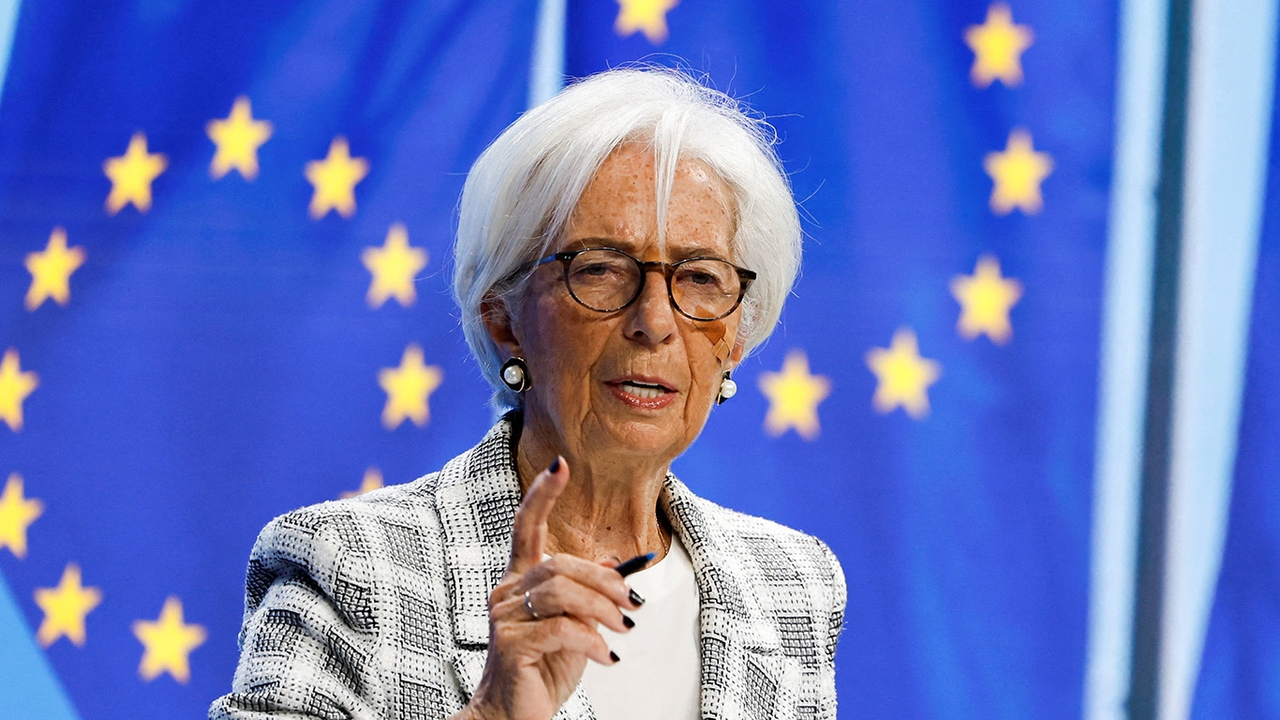
After assuming the position of President of the European Central Bank (ECB) in 2019, over seven years Christine Lagarde faced some of the most significant economic challenges in European history, including the COVID-19 pandemic, the Russia-Ukraine war, an energy crisis, and soaring inflation that forced rapid interest rate hikes. However, the journey of the first woman to lead the ECB is now approaching another turning point.
On 29 October 2026, the ECB announced that Lagarde will step down on 7 February 2027, nearly nine months before her original eight-year term was due to end in October of the same year. This decision comes at a time when Europe's economy faces ongoing uncertainty, including inflation pressures, energy price risks, and financial market volatility amid upcoming political changes.
Lagarde stated that she wants freedom to express her views and engage in global issues beyond monetary policy, which the ECB presidency's neutrality obligations restrict, limiting her ability to fully comment on political and social matters.
Her early resignation is not just the end of her role as ECB president but also raises questions about the future direction of this influential financial institution and European monetary policy going forward.
Her early resignation thus marks not only the end of her ECB leadership but also opens questions about the institution’s global economic influence and the future of European monetary policy.
Thairath Money invites readers to revisit Christine Lagarde's more than seven-year journey, examining her achievements and lessons amid ongoing crises, while watching who will succeed her and the direction the ECB will take next.
Before becoming ECB President in 2019, Lagarde’s career path differed from typical central bank governors, as she did not start in economics or finance but came from a legal background. She began as a business law attorney and rose to senior executive at Baker McKenzie, a global law firm with offices worldwide.
She then entered French politics, serving as Minister of Trade and Minister of Economy and Finance from 2007 to 2011, during the global financial crisis.
In 2011, she made history as the first woman appointed Managing Director of the International Monetary Fund (IMF), during Europe’s sovereign debt crisis. She played a key role coordinating international cooperation to stabilize the global economy before being elected ECB President in 2019, succeeding Mario Draghi and becoming the first woman to hold the position.
Leading two major global financial institutions, IMF and ECB, established Lagarde as one of the most influential women in international economics. Forbes ranked her the world’s second most powerful woman in 2019 and 2020. Unlike technical central bank leaders, her legal, political, and diplomatic experience helped bridge differing economic interests among Eurozone countries.
1. COVID-19: Supporting Europe's economy from collapse
One of Lagarde’s earliest and biggest tests was the 2020 COVID-19 pandemic, which halted economic activity globally, causing many businesses to lose revenue and financial markets to become highly volatile.
Under her leadership, the ECB launched the Pandemic Emergency Purchase Programme (PEPP), a bond-buying scheme to maintain liquidity and reduce borrowing costs for governments and private sectors, with a ceiling of 1.85 trillion euros.
This measure was crucial for stabilizing bond markets and ensuring monetary policy transmission across Eurozone members during the crisis. However, Lagarde’s initial statement in March 2020 that "the ECB is not here to close spreads" caused market concern and a sell-off in Italian bonds, prompting her to clarify and adjust communications later.
2. Inflation war: From liquidity injection to major interest rate hikes
As the economy began recovering from COVID-19, Europe faced a new crisis from the 2022 Russia-Ukraine war, impacting energy, food prices, and supply chains, which drove Eurozone inflation sharply higher.
The ECB shifted its monetary policy from low interest rates and asset purchases to rapid rate hikes to contain price pressures. This was among Lagarde’s most challenging periods since raising rates helps control inflation but also raises borrowing costs for businesses and households, potentially slowing fragile growth.
Initially, the ECB was criticized for underestimating inflation risks but subsequently accelerated policy tightening. These measures contributed to inflation returning to the 2% target by late 2024, though energy prices and geopolitical risks remain key challenges for Europe.
3. Laying foundations for the future: Digital euro and new financial infrastructure
Beyond short-term crisis management, Lagarde pushed the ECB to prepare for changes in the global financial system, especially the shift to a digital economy. A key project is the Digital Euro, aiming to develop a form of central bank money accessible to the public via digital means.
Its main goal is to preserve the role of central bank money in an economy where payments increasingly move to digital platforms, while reducing reliance on foreign payment providers. Meanwhile, the ECB is also developing infrastructure for payments and central bank money use in asset transactions based on tokenisation technology.
Lagarde also advocated for central banks to focus on climate change risks that could affect inflation, financial stability, and the economy long-term.
Although some initiatives remain under development with outcomes not fully measurable yet, these efforts show she viewed the ECB’s role as more than setting interest rates; she aimed to prepare financial structures for the new economy.
Lagarde’s early departure triggers not just a leadership change at the European Central Bank but also intensifies attention on the selection process for the new ECB President. This transition is particularly notable as it occurs ahead of the French presidential election in April 2027.
Lagarde’s exit on 7 February 2027 allows the current European Union leadership to select her successor before the French election, at a time when opinion polls show far-right National Rally candidate Marine Le Pen with strong support.
Timing matters because French President Emmanuel Macron, a key figure in choosing the ECB President, faces political shifts that could affect France’s relationship with the EU and regional economic and fiscal policies.
Le Pen has previously expressed interest in discussing the ECB’s role and said that if elected, she would push the central bank to intervene to reduce France’s interest cost burdens, a stance that markets are watching closely.
This transition tests the EU’s ability to uphold the principle that the ECB must conduct monetary policy independently from national governments and politics.
Top candidates to succeed Lagarde include Klaas Knot, former Governor of the Dutch central bank, and Pablo Hernández de Cos, former Governor of the Bank of Spain, who currently serves as General Manager of the Bank for International Settlements (BIS).
Both have strong monetary policy experience and international recognition, reassuring markets about a stable ECB leadership transition.
However, this selection is more complex than choosing a single president, as the ECB faces simultaneous transitions in several senior positions.
For example, Executive Board member Isabel Schnabel will leave in early January 2027, and Chief Economist Philip Lane’s term ends in May the same year.
Thus, the EU must manage multiple ECB leadership placements amid economic uncertainties including energy-driven inflation, borrowing costs, and public debt risks.
Markets seek not only a new president’s name but also a transparent, systematic appointment process that preserves ECB independence and maintains global financial confidence regardless of who succeeds Lagarde.
Over seven years, Lagarde’s tenure included both successes and controversies, but undeniably she led the ECB through multiple crises, each requiring different tools and decisions.
From injecting liquidity to support the economy during the pandemic, to raising interest rates to fight inflation, and laying groundwork for digital financial systems, her leadership reflected a central bank adapting to global economic shifts.
However, ECB’s challenges continue: Europe faces fragile growth, energy risks, geopolitical conflicts, and competition with other economic powers in technology and finance. The new leader must balance inflation control, economic support, and enhancing Europe’s competitiveness simultaneously.
Ultimately, a central bank leader’s legacy depends not just on tenure length but on the foundations laid for the institution and how well the economy is prepared for future crises.
Read economic and policy news with ThairathMoney for better financial life at
Follow the Facebook page Thairath Money at the link https:// www.facebook.com/ThairathMoney