

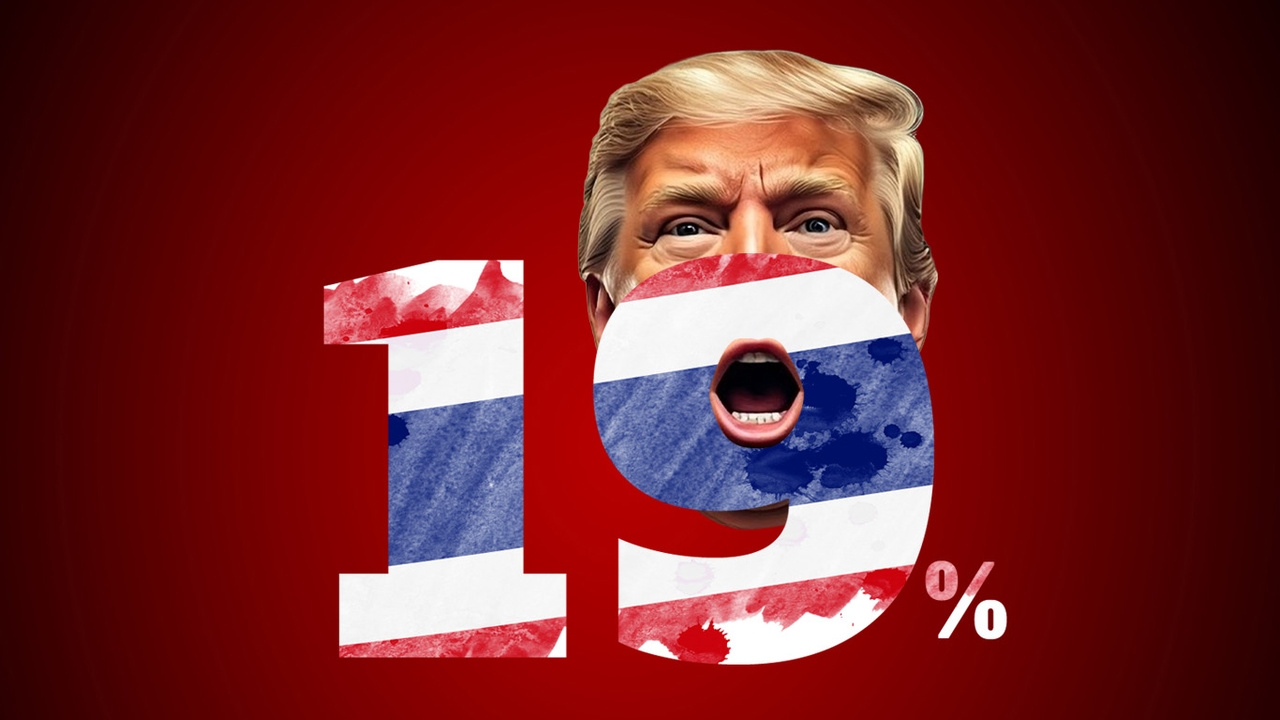
The major news attracting widespread attention is that Thailand has successfully closed a trade negotiation deal with the United States, after months of uncertainty over facing import tariffs as high as 36%, as previously announced by US President Donald Trump in April 2025.
However, on 1 August 2025, the latest round of negotiations concluded. Thairath Money has summarized the key details and potential impacts on Thailand here.
The latest statement from the White House (1 August 2025) concluded the import tariff rates that the US will impose on each country’s products, for example, Vietnam at 20%, India at 25%, while Malaysia, Cambodia, and Thailand will be subject to a 19% rate, effective from 1 August 2025 onward. . Meanwhile, for the anti-transshipment measure, the US will maintain a 40% tariff rate for all countries. This aims to prevent Chinese goods from being routed through low-tariff countries to the US. Further details on Thailand’s negotiation remain to be monitored.
Overall, although it is good news that Thailand avoids the previously announced 36% tariff, it may not always be beneficial for Thailand.
Methus Rattanasorn, Senior Economist at TISCO Economic Strategy Unit (TISCO ESU), said that Thailand’s reciprocal import tariff agreement with the US at 19% is a satisfactory deal because the tariff rate is comparable to neighboring countries, allowing Thailand to maintain competitiveness in the US market.
However, the 19% tariff is still much higher than the previous average rate of just 2%, representing nearly a tenfold increase. Previously, Thai businesses paid almost no tariffs, so this increase raises costs for Thai operators and may negatively impact export volumes in the future.
Based on this conclusion, TISCO ESU expects Thailand’s economy to grow by 1.9% in 2025, up from the previous 1.6%, and 1.6% in 2026, up from 1.4%, assuming Q2 2025 growth is close to or above the forecast of 2.4% year-on-year. However, actual figures will depend on other risks such as domestic political situations, border disputes with Cambodia, and tourism recovery.
Dr. Amorntep Jawala, Assistant Managing Director and Research Executive at CIMB Thai Bank (CIMBT), told Thairath Money that a positive result of facing a 19% tariff is that Thailand is likely to avoid a technical recession, which was previously expected as GDP in Q3 and Q4 2025 might contract quarter-on-quarter.
CIMBT maintains its 2025 GDP forecast at 1.8%, assuming tariffs exceed 19%, and believes monetary and fiscal policies will support the economy. Yet, forecasts may be adjusted depending on changing conditions, while the economy is expected to slow due to ongoing risks.
Looking deeper at Thailand’s 19% tariff negotiation, part of this is believed to result from reducing US import tariffs to 0% on most Thai goods, unlike "all items" as applied to Vietnam and Indonesia. However, Thailand may need further talks on US imports such as gas and agricultural products, and might open markets further to US companies in services and investment.
Therefore, while the 19% tariff deal is better than 36%, likely limiting export contraction expected in the second half of 2025 (when exports were anticipated to shrink due to prior export acceleration), Thai businesses and exporters cannot be complacent due to higher costs and increased market competition from US and regional products.
Dr. Amorntep Jawala added that despite clearer reciprocal tariff arrangements between the US and Thailand, as well as other countries, the Thai economy remains at risk depending on the outcome of US trade negotiations with China, a major trading partner for Thailand and ASEAN.
"Once the US ends trade conflicts with other countries, the next focus will be accelerating negotiations with China. Currently, the US has paused tensions with China to conclude deals with others. Once done, a full-scale trade war with China will resume. If the previous pattern continues, tariffs currently over 30% could rise further, impacting US consumers. Today’s situation is less severe, and the US economy is expected to slow down."
Regarding Thailand, the US uses transshipment measures to prevent export misclassification. However, modern global supply chains mean no product is made entirely in one country, and assessing the value-added origin is challenging. Therefore, it remains to be seen which products and to what extent these rules will apply, potentially disrupting trade between China, Thailand, and ASEAN. Thus, Thailand’s initial solution remains long-term: accelerating investment to enhance competitiveness and developing domestic production chains.
SourceThe WHITE HOUSECIMBT, TISCO
Follow economic information and government policies with ThairathMoney athttps://www.thairath.co.th/money/economics/thailand_econ
Read stock, gold, investment, and finance news with Thairath Money athttps://www.thairath.co.th/money/investment