

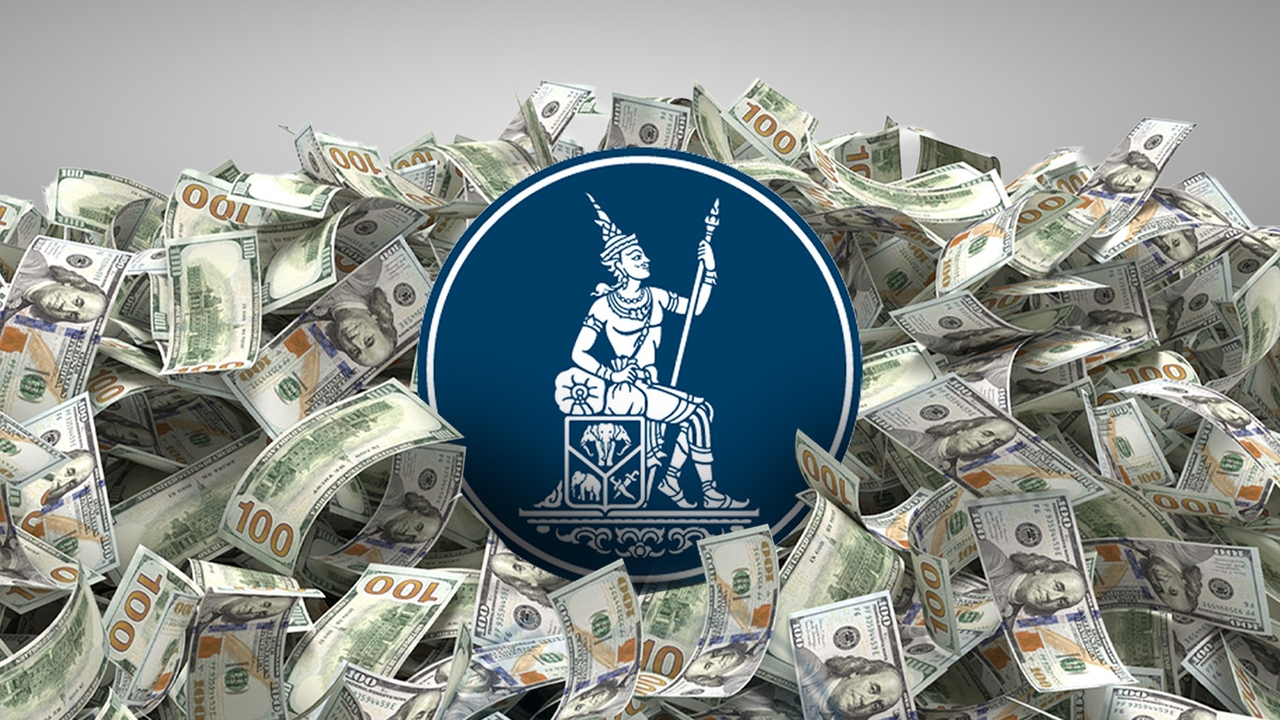
Although Thailand's economy remains sluggish, enormous sums of money continue to flow into and out of the country daily. Notably, there are hundreds of billions of baht that even the central bank cannot trace the source of, leading to debate over this "mysterious" or "Net Error" money. These funds may be causing the baht to appreciate or might represent grey money that the government needs to monitor and resolve.
First, let's understand that just as individuals have income and expense accounts, a country has a "balance of payments." The Bank of Thailand (BOT) records the flow of capital and goods between countries, tracking how much foreign currency moves in and out.
The issue arises in the balance of payments where some funds have unidentifiable origins, known as Net Errors and Omissions (NEO). In 2024, as of March, NEO stood at 12.5 billion U.S. dollars, equivalent to 398.087 billion baht, prompting questions about whether this mysterious money includes grey funds or has contributed to the baht's recent strengthening.
Regarding Pipat Luangnarumitchai, Chief Economist at Kiatnakin Phatra Financial Group (KKP) explained that having NEO figures or untraceable money is statistically normal. However, in Thailand, NEO reaches 3 to 4 billion baht per quarter and has persisted for two years, consistently showing net inflows, warranting further analysis.
From another perspective, Prakit Siriwattanaket, Managing Director of Mershion Partners Asset Management Company Limited, stated that the Net Error topic remains unclear. Essentially, Net Errors represent the difference between actual money transferred in and out of the country and the amount reported in transaction records; when these figures do not match, it results in untraceable funds.
Regarding "grey money," he views that today such funds are often moved through channels other than the baht directly, such as cryptocurrency, U.S. dollars, or gold—especially transactions via digital wallets and cryptocurrencies, which constitute a significant share. The rise in gold prices might contribute to discrepancies in Net Errors, but this is not considered the cause of the baht's unusual appreciation this year.
All these pressing questions were directed to the central bank, where Chayawadee Chayanan, Assistant Governor for Corporate Communications and spokesperson for the Bank of Thailand, responded first that in the BOT's definition, grey money refers to funds linked to all forms of corruption. Some of this may remain within NEO, but not all, as some transactions with clearly identified origins may still involve corruption.
For example, companies with directors involved in grey businesses investing in the stock market, or using off-bank channels such as cryptocurrencies to transfer funds—these transactions may be recorded normally but could still have illegal origins.
The second point is that the mysterious or high-value NEO at certain times is a statistical discrepancy possibly due to incomplete data. Over time, transactions become clearer. For instance, as of March 2024, NEO was 12.5 billion U.S. dollars but the updated figure as of September 2025 has decreased to 7.3 billion U.S. dollars (around 230 billion baht) due to revisions in three data areas.
1) A reduction in total import value after Customs Department adjusted import oil prices based on actual importer data, which was lower than previous estimates, resulting in an increased current account balance and a reduction in NEO by about 2 billion U.S. dollars.
2) An increase in foreign direct investment (FDI) adjusted according to financial statements businesses gradually reported to the Department of Business Development, leading to a decrease in NEO of approximately 2.7 billion U.S. dollars.
3) An increase in trade credit data due to creditors extending payment terms for importers in the private sector, reducing the trade credit repayment burden in 2024 and lowering NEO by about 4.2 billion U.S. dollars.
Chayawadee emphasized that NEO funds do not add further pressure to the baht currently because this money flowed into the economy since 2024 and has already been accounted for; it is not new money that would strengthen the baht this year.
The main reason for the baht's appreciation partly stems from increased trade and a rapid 40% rise in gold prices this year, causing the baht to move more than other regional currencies, with the crucial factor being a weakening U.S. dollar.
Amid concerns about grey and mysterious money, the Bank of Thailand continuously investigates and monitors the origin of funds through cooperation with relevant agencies such as the Anti-Money Laundering Office (AMLO) to close loopholes exploited for illegal transactions. They seek a balance between convenient technology and risk regulation.
"Grey issues are naturally hard to see. If we can better link data, we can clarify what is grey or not, narrowing the unidentified scope. In some areas, additional disclosure regulations would help, similar to efforts in catching fraudsters, which we try to pursue as much as possible," Chayawadee concluded.
Note: The exchange rate is 31.85 baht per U.S. dollar.
Read more economic and government policy news at ThairathMoney:https://www.thairath.co.th/money/economics/thailand_econ
Follow the Facebook page Thairath Money at the link below:https://www.facebook.com/ThairathMoney