

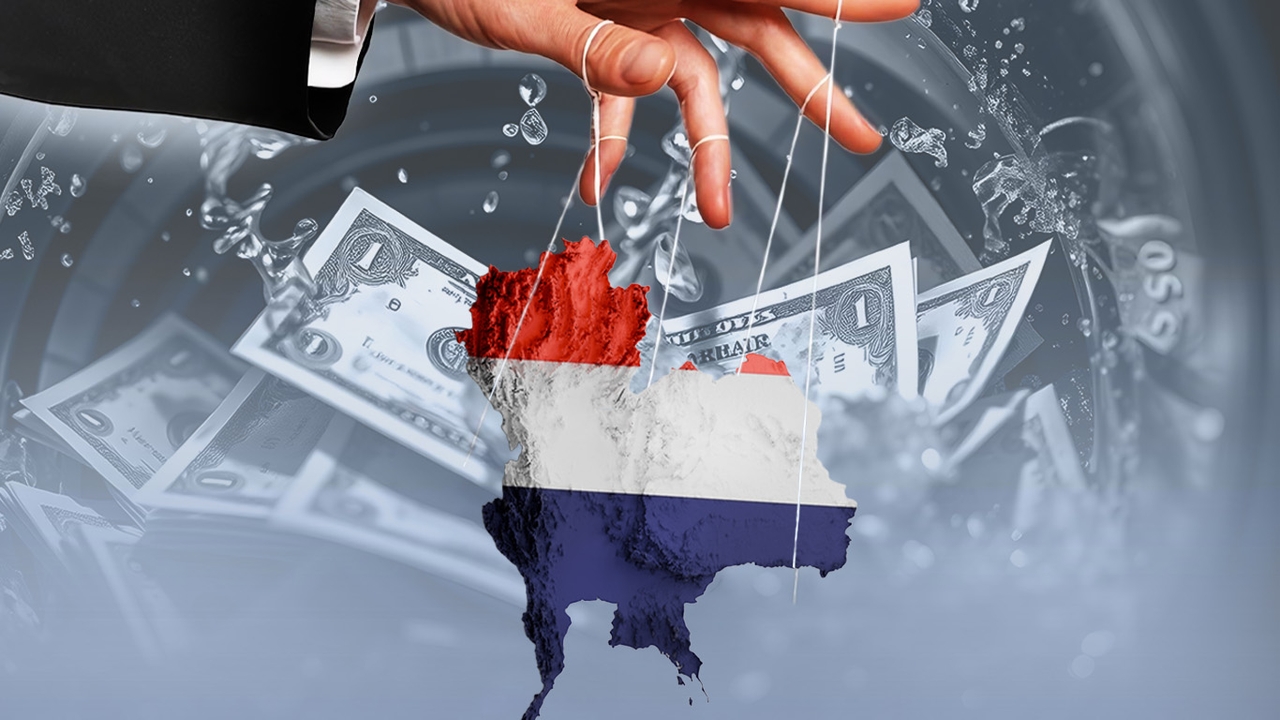
Currently, no news is more intense than that about the "scammer gangs" and "grey money" flooding into Thailand's economy, raising concerns globally about whether Thailand is becoming the world's money laundering center and how effective the government's rushed Data Bureau initiative will be.
Countries with high corruption often attract grey money—funds derived from illicit or illegal activities—for laundering to appear legitimate. Traditionally, simple laundering used cash due to its hard-to-trace origins or involved high-value small items without clear market prices, such as amulets, paintings, or antiques, claimed to legitimize the source. In some cases, large sums are alleged to come from gambling.
However, grey money now moves faster and can be laundered through multiple channels.
Especially, money circulating among "scammer" operations today is enormous. Dr. Phiphat Luangnarumitchai, Chief Economist at Kiatnakin Phatra Financial Group (KKP), told Thairath Money that U.S. authorities report scammer businesses in Southeast Asia defraud Americans of $10 billion annually (about 325 billion baht*), excluding amounts swindled from other countries.
Such grey money circulates worldwide to be laundered and ready for use. From Thailand's perspective, daily news about mule accounts and scammers raises the question: if Thailand does not quickly adapt its anti-money laundering measures, will the world perceive it as complicit?
Dr. Phiphat added that Thailand's banking system today meets near-global standards, with KYC (customer identity verification) and strict cash transaction controls. Yet, vulnerabilities exist in other financial systems, likened to "low fences" easily breached by criminals. The four main high-risk channels are:
1. Cryptocurrency markets Although licensed exchanges conduct KYC, funds transferred out of exchanges often "vanish into thin air," making tracking difficult due to the absence of the Travel Rule (which requires clear sender and receiver identification). Other countries have begun implementing this rule to monitor crypto fund flows.
2. Gold Gold is frequently used for laundering due to its high value. Previously, diamonds were common, but with their price drop, gold laundering has increased—raising suspicions about Thailand's large gold exports to Cambodia and who actually owns those funds.
3. Foundations, temples, and public benefit organizations There has been an increase in cases as donations often lack clear verification, making these entities a cover for "hiding behind goodwill." Therefore, standards for scrutiny should be stricter, transparent, and publicly disclosed.
4. Non-Bank financial service providers or e-Wallets (including crypto) These are less regulated than banks but serve as channels through which money can flow without clear identification of sender or receiver, complicating tracing efforts.
If Thailand does not promptly address these issues, grey money could cause further problems. Recently, the Thai government began planning to tackle this.
Many Thais have suffered massive losses from scammers. Recently, Deputy Prime Minister and Minister of Finance Akniti Nitithanprapas announced Thailand's firm stance by establishing a Data Bureau to link and consolidate financial data from all relevant agencies to detect, track, and inspect suspicious financial transactions. Clarity and a new system are expected by the end of 2025.
Akniti emphasized three financial channels prone to suspicious activity: crypto, gold, and currency exchange. Working in a uniquely Thai way, the Data Bureau will be overseen by a subcommittee comprising the Ministry of Finance, Ministry of Digital Economy and Society (DES), Bank of Thailand, Securities and Exchange Commission, Anti-Money Laundering Office, Department of Special Investigation, Ministry of Justice, Royal Thai Police, Thai Bankers' Association, and others.
The Data Bureau will focus on three main points: 1) verifying identity (KYC) to confirm true identity and detect nominees; 2) analyzing suspicious financial behavior, such as tourists with abnormal money inflows and outflows; 3) checking financial flows where intermediaries like exchanges and banks must monitor transaction paths. Upcoming subcommittee meetings will identify fixes and loopholes.
Currently, financial oversight in Thailand is fragmented: securities and crypto fall under the SEC, banks under the central bank, while victims involve police and digital agencies like DES. The government views slow problem-solving as due to insufficient data integration, hindering timely loophole closure.
The key question is the Data Bureau's methods and procedures—how targeted and swift they will be, especially in markets with incomplete legal coverage. Solutions must avoid harming innocent parties. Many issues can be addressed through existing regulatory powers, such as enhancing Travel Rule standards and enacting laws to "fence off" high-risk areas like crypto and gold.
*Exchange rate: 32.52 baht per U.S. dollar
Read economic news and government policies at ThairathMoneyhttps://www.thairath.co.th/money/economics/thailand_econ
Follow the Facebook page: Thairath Money at this linkhttps://www.facebook.com/ThairathMoney