

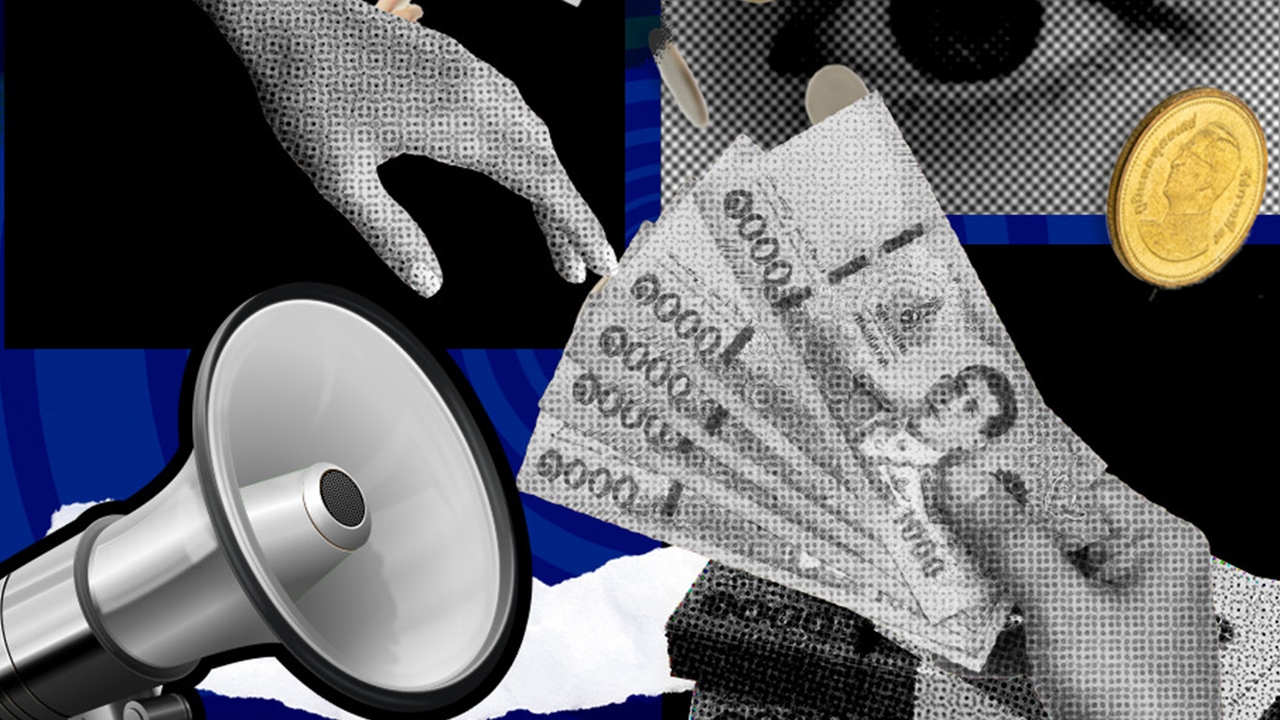
Only one month remains before the important 8 February 2026 election, amid a political battlefield where parties continue to serve "populist menus" to win over new Thai voters, including debt forgiveness for retirees, farmer debt holidays, and even abolishing credit bureaus.
While political parties compete to "give," the question workers and the middle class must ask together is "Where will the money come from?" and "Who will pay this bill?" Data from the discussion forum “They Give, But We Pay... Time for People to (Stop) Populism” by TDRI (Thailand Development Research Institute) reflects that Thailand’s fiscal status is heading toward a crisis.

Looking back at data analyzed by TDRI on the policy costs of three major parties in the 2023 election reveals alarming figures.
These figures are sky-high, and in 2026, TDRI is awaiting new data each party must submit to the Election Commission, which is expected to "outbid" previous promises amid public debt hitting 65% and household debt reaching 90% of GDP — levels that global credit rating agencies are starting to watch Thailand with distrust.

Perspectives from the three main pillars of the private sector (Joint Standing Committee on Commerce, Industry and Banking) clearly reflect that the "giveaway" policies, which sound appealing, have become "time bombs" that businesses and workers must immediately pay for.
Dr. Phot Aramwattanon, chairman of the Thai Chamber of Commerce, emphasized that the business sector does not oppose money injections but worries that the funds will "disappear" without creating economic cycles.

“We want populism that creates jobs and income, not just spending that ends there. Right now, we only think about spending money but not about how to earn it.”
Meanwhile, Kriangkrai Thianukul, chairman of the Federation of Thai Industries, warned about campaign promises made "just for fun," such as sudden minimum wage hikes, where the real payer is the business sector.
“Distributing money requires skill. Long-term harmful giveaways must not happen. Funds should be used to restructure the economy and increase innovation, not just populist lures that damage competitiveness.”

Piyawong Sriwanich, chairman of the Thai Bankers’ Association, offered a sharp view that cash handouts may act like "addictive substances or steroids" harmful to vulnerable groups.
“They don’t help people truly escape financial black holes unless they lead to changed financial behavior. Ultimately, these debts will come back to destroy the banking system and the country’s credit.”

The most worrying data from TDRI concerns corruption: every government investment project typically has 20-30% kickbacks, alongside more than 320,000 scammer cases causing huge damages worth tens of billions of baht, yet only 1% has been recovered.
At the same time, Thailand is losing opportunities in the global market because Thai labor skills have declined, making it unattractive to investors (the Thai education curriculum hasn’t been updated for 18 years, since the first iPhone was launched).
Meanwhile, the middle class in the tax system faces the highest risk of having to "bear increased taxes" in the future (such as VAT hikes) to offset government spending on giveaways that do not generate revenue.
Professor Dr. Athiphat Muthitajaroen from Chulalongkorn University’s Faculty of Economics points out that ultimately the middle class may become the unavoidable bearer of burdens when the government runs continuous deficits of 4-5% and tax revenues begin to shrink.

Dr. Somkiat Tangkitvanich, chairman of TDRI, proposes that to restore Thailand’s appeal, the 2026 government must act within one year as follows:
In summary, today’s giveaways become tomorrow’s burdens. Policies like "debt forgiveness" or "abolishing credit bureaus" may sound good, but if they lead to fiscal collapse, the last to pay the bill will be the "middle class" who cannot avoid the tax system. Will we still choose to stay?
Follow economic and government policy updates with ThairathMoney athttps://www.thairath.co.th/money/economics/thailand_econ
Follow the Facebook page: Thairath Money at this linkhttps://www.facebook.com/ThairathMoney