

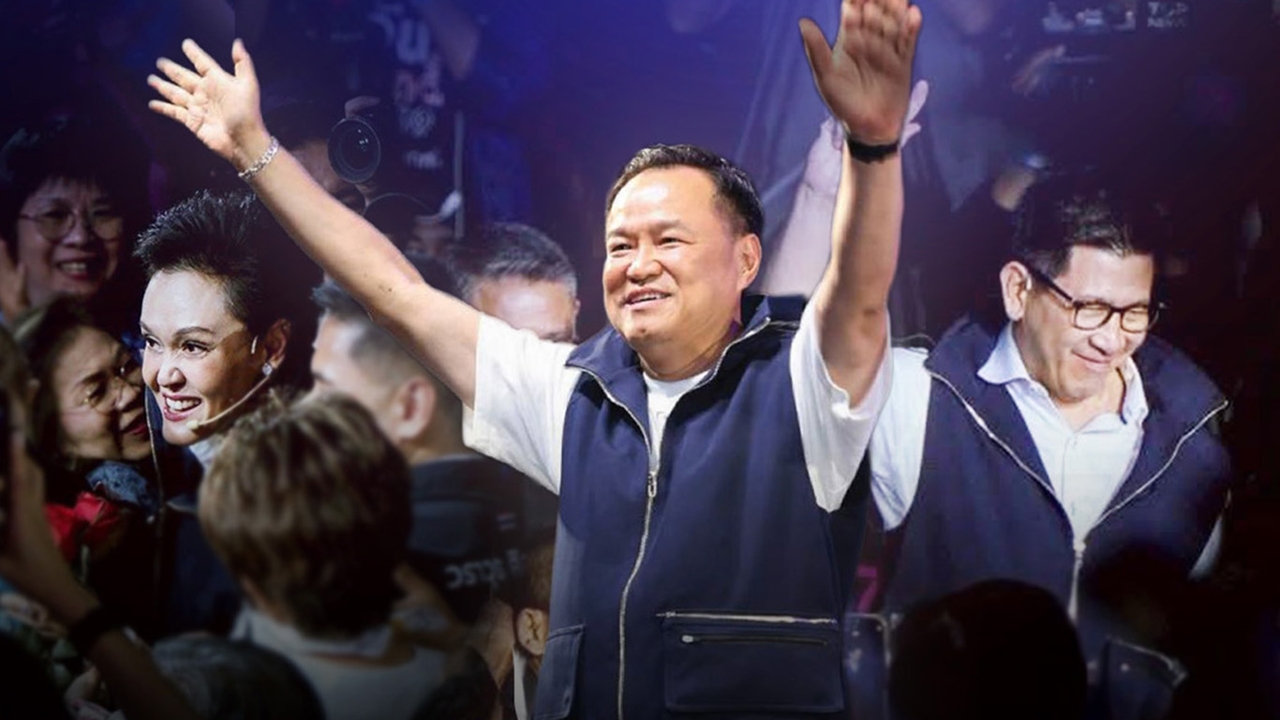
The 2026 election results revealed the "Deep Blue" phenomenon, which was not just about maintaining a stronghold but marking Bhumjaithai Party's rise as the top party. Previously seen as a "regional party" or "local stronghold," it unexpectedly became the main force in forming the government.
This seems to prove that a strategy emphasizing "stability" and "economic survival" may be what most Thai people long for amid global views of Thailand as the "Sick Man of Asia," struggling with political instability and sluggish economic growth.
In the past years, Thai politics was driven by grand concepts.
But the 2026 election results clearly show that many voters decided based on one question: which party will improve their lives fastest? And the answer many chose was Bhumjaithai Party.
Numerous analyses focused on “Super G (Supachai),” Sihasak, and Ekniti—professional executives who speak the language of work and policy rather than politics. This immediately changed the party’s image from a local stronghold to one with “country managers” ready to move forward without starting from scratch.
This made people feel they were not electing politicians but a management team. This is where the term “Bhumjaithai Plus” originated and was unanimously accepted by groups prioritizing livelihood over the constitution—business sectors, investors, and the middle class who feel safe entrusting the future to them.
Another undeniable factor is that Bhumjaithai did not take an extreme ideological stance, did not announce major structural upheavals, and did not cause anyone to feel at risk. This model appeals both to investors and to citizens tired of turmoil.
“Stability + Continuity + Clear Economic Messaging.”
This led Bloomberg and foreign media to analyze that Anutin Charnvirakul’s victory brings hope for stability in Thailand, once seen as the Sick Man of Asia.
Bhumjaithai volunteered to be the “doctor” treating the “Sick Man of Asia,” aiming to push GDP growth to 3%, not through mega projects but by getting money to people as quickly as possible.
Thairath Money examines the “powerful medicine” called the “10 Plus” economic policy announced by Bhumjaithai, to hold them accountable and see if every baht spent and policy declared will be truly implemented as promised under the slogan “say and do.”
The policies focus on “injecting money, reducing burdens, and creating opportunities” targeted at specific groups.
Grassroots and small earners (Short-term Stimulus).
This is the signature policy of Supachai, notably “buying fighter jets paid with rice.” It states that if the government spends huge budgets buying military equipment or foreign goods, there must be an offset condition requiring the foreign side to purchase Thai agricultural products (rice, rubber, cassava) at agreed values.
This strategy will transform Thailand from a “buyer” to a “trading partner,” helping to reduce agricultural stockpiles and support crop prices without relying solely on price intervention budgets.
If Anutin Charnvirakul is prime minister, Bhumjaithai’s vision is driving the economy with “speed” combined with using technology as a main tool—not just rhetoric.
All these concepts are woven into the “10 Plus” framework, which Bhumjaithai believes will help Thailand’s economy grow inclusively, with quality and full potential.
It consists of:
Even though Bhumjaithai’s policies address short-term economic stimulus well, feedback from the private sector, specifically the Joint Standing Committee on Commerce, Industry and Banking (JSCCIB), notes that genuine economic growth requires more. Amid geopolitical risks and US tax uncertainties, the new government must:
JSCCIB also highlights that populist campaign policies and short-term stimulus often involve large budgets but lack a systematic strategy for long-term national revenue growth.
Moreover, fiscal space constraints are critical. As of December 2025, Thailand’s public debt stood at 12.45 trillion baht, or 66.09% of GDP, close to the fiscal discipline limit of 70% set by law.
This means the new government will no longer have the freedom to spend as in the past. The private sector also stresses that corruption is the highest hidden cost to Thailand’s economy. Without addressing this, no matter how good the policies, the country's competitiveness will remain hindered.
Therefore, the key question after this election is not only what policies Bhumjaithai has but how they will implement these policies under fiscal constraints and structural problems. This is the true test of whether this victory will really help Thailand stop being the “Sick Man of Asia.”
For economic and government policy updates, follow ThairathMoney athttps://www.thairath.co.th/money/economics/thailand_econ
Follow the Facebook page: Thairath Money at this linkhttps:// www.facebook.com/ThairathMoney