

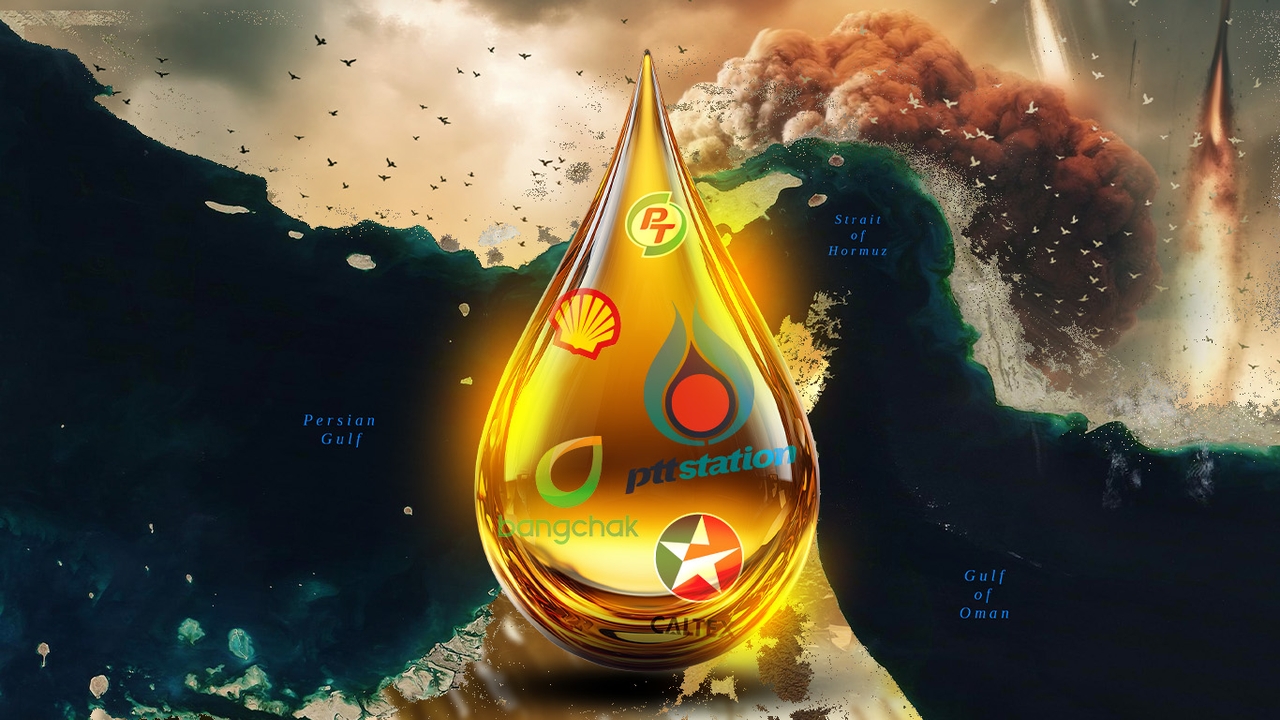
Whenever there is a war in the Middle East, the first thing Thais do is not check international news but instead check the “fuel prices at the gas station.”
The latest situation on 3 March 2026, after Iran announced the closure of the "Strait of Hormuz," a major trade and energy artery, caused global crude oil prices to immediately surge. Although the Thai government, through the Energy Ministry, firmly reassured that "we have oil reserves sufficient for 60 days" and requested retailers to hold prices steady,
the resulting phenomenon confused consumers as foreign fuel stations like Shell and Caltex chose to raise prices first, while major players such as OR (PTT) and Bangchak announced price freezes to assist the public.
The question is why each company adjusts prices at different times? The answer lies not only in the war but also in the "business structure" and "roles" of the five dominant Thai oil station companies. Thairath Money invites readers to explore this market and business structure in depth for a clearer picture.
Amid concerns that oil transportation might halt, the Energy Ministry urgently convened fuel traders and confirmed that Thailand holds a total of over 7.66 billion liters of fuel (including legal reserves and fuel in transit), enough to supply the country fully for two months without new imports.
Yet in the business world, the "crude oil cost" has already moved.
The reason Shell and Caltex dared to adjust prices first is that both are "International Oil Companies" closely linked to global market pricing mechanisms and manage costs differently than state enterprises or companies with major government shareholding, which must bear the additional "security mission".
However, on 4 March 2026, reporters observed that Shell has subsequently reduced retail prices of gasoline and gasohol by 1 baht per liter and sharply cut Shell FuelSave diesel by 4.20 baht per liter. Similarly, Caltex also announced price reductions.

Based on LH Bank research in 2025 and current market conditions, here are the key players fiercely competing for control of Thailand’s energy sector.
Note: The market share percentages are based on the number of fuel service stations; medium and small stations combined account for another 7% of the market structure.
Regarding why foreign fuel stations can raise prices, LH Bank data indicates that the "marketing margin"—the income stations receive after deducting refinery costs and taxes—is critical.
Whenever oil prices move, we tend to blame the "war" in the Middle East. However, that is only an "external factor" affecting the market. The real internal factor is the "structure of Thailand’s oil market," which mixes state-mission stations (PTT) with private multinational companies (Shell/Caltex). This explains the differing decisions seen during crises. Shell and Caltex’s price hikes likely reflect concerns over future higher replacement costs without government backing.
Recently, Anutin Charnvirakul stated that as head of government, he has ordered the Energy Ministry and related agencies to cap diesel prices at 29.94 baht per liter for 15 days starting today, after which assistance measures for the public will be reconsidered. Importantly, all PTT stations are mandated to sell diesel at 29.94 baht per liter.
Sources: Ministry of Energy, LH Bank Research.
Follow economic information and government policy updates with ThairathMoney at
Follow the Facebook page: Thairath Money at this linkhttps:// www.facebook.com/ThairathMoney