

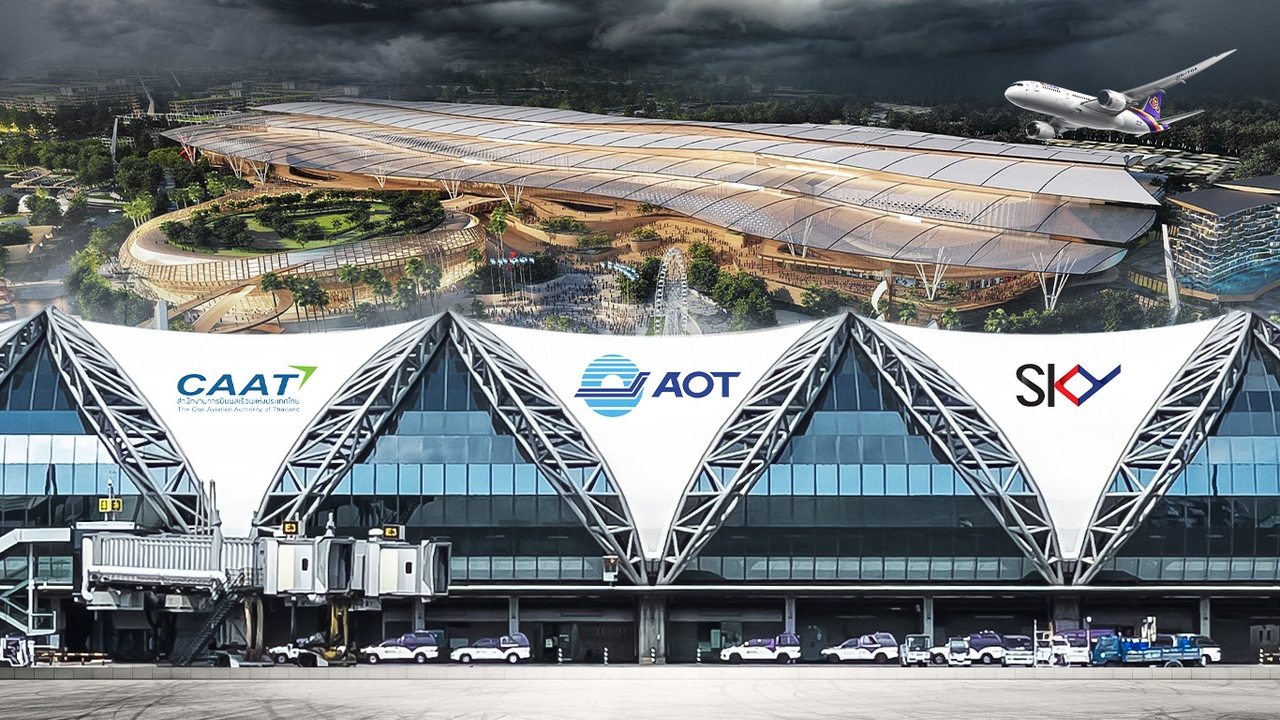
Thailand's aviation industry is experiencing an upswing after the COVID crisis and major aviation standard restructuring over the past decade. However, this recovery occurs amid a changed global context, marked by geopolitical tensions, volatile energy prices, and intensified competition among aviation and airport service providers across Asia. / This raises the key question: How prepared is Thailand to manage risks and seize opportunities from global developments to elevate itself as a regional Aviation Hub?

/ "Potential and Readiness of Thailand's Aviation Industry Towards Becoming an Aviation Hub" / "SKY Aviation Lab" An intelligent airport laboratory where SKY, in collaboration with Kasetsart University, simulates real airport operations from check-in to passenger screening, preparing new personnel to strengthen Thailand's aviation sector. Perspectives come from three vital players in Thailand's aviation system: the Civil Aviation Authority of Thailand (CAAT), Airports of Thailand Public Company Limited (AOT), and SKY ICT Public Company Limited (SKY), a developer of aviation-related technology systems for airports nationwide. /
They point out that Thailand's airport infrastructure and management are ready to handle impacts from war in terms of aviation standards, airport structures, and regulatory systems. Nonetheless, significant risks remain from uncontrollable external factors such as energy prices, global airspace stability, and traveler behavior.
Air Chief Marshal Monut Chuanaprayoon, Director-General of the Civil Aviation Authority of Thailand (CAAT), said that over the past decade, Thailand’s aviation industry faced major challenges after its safety standards were downgraded to Category 2 due to regulatory structure misalignments with international standards.
However, following legal reforms, restructuring to clarify roles, and continuous regulatory improvements, Thailand successfully restored its safety rating to Category 1.
Moreover, Thailand became the only country simultaneously audited by three global aviation bodies in one year: the US Federal Aviation Administration (FAA) and the International Civil Aviation Organization (ICAO), covering safety and security measures.
From a previous average assessment score of around 60%, the latest audits achieved over 90%, significantly surpassing the global average. This reflects that Thailand’s aviation standards today are internationally recognized and robust. Beyond image improvement, regaining Category 1 lifted key restrictions, allowing Thai pilots to work globally and airlines to open new international routes, restoring overall industry confidence.
/ Sirote Duangrat, Senior Executive Vice President (Business Development and Marketing) of Airports of Thailand Public Company Limited (AOT), noted that the global tourism recovery is driving rapid growth in Thailand’s air passenger volume, rising from approximately 111 million pre-COVID to a current trajectory toward 121 million annually. Air cargo business has also recovered beyond pre-COVID levels.
Expanding fleets means more than additional flights; it entails large-scale expansion of personnel including pilots, cabin crew, maintenance engineers, security staff, ground handling, baggage transport, and logistics providers, underscoring aviation’s high multiplier effect on the economy.
Although global aviation grows at about 8% annually, especially faster in Asia, modern airport competition focuses not on size but on efficiency—meaning operational effectiveness matters more than scale.
Sithidet Mailap, Chief Executive Officer of SKY ICT Public Company Limited (SKY), a key technology developer for airports nationwide, shared from the perspective of an Aviation Tech as a Service provider that today’s competition is not about transporting the most passengers or cargo, but about how quickly airports move passengers, reduce congestion, and increase commercial revenue.
Technology is thus a crucial competitive factor, especially in Thailand where digital and technological systems are increasingly adopted to enhance service efficiency. Examples implemented include Self Check-in, biometric identification, and Automatic Border Control systems that allow eligible Thai and certain foreign passengers to pass through immigration automatically without queueing.
These technologies reduce passenger processing time from approximately 45–50 minutes to 30–35 minutes, and in the best cases, 15–20 minutes. For airports handling 60,000–70,000 passengers daily, saving 10 minutes per passenger equals hundreds of thousands of hours saved daily. The time saved often translates into increased spending on airport services, generating significant revenue.
Beyond convenience, a critical driver is data utilization, which has proven to be a genuine new resource for airports. Data analytics reveal high-traffic areas, time spent in zones, and passenger spending tendencies, enabling precise commercial space design, retail placement, and revenue optimization strategies.
Further digital transformation accelerates airport processes, reducing flight delays. Fewer delays enable airlines to increase flight frequency. Each additional flight adds 200-300 passengers, directly boosting national revenue.

Unlocking aviation standards, post-COVID travel recovery, and large infrastructure investments are ushering Thailand’s aviation industry into a new growth phase.
Air Chief Marshal Monut added details on multi-hundred-billion-baht mega projects expanding several airports to accommodate travel growth. Thailand has around 39 airports nationwide, with seven major ones managed by AOT, which are continuously expanding capacity, such as:
Don Mueang Phase 3, increasing capacity to about 40 million passengers per year; Phuket Airport expansion to 18 million; Chiang Mai Airport to around 8 million; Suvarnabhumi Terminal and infrastructure expansion; plus U-Tapao and Eastern Aviation City developments by U-Tapao International Aviation Company Limited (UTA).
Regarding regional airport competition, Thailand’s strengths include geographic location, multiple international airports, and status as a global tourist destination. The challenges lie in scaling infrastructure and services to meet rising demand and ensuring operational efficiency across airports.
Tensions in the Middle East are impacting the global aviation system, affecting energy costs, airspace security, and intercontinental routes. In this context, Thailand’s aviation industry overall shows moderate readiness to handle war-related impacts but must closely manage risks.
A key factor is jet fuel prices, comprising approximately 30-40% of airline costs. Security risks in certain airspaces may force airlines to reroute flights, increasing distance and flight time, resulting in higher fuel expenses.
If conflicts push crude oil prices higher in global markets, airline costs rise immediately, likely passing on to ticket prices determined by dynamic pricing algorithms. Historically, ticket prices have increased during peak seasons due to these algorithms adjusting prices based on booking volume.
Closer to travel dates and during periods of high fuel prices and demand, prices rise automatically. Government short-term measures during peak seasons included urging airlines to cap fares by about 30% and increase flights to meet demand.
Air Chief Marshal Monut commented that CAAT is considering discussions with the Ministry of Finance about reducing excise tax on aviation fuel to lower airline costs at the source, instead of allowing ticket prices to fully reflect higher costs.
Another approach is reducing airport fees charged by AOT, such as aircraft landing fees, passenger fees, and airport service charges. Lowering these two cost components simultaneously would give airlines more flexibility to manage ticket prices and lessen cost burdens on passengers.
While global tensions present cost and tourism risks, they may also offer strategic opportunities for Thailand. Air Chief Marshal Monut explained that some Europe-Asia flight routes needing to avoid Middle Eastern airspace might lead airlines to seek new regional stopover points or hubs, presenting a significant strategic chance for Thailand.
In summary, perspectives from CAAT, AOT, and SKY reflect that Thailand’s aviation development is advancing on three main fronts: global standards, infrastructure investments to meet demand, and technological advancements to enhance airport management efficiency. Thailand is regaining a strong position but must monitor several critical factors closely.

Read more
Follow Thairath Money on Facebook at this link -