

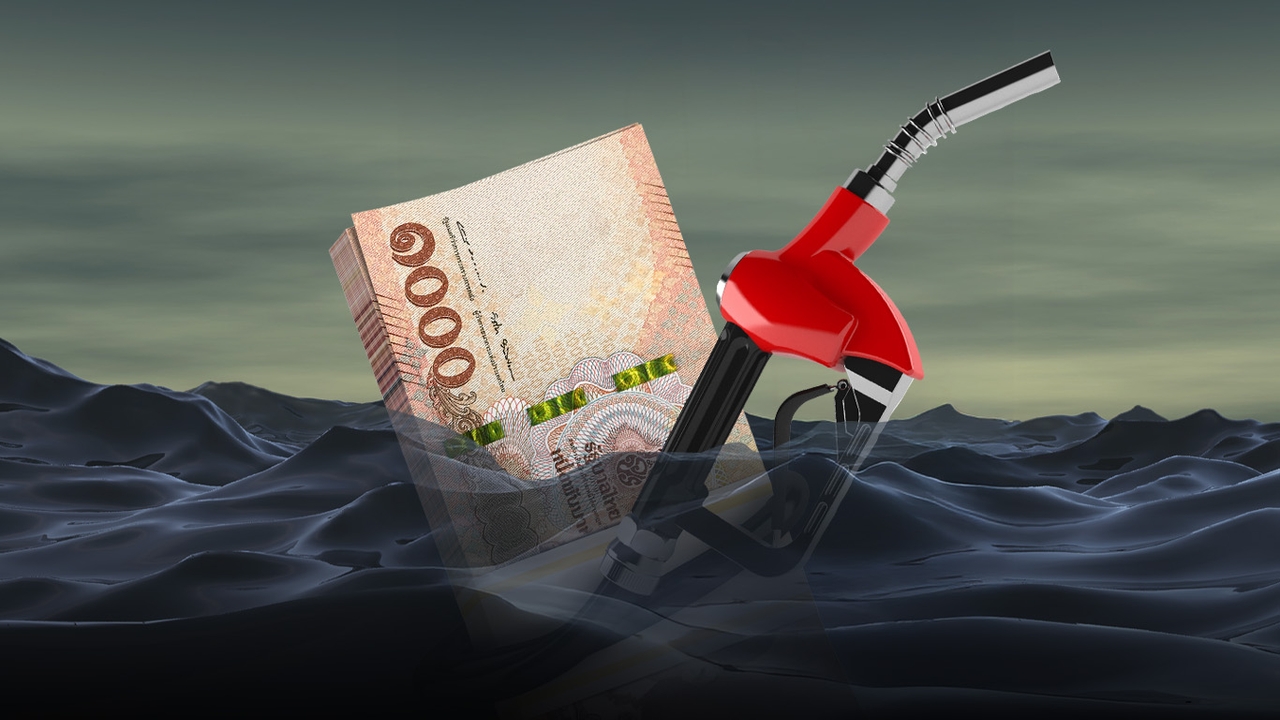
While the government continues to try to keep diesel prices below 30 baht per liter, the Oil Fuel Fund recently had to increase subsidies to as much as 20.36 baht per liter. This figure not only marks a historic high for Thailand but also reflects that the "oil price buffer" used by the government to manage living costs is turning into a debt burden that future oil consumers may have to share.
This measure follows an announcement from the Oil Fuel Fund Office to adjust diesel compensation rates so that the retail price remains around 29.94 baht per liter, preventing it from exceeding the 30-baht ceiling.
The price cap is set to end today (17 March), putting close scrutiny on energy prices moving forward, as the government must decide whether to extend the price support or allow diesel prices to reflect actual costs more closely.
However, maintaining diesel prices at this level has continuously increased the Oil Fund's burden amid ongoing tensions in the Middle East and global crude oil prices remaining above 90 US dollars per barrel.
The latest fund status data shows that as of 15 March 2026, the Oil Fund's net position is still negative by approximately 12.605 billion baht.
This breaks down into:
Although the oil account still holds some remaining funds, the subsidy burden over recent periods means the overall fund status cannot yet return to positive.

At the same time, government economic sectors are evaluating contingency plans should global energy prices continue fluctuating. The Public Debt Management Office indicated that, in principle, the Oil Fuel Fund can borrow on its own to manage oil price scenarios, with an initial credit limit of about 20 billion baht.
If more funds are needed, legislation may be required to allow the Ministry of Finance to guarantee the fund's borrowing, which would then be counted as part of the country's public debt.
Relevant economic agencies, such as the Fiscal Policy Office and Excise Department, have begun discussions to prepare for oil price volatility, but final decisions rest with policymakers.
Currently, Thailand's public debt stands at about 66% of GDP, compared to the ceiling of 70% of GDP, leaving approximately 4% of GDP room that could be used to support fiscal measures if necessary to stabilize the economy or energy prices.
Previously, the Oil Fund's deficit exceeded 100 billion baht due to energy subsidies during crises, prompting the government to borrow to bolster the fund's liquidity.
Recent reports suggest the government may need to raise the diesel price ceiling from 29.99 baht to as high as 33 baht per liter, potentially starting from 18 March, by gradually increasing prices by less than one baht at a time to reduce the impact on living costs.
This anticipated price ceiling adjustment is not merely a response to rising global crude costs but signals that the Oil Fund’s "price buffer" is reaching its limits and entering a phase where debt burdens are increasingly passed on to consumers.
The Oil Fund's role is to stabilize energy prices by collecting funds when prices are low and using them to support prices when costs surge.
However, recent years have seen global energy price volatility driven by geopolitical factors like the Russia-Ukraine war, forcing the government to rely on the fund continuously to cap energy prices.
As a result, the money used to suppress oil prices today may eventually be recovered through future oil pricing structures. The critical question increasingly asked is whether the current price buffer that helps reduce living costs is becoming a debt burden that future oil consumers must share.
Ultimately, the accumulating burden on the Oil Fuel Fund from price capping will affect long-term oil pricing structures. Once the fund's status turns negative enough to require borrowing, debt repayment mechanisms will be enforced through excise taxes or higher fund contributions when global crude prices decline.
This means that even when crude oil costs fall in the future, consumers may still pay higher prices to gradually repay the current accumulated debt.
Moreover, if the fund’s debt is classified as public debt, interest and principal repayments will come from the state budget, which is funded by taxpayers.
Therefore, the current diesel price support measures are not merely short-term cost-of-living management but represent a decision to draw on future financial resources to mitigate present impacts. Those inevitably bearing these debts will be future oil users and taxpayers.
Source: Weekly Oil Fuel Fund Status Report, Oil Fuel Fund Management Committee (OFMC) resolutions, Thai Oil Public Company Limited.
Follow economic and government policy updates with ThairathMoney at
Follow the Facebook page: Thairath Money at this linkhttps://www.facebook.com/ThairathMoney