

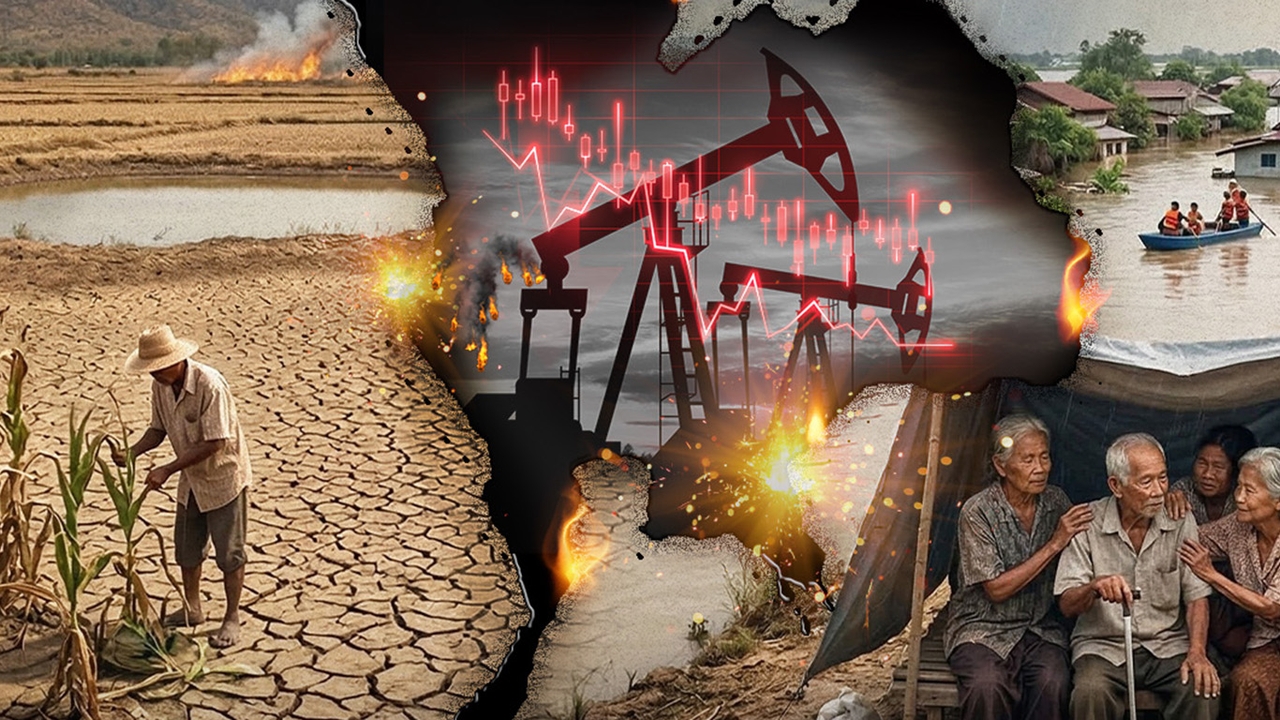
Amid a world full of volatility, Thailand's economy is facing a series of overlapping severe risk storms.
These include external factors such as geopolitical conflicts in the Middle East that may cause oil prices to soar, as well as deep-rooted internal issues like the transition to an aging society, rapidly rising healthcare living costs, and natural disasters.
TISCO Economic Strategy Unit (TISCO ESU) assesses that these converging risks could pressure Thailand's economy to grow less than 1% this year, further worsening the financial vulnerability of many Thais, especially the middle class and workers who bear increasing living costs and future uncertainties.
In this context, "insurance" is no longer merely an optional financial tool but is becoming a necessary risk management mechanism that acts as a buffer against unexpected shocks in health, income, and property.
Methus Rattanasorn, Head of Economic Research at TISCO ESU, stated that although early in 2026 there was an estimate that Thailand's economy might grow up to 1.8%, supported by government formation and improved private investment,
the escalating tensions in the Middle East, culminating in the closure of the Strait of Hormuz—a route transporting over 20% of the world's oil—have become a critical turning point, as Thailand imports about half of its oil from the Middle East.
If crude oil prices rise 10% above the original assumption of 72 USD per barrel, GDP growth could be impacted by about 0.3-0.4%, while inflation could increase by approximately 0.8%.
The surge in energy prices is placing a huge burden on Thailand’s fuel oil fund, with the government currently subsidizing diesel prices by nearly 20 baht per liter, amounting to about 1.3 billion baht daily, which means the fund's liquidity may only last about a month without emergency loan legislation.
"Ultimately, we cannot fight the market’s price mechanism... I believe the 33 baht price won’t hold; it will likely step up gradually, possibly to 35 baht, and in the worst case, to 40 baht," Methus said.
He also emphasized unseen risks, noting that if the conflict drags on and oil production infrastructure is destroyed, global crude oil prices could soar to 150 USD per barrel, severely impacting the economy and potentially causing Thailand’s growth to fall below 1% this year.
Beyond the Middle East issue, Thailand’s economy faces structural vulnerabilities, especially climate change causing severe damage.
Statistics show that the economic losses from floods and droughts in Thailand equal about 0.7% of GDP; Thailand ranks second highest globally in disaster impact. Additionally, rising heat reduces labor productivity, particularly in agriculture, which may decline by 15-16% over the next decade.
At the same time, public health challenges and entering a super-aged society are becoming major time bombs for households. Currently, medical costs in Thailand rise by an average of 10.8% annually, exceeding the global average.
Combined with the fact that over 73% of Thai elderly cannot support themselves on government subsidies of only 600-1,000 baht per month, the burden falls on working-age people who must cover household expenses and sudden medical bills, putting many households at risk of sudden poverty.
Due to overlapping pressures, traditional separate savings or insurance methods are no longer sufficient to protect life stability. TISCO has adjusted its strategy to address changing behaviors and risks.
Kusuma Prathomsrimek, Senior Assistant Managing Director of TISCO Financial Group, shared an insightful view that modern risks inevitably flow down to families. Household financial management must apply the "business balance sheet" concept by proposing an integrated risk management approach called "3 Save Series," viewing the family as a business that must balance assets, liabilities, and capital.
This begins with protecting dreams and the future (Save Dreams), equivalent to preserving business capital.
Next is closing risks from unexpected events like health problems and accidents (Save Risks), similar to controlling liabilities.
Finally, protecting living standards (Save Assets) ensures that accumulated wealth is not wiped out by crises.
TISCO will provide proactive consulting, helping each family design protective shields through appropriate "insurance" suited to their specific context.
For economic information and government policies, follow ThairathMoney athttps://www.thairath.co.th/money/economics/thai_economics
Follow the Facebook page: Thairath Money at this link
https://www.facebook.com/ThairathMoney