

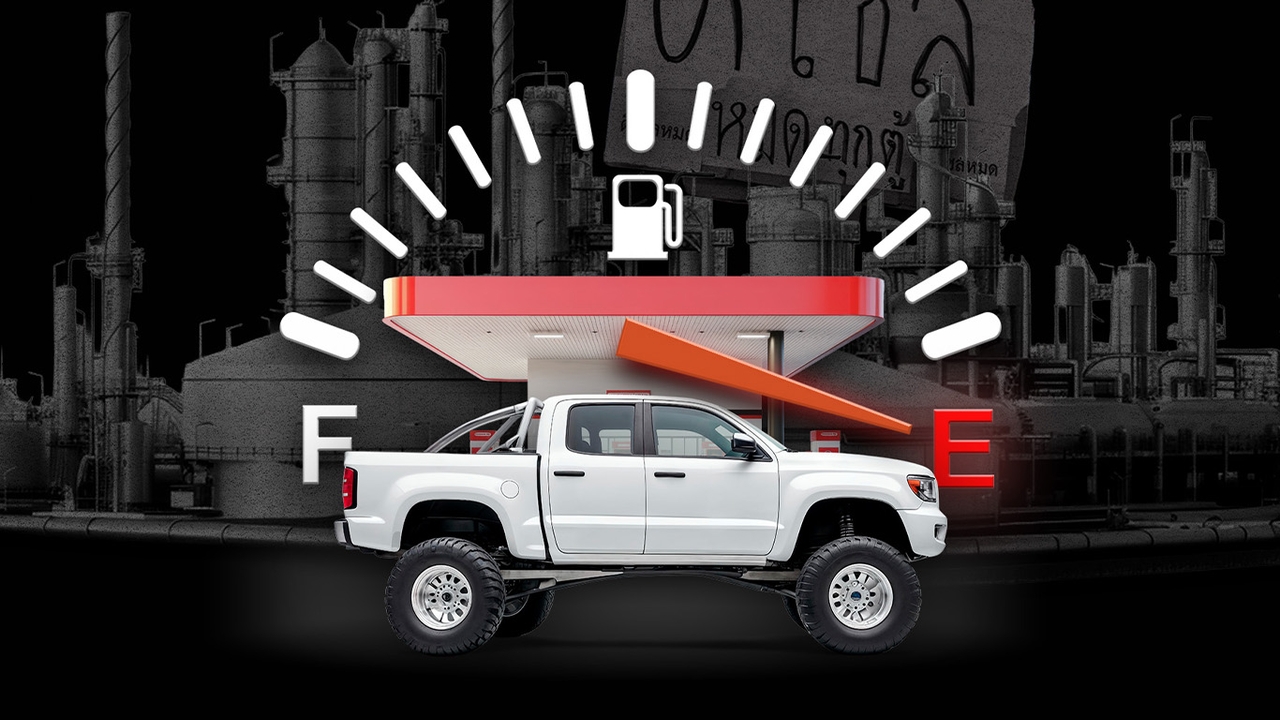
On days when "oil prices" keep soaring, the greater concern is not just the rising cost but the inability to find fuel even with money in hand. Some gas stations have queues stretching kilometers long, others display "temporarily out of fuel" signs, and some limit refills to only a few hundred baht per vehicle. The question is: Is there really an oil shortage, or is the fuel simply not reaching consumers?
While many attribute the situation to tensions in the Middle East that directly affect global oil prices, the government insists that "Thailand's oil reserves remain sufficient for over 100 days." The conflicting narratives raise the question: What exactly is causing this problem?
This article aims to peel back the layers of the real situation by tracing the path of 1 liter of oil from the origin at the "refinery" to the nozzle at the "gas station," to identify which "players" and "factors" determine whether you can refuel today.
Before understanding the oil supply route, it is crucial to recognize that Thailand's "energy wallet" is currently in crisis.
Regarding the journey of crude oil from refineries to consumers, information published by major players like PTT indicates that oil does not flow directly through pipelines from refineries to our vehicles. Instead, it is managed by "licensed oil traders" divided into two main groups:
1. The major players "Section 7" (large oil traders).
These are the prominent brands clearly visible nationwide. This group comprises licensed traders under Section 7, with annual trade volumes exceeding 100,000 metric tons, including:
Their role is to receive oil directly from refineries and deliver it to their own "service stations (brand gas stations)." Their strength lies in owning transport networks and storage facilities, maintaining relatively stable systems. However, if many people rush to refuel simultaneously, delivery trucks can still struggle to keep up.
Besides those owning their own stations, there are Section 7 traders focusing on "refining and wholesale" large batches to intermediaries or industrial factories, such as:
These major groups must maintain oil reserves as mandated by law (for example, crude oil reserves of 1.5-3% per government policy) to guarantee supply in case of war or global crises.
2. The intermediaries "Section 10" (Jobbers / Wholesale).
This crucial yet lesser-known cog in the wheel is the licensed oil traders under Section 10.
They act as middlemen or wholesalers who purchase large batches of oil from Section 7 traders or refineries and redistribute it to:
However, Section 10 traders are vulnerable due to typically shorter capital chains. During times of high oil prices or volatile costs, they may reduce inventory or struggle to procure fuel, causing independent community gas stations to run dry first. This group also faces high risk; for instance, if they stockpile 100,000 liters but the government suddenly announces a price cut the next day, they incur significant losses on their inventory.
This is where the "shortage" originates. When prices fluctuate heavily or the government relaxes price controls, some traders may "halt deliveries" because it becomes unprofitable or too risky.
The consequence is empty fuel tanks at local stations, tractors running out of fuel, factories halting machinery, and consumers flocking to branded stations, resulting in long queues.
The answer is not that "domestic oil is depleted" but due to "logistics bottlenecks" and "allocation." When demand spikes suddenly, oil trucks that used to run once or twice daily may need to operate 4-5 times, which is practically impossible given legal driving time limits and long distances from storage facilities.
In some cases, fuel is available in storage tanks but insufficient on transport trucks, and underground tanks at stations are empty. Smaller stations relying on Section 10 traders may become "temporarily deserted" if intermediaries cannot deliver on time, cannot source fuel, or are unwilling to transport it. Meanwhile, larger branded stations (Section 7) may sustain their supply longer.
Some fuel station owners report that the root cause of shortages is quota restrictions. Previously, they sold fuel allowing customers to fill up to 1,000 baht per transaction, but when the refinery limits their quota, they must reduce the fill limit to 500 baht per vehicle to ensure availability for all customers. They prefer not to do this since operating fuel pumps consumes substantial electricity.
Understanding the oil supply chain reveals that "energy security" means more than just having large crude reserves; it requires a robust distribution system. As prices increasingly reflect market mechanisms amid shortages, the best we can do is plan energy use efficiently and recognize that what we see at the pump is the endpoint of a complex system with many hidden mechanisms behind it.
Sources: PTT, Ministry of Energy.
Follow economic news and government policies with ThairathMoney at:
Follow the Facebook page: Thairath Money at:https:// www.facebook.com/ThairathMoney