

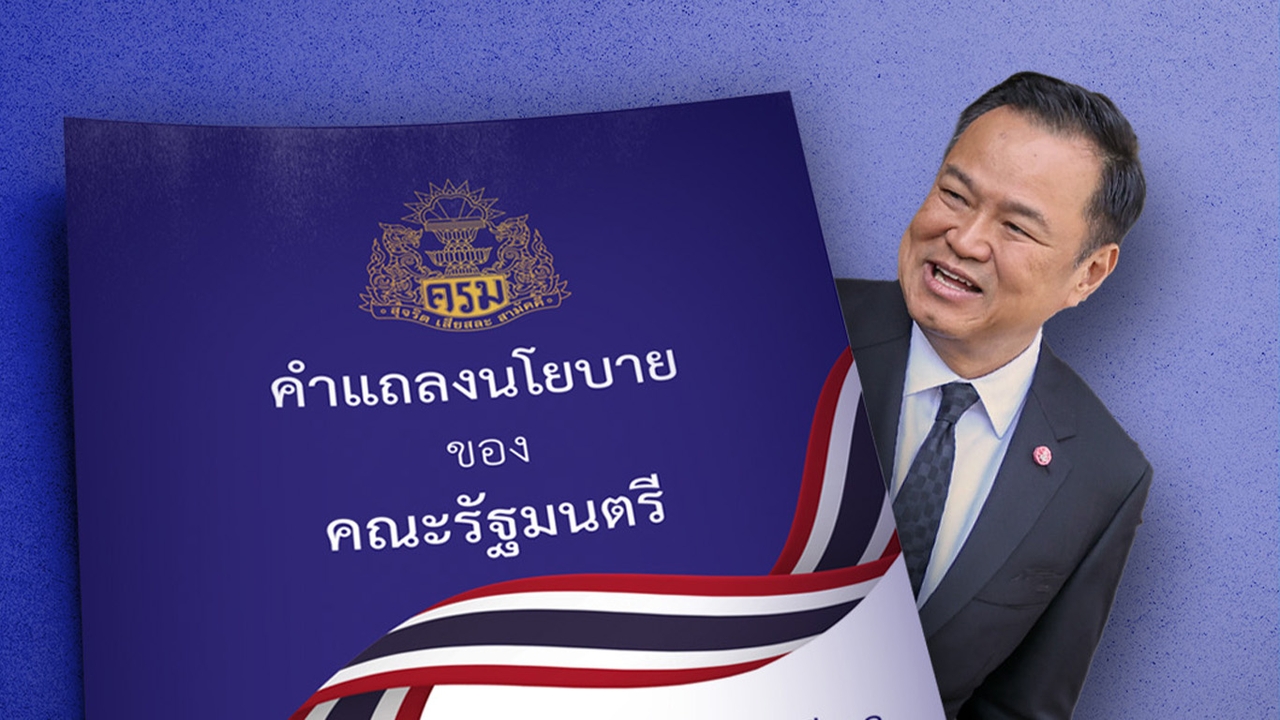
A significant milestone for Thailand occurred on 9-10 April 2026 when the government led by Anutin Charnvirakul entered Parliament to present its policy statement amid rumors of dividing roles among deputy prime ministers and ministers attached to the Prime Minister's Office to accelerate visible results from day one.
Thairath Money summarized the key economic policies from the 90-page policy statement for Thai people to watch closely, questioning whether these can be realized. The approach differs from previous administrations by aiming to 'Set Zero' old problems and 'Re-structure' the system through five interesting strategies.
As the Prime Minister said, the goal is to create opportunities and lead the country to higher competitiveness and resilience to boost confidence and happiness for Thai citizens from now on.
The Anutin 2 government starts by addressing the long-standing economic burden of debt, focusing this time on a 'debtor-centered' approach by linking big data between financial institutions and cooperatives to resolve debt comprehensively.
This marks a major shift in the 'economic engine' as the government targets building future industries to move Thailand beyond being just a contract manufacturer.
'Developing capital markets to facilitate fundraising for innovative businesses, establishing matching funds to nurture promising startups to grow and compete globally, and fostering collaboration with the private sector to prepare human resources for future technologies.'
In trade, the government declared its stance to 'turn partners into allies' based on equality, creating advantages for Thai SMEs by enforcing the 'Made in Thailand First' policy in public procurement to secure Thai businesses' place in supply chains.
'Incorporating Thai goods and services into trade negotiations for high-value government machinery and equipment procurement from abroad, revising tax structures, and implementing related measures to create opportunities and enhance competitiveness for Thai businesses, such as giving preference to producers of Thai-made products in public and large business procurement to elevate the quality and standards of Thai goods and services.'
At the same time, a serious campaign was announced against multinational nominee businesses operating non-transparently to protect the interests of community enterprises and Thai SMEs.
Transitioning traditional farming to 'secure agriculture' using biotechnology and AI.
'Cracking down on illegal agricultural goods, promoting research and development to improve quality, increase yields, and reduce costs, such as developing seed stock and high-quality fertilizers, supporting farmers' self-reliance in production inputs—especially fertilizers—to reduce import dependence and stabilize costs, as well as land management to ensure fair and secure farmland rights for farmers.'
The most headline-making restructuring is the preparation of legislation to transfer tourism duties to the Ministry of Culture, with the government planning to use cultural diplomacy to lead the economy and elevate tourism from quantity to high-value (value-based) tourism.
Also, developing areas to accommodate high-potential professions who work from anywhere globally to reside long-term in Thailand, alongside mandatory health insurance linked to the Thai public health system.
Overall, this policy statement shows the Anutin 2 government is heavily betting on 'technology' and 'data.' However, the biggest challenges remain enforcing laws, particularly managing multinational nominee businesses and effectively linking the 'Khon La Khrueng Plus' program with Thai digital skills to produce tangible results.
Source: Thai Koo Fah Building.
Follow economic information and government policies with ThairathMoney athttps://www.thairath.co.th/money/economics/thai_economics
Follow the Facebook page: Thairath Money at this linkhttps:// www.facebook.com/ThairathMoney