

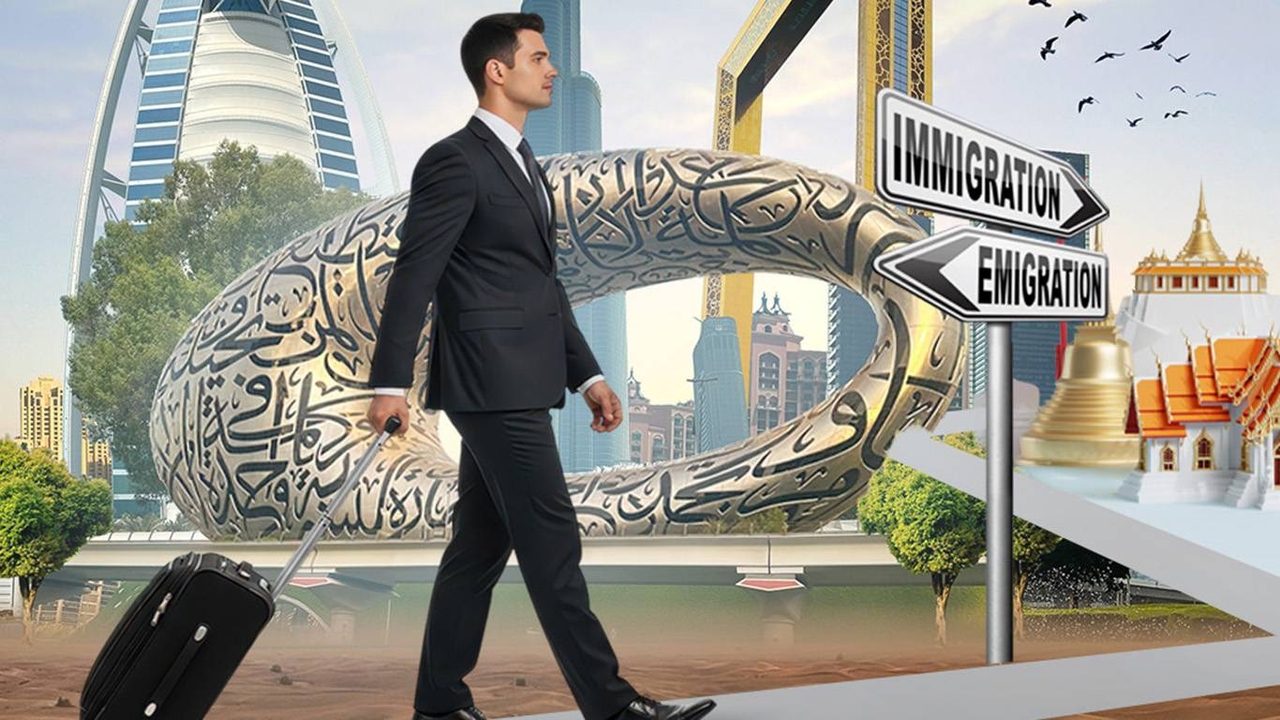
In a world full of geopolitical volatility and structural uncertainty, "money" has become the key factor that can enable us to "migrate" to areas with greater opportunity and safety.
This has led analysts to describe the current era as the "age of extreme volatility," estimating that between 2025 and 2026, the world will experience the largest migration of personal wealth (Private Wealth Migration) in history.
High-net-worth individuals (HNWIs) are not just seeking luxurious lifestyles but engaging in "geopolitical arbitrage" to diversify risks from tax policies, wars, and unrest in their home countries.
Statistics from New World Wealth by Henley & Partners show that in 2025, 142,000 wealthy individuals relocated their residence, with the United Arab Emirates (UAE) leading as the top destination for the third consecutive year.
UAE’s success is no accident but results from "designing" the country as a haven for migrating capital, featuring a tax-friendly system, world-class infrastructure, and a neutral stance amid conflicts.
Meanwhile, the USA, although still prestigious, faces challenges, while Italy and Switzerland have become primary targets for European wealthy individuals seeking to escape taxes and political congestion.
Thailand has moved up to 14th place worldwide, just behind Singapore, attracting about 450 wealthy migrants bringing over 150 billion baht. Despite a 50% growth over the past decade, experts caution "not to celebrate prematurely."
Surachet Kongcheep, Head of Research and Advisory at Cushman & Wakefield Thailand, a real estate consultancy, offered an insightful perspective that Thailand may not be a "permanent home" for global billionaires but merely a "temporary safe zone" during crises such as Middle Eastern wars or pandemics.
"Thailand is not a target country where the ultra-wealthy want to settle permanently, but rather a short-term refuge due to its effective crisis management and high safety perceived globally," he said.
The definition of Thailand as a "residence" stems from the investment pattern of foreign wealthy individuals, who mostly focus on luxury real estate and lifestyle consumption, rather than establishing high-tech production bases or multinational asset management centers.
However, considering the data of 450 wealthy migrants may seem abstract. Thairath Money examined actual condominium ownership transfer records for 2025 from the Real Estate Information Center (REIC), which clearly reflects the "new capital map."
From January to December 2025, although the total value of foreign condominium transfers fell by 10.7% (60.9 billion baht), the number of units increased by 2.2% (14,899 units), indicating demand remains but buyers are opting for "smaller" or "cheaper" units.
What do the figures of 450 wealthy migrants to Thailand and the condo transfers by Myanmar and Russian buyers tell us? It suggests Thailand is the "number one choice" when global problems arise, but an important question remains...
As global wealth relocates, if we fail to evolve beyond a mere "refuge," these funds may eventually move on once conflicts in their home countries subside.
Sources: REIC, Henley & Partners
Follow economic and government policy news with ThairathMoney athttps://www.thairath.co.th/money/economics/thai_economics
Follow Thairath Money on Facebook at this linkhttps://www.facebook.com/ThairathMoney