

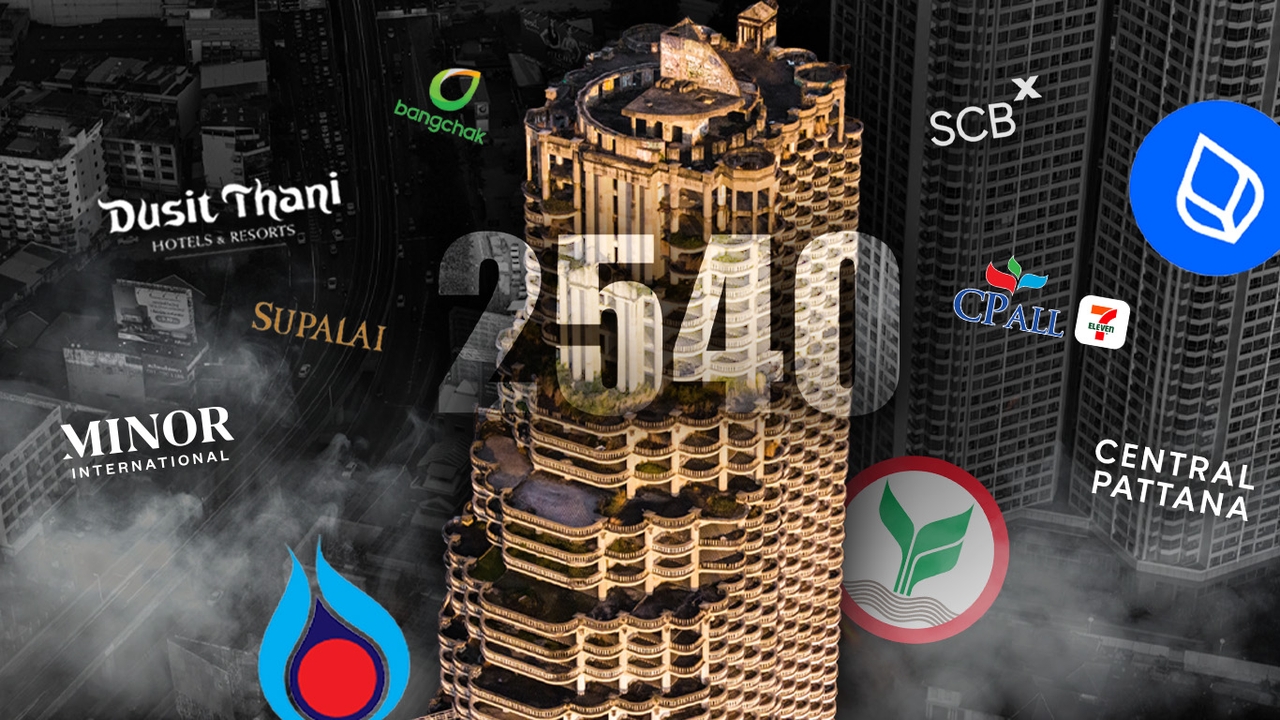
On 2 July 1997, the Bank of Thailand announced the floating of the baht, which had been fixed at 25 baht per US dollar, quickly reaching nearly 55 baht. This marked one of the most structurally damaging lessons to Thailand's economy and business sector in its history.
This devastation pulled Thailand's GDP growth down by an average of 5.2% annually during 1997–1998. Financial institutions and securities companies were permanently closed as they could not handle rapidly rising non-performing loans. The private sector faced widespread bankruptcies, massive pay cuts, and layoffs, leaving many Thais suddenly unemployed.
The Thai government had to urgently borrow over 17.2 billion US dollars from the International Monetary Fund (IMF) to stabilize the country's finances. For many, the crisis is remembered by images like the abandoned Sathorn Unique Tower, an unfinished building left as a symbol of collapse, or the overnight closure of 58 finance companies.
However, little told are the stories of companies that "almost did not survive" but managed to turn around, restructure, and endure sacrifices to survive, even using the crisis as a pivotal turning point. Today, these companies have become major household names, though few realize they once stood on the brink.
On the 29th anniversary of the "Tom Yum Goong" crisis, Thairath Money invites a look back at 10 Thai business case studies that overcame that turning point, showing that crises are not only to survive but to grow.
1. Thai Commercial Bank allowed the government to temporarily hold shares to preserve the bank.
The real estate crisis reduced SCB's Tier 1 capital (formerly Siam Commercial Bank) below required levels. The bank joined the state capital injection program, letting the Ministry of Finance temporarily become the major shareholder in exchange for capital support, before allowing private investors to buy back shares at cost within three years.
Today, SCB has transformed into SCBX, a leading regional fintech business. The lesson is that sometimes temporarily losing control is better than stubbornness that leaves nothing at all.
2. Kasikornbank declined government aid but created new financial tools themselves.
Unlike SCB, Banthoon Lamsam chose not to join the government bailout program but innovated capital raising through new financial instruments called SLIPS (Stapled Limited Preferred Securities) and CAPS (Capital Augmented Preferred Securities). This quickly increased capital from retail and foreign institutional investors, preserving Thai ownership. Then the bank overhauled its entire loan system. Today, KBank leads digital banking. The lesson: past reputation does not guarantee the future; one must dare to dismantle what is truly broken.
3. Bangkok Bank stood by its borrowers instead of abandoning them.
At that time, non-performing loans from large industrial groups heavily hit Bangkok Bank. Newly appointed CEO Chatisiri Sophonpanich coordinated with the government to transfer bad debts to an asset management company while supporting existing customers to continue rather than pushing them to collapse.
Today Bangkok Bank is the largest in Thailand and has expanded to Indonesia. The lesson is that relationships nurtured during clients’ hardship become loyalty capital in the future.
4. PTT transformed into a public company to escape state enterprise constraints.
PTT’s foreign debt doubled after the baht floated. The solution was to corporatize into PTT Public Company Limited in 2001 to freely raise capital from international markets without relying on the government budget. Today, PTT is the country’s top energy and petrochemical company. The lesson is that sometimes true limitations are not capital, but outdated organizational structures.
5. CP All sold Lotus and Makro to preserve 7-Eleven.
The crisis burdened the CP Group with huge foreign debt from its telecommunications business. Thanit Charoenwong decided to sell controlling stakes in Tesco Lotus and Makro to raise cash, reduce debt, and preserve core businesses like food and convenience stores. They shifted 7-Eleven’s expansion to a franchise Store Partner model instead of fully self-funded.
Today, CP All has reacquired Makro and Lotus. The lesson is knowing your core business and boldly letting go of cherished assets when necessary.
6. Minor International took Thai business abroad.
Facing bankruptcy and domestic market collapse, William Heinecke chose not to tie his fate solely to Thailand. Using the weak baht as an opportunity, he launched the Anantara brand internationally and later acquired NH Hotels in Europe, diversifying revenue into dollars and euros.
Today, Minor owns over 640 hotels, resorts, and serviced apartments and more than 2,699 restaurants in 24 countries. The lesson is that domestic crises can signal the need to look beyond home.
7. Central Pattana sold parts of its business to gain cash flow.
Multiple shopping mall projects stalled due to banks halting loans. Tos Chirathivat negotiated transparent debt restructuring and sold some non-core businesses to raise cash for developing projects with quicker recovery prospects.
Currently, Central Pattana is Thailand’s largest shopping mall developer and manager, continuously expanding its retail empire and large mixed-use projects like Dusit Central Park joint venture. The key lesson is that during crisis, selling some businesses to save core ones can be the best decision.
8. Supalai chose slow but steady growth.
Supalai, a real estate developer, suffered from the bubble burst and sharply rising interest rates, accumulating losses near 1 billion baht and severely impacting family financial management.
Prateep Tangmatitham set new rules, strictly controlling debt-to-equity, avoiding risky expansion, and gradually expanding along early BTS lines, provincial cities, and investing abroad in Australia.
Today Supalai ranks in the top 5 real estate companies with high profit margins and low debt. The lesson is that caution is not cowardice but discipline enabling longer survival.
9. Dusit Thani chose to keep staff, cutting other costs instead.
Tourism vanished and hotel revenues plunged, but Thanpuying Chanat Piyaoui chose not to lay off many employees, cutting excess costs elsewhere, and expanded into education and food businesses to reduce reliance on tourism income. Today, Dusit Thani is developing the massive Dusit Central Park project. The lesson is that in service businesses, people are assets, not costs to cut.
10. Bangchak turned currency weakness from a liability into an asset.
Importing crude oil priced in dollars, the baht’s depreciation doubled debt, and foreign advisors even recommended closure. But Bangchak realized its refinery pricing was already dollar-linked, so it matched revenues and expenses in dollars, naturally hedging exchange risk. It then gradually shifted toward clean energy. Today, Bangchak is a major green energy group. The lesson is that sometimes survival lies not outside the business but hidden within its existing structure, just unseen.
From these 10 stories, there is no single formula: some accepted government help; others refused. Some sold cherished assets; others preserved staff over cash. The common thread is that all accepted reality quickly and made painful, decisive restructuring rather than delaying until no options remained.
After 29 years, the abandoned Sathorn Unique Tower still stands as a monument to failure. Yet across the city, these 10 companies continue moving forward, becoming part of everyday Thai life almost unnoticed.
Follow economic and government policy news with Thairath Money athttps://www.thairath.co.th/money/economics/thai_economics
Follow the Facebook page: Thairath Money at this linkhttps:// www.facebook.com/ThairathMoney