

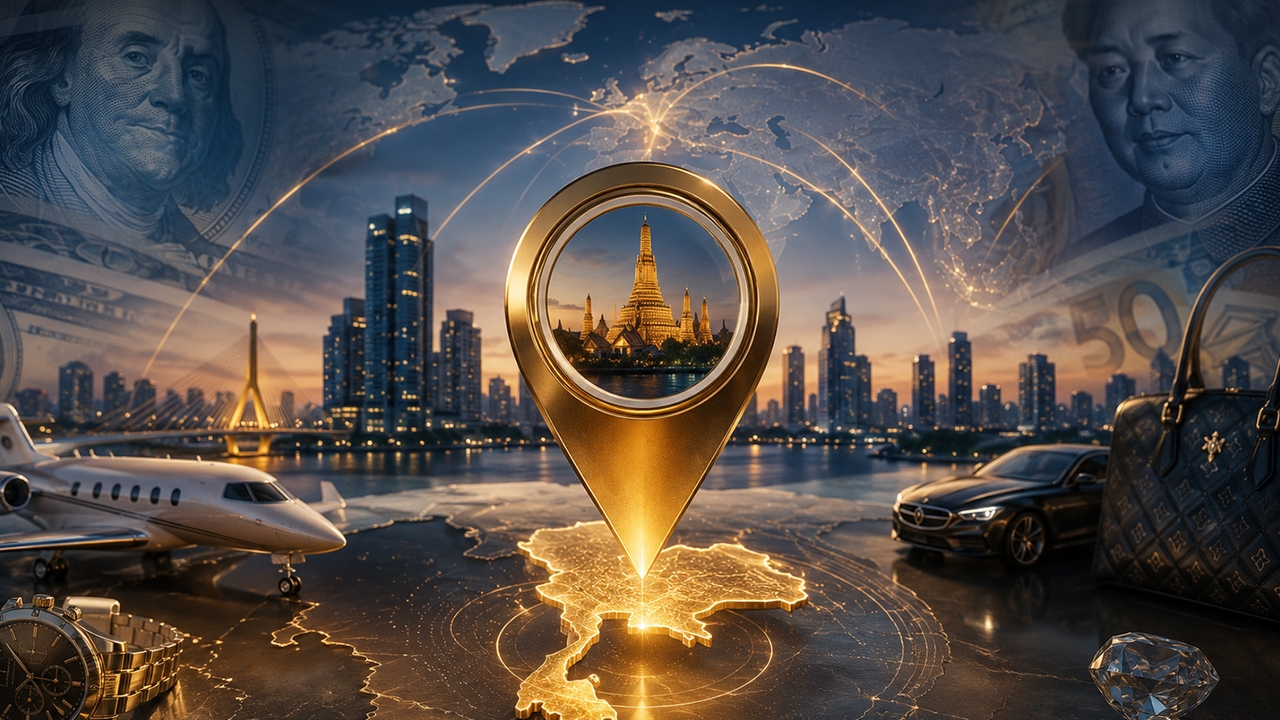
Currently, the influence of "currency" has become a key factor determining the affordability or expense of cities worldwide. This is clearly seen in the latest Global Wealth and Lifestyle Report 2026 by Julius Baer (Private Banking), which found that cities with currencies appreciating against the US dollar, such as the Swiss franc and the euro, have rapidly climbed higher in the rankings.
Conversely, the weakening US dollar has led to no cities in the Americas region appearing in the Top 10 luxury lifestyle cost rankings for the first time in three years, despite North America's wealth accumulation rates remaining the strongest.
In contrast, the new centers of financial power and global wealth accumulation for the rich are increasingly shifting to the Asia-Pacific region, with 5 of the top 10 cities located there, and for the first time, Thailand's capital, Bangkok, making the global Top 10.
This index is calculated from a "basket of 20 luxury goods and services," including luxury homes, cars, watches, jewelry, private school tuition, MBA fees, fine dining, and business class airfare, to reflect the cost of living for the wealthy—not the general population's living expenses.
Rank 1 Singapore: Holds the title as the most expensive city for the wealthy for the fourth consecutive year, driven by high real estate and vehicle costs, alongside the strength of the Singapore dollar and political stability.
Rank 2 Zurich: Climbed three places thanks to the Swiss franc's appreciation, supported by its role as a safe haven for capital during global geopolitical tensions.
Rank 3 Monaco: Enters the top three for the first time due to the euro's strength and having the world's most expensive premium residential real estate (with the smallest unit area proportion in the index comparison).
Rank 4 Hong Kong: Slightly dropped but remains a financial hub, ranking first globally for the most expensive legal services and among the highest for MBA tuition fees.
Rank 5 London: Dropped in ranking as the British pound moves in tandem with the US dollar, resulting in prices in US dollar terms not rising as sharply as in mainland European cities tied to the euro.
Rank 6 Shanghai: Maintains its regional leadership as the city with the highest fine dining costs in the world.
Rank 7 Paris: Directly influenced by the euro's appreciation and retains second place globally for luxury dining costs.
Rank 8 Sydney: Rose six places, the biggest jump this year, driven by a strong Australian dollar and higher import costs for premium goods.
Rank 9 Milan: Shows steady growth aligned with rising prices of high-end fashion brands and the recovery of the premium real estate market in mainland Europe.
Rank 10 Bangkok: Officially enters the global Top 10 for the first time, driven by sharp increases in personal luxury goods prices and higher education fees.
It is evident that the Asia-Pacific region remains a powerhouse in wealth accumulation, with an average economic growth rate of 4.5% in 2026, well above the global average of 2.9%. This has resulted in 5 of the 10 most expensive cities in the world being located in this region.
A notable shift in capital movement this year is Hong Kong surpassing Switzerland as the world's largest cross-border wealth management hub. Together, Hong Kong and Singapore act as the "dual core axis" of Asia's wealth network, attracting investments seeking to avoid geopolitical tensions and regulatory changes in the West.
Bangkok's rise to 10th place globally marks a transformation in Thailand's image among global billionaires. Various factors indicate affluent consumption patterns in Bangkok, turning it into a high-priced luxury market.
For example, tailored men's suits, women's shoes, and MBA tuition fees have surged, while Thailand ranks second worldwide for imported luxury car prices due to high excise and import tax barriers.
Currently, Bangkok is also among cities with continuous launches of ultra-luxury condominium projects, world-class private hospitals, Michelin-starred restaurants, and increased investment by luxury brands over recent years.
However, experiential and relaxation luxury services, such as spas in Bangkok, remain relatively affordable—ranked 20th out of 25 cities in the index. This clear contrast between premium imported goods and local service prices indicates Bangkok is evolving into a "hybrid lifestyle hub" where billionaires can access world-class services at reasonable prices while willingly paying top dollar for luxury fashion items to display social status.
Sources: Julius Baer, Lifestyle Asia
Follow economic and government policy news with ThairathMoney athttps://www.thairath.co.th/money/economics/thai_economics
Follow the Facebook page: Thairath Money at this linkhttps://www.facebook.com/ThairathMoney