

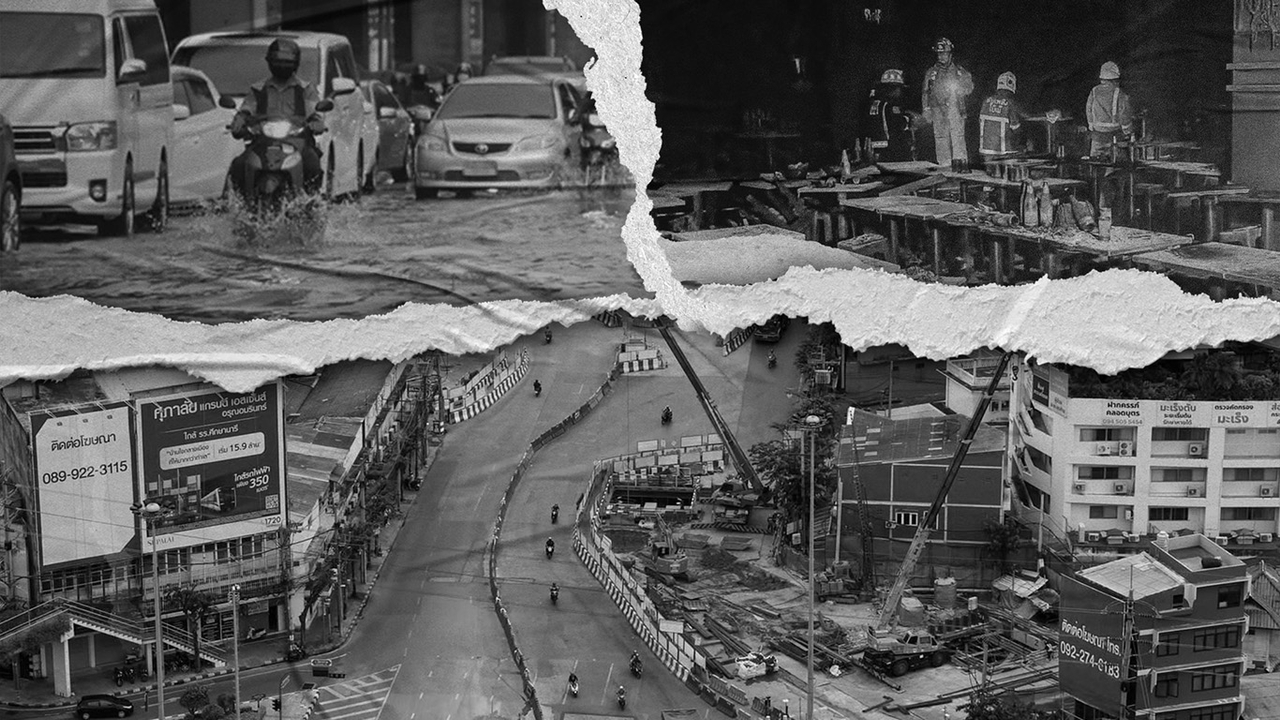
The fire at the Lat Phrao brewery has become another event prompting Thais to question the "safety" of the city they live in every day.
Not long before this, there were reports of a construction crane collapsing on Rama 2 Road, roads subsiding downtown, and repeated flooding in Bangkok, as well as unexpected accidents on public transport that people worry about daily.
The question society faces goes beyond "who is responsible" to whether the infrastructure system we rely on every day and the urban resilience to emergencies remain trustworthy.
What is more concerning is that Thais themselves recognize this is abnormal, and the situation is not new but worsening.
This aligns with the Ipsos Global Infrastructure Index 2026 study, conducted with the Global Infrastructure Investor Association (GIIA), which shows Thai satisfaction with infrastructure has declined compared to previous surveys, similar to Mexico and Indonesia.
Meanwhile, regional neighbors show higher satisfaction: Singapore at 74%, India at 69%, Indonesia at 49%, but Thailand is only at 43%.
76% of Thais believe the government "is not doing enough" to meet infrastructure needs, ranking second highest among 29 countries worldwide, just behind South Africa, with the global average at 57%.
Most notably, 61% of Thais prioritize "flood prevention systems" as the area needing the most investment—the highest among the 29 countries surveyed. Only Thailand, Indonesia, and Brazil ranked flood control first.
More worrying, 63% of Thais think existing infrastructure is insufficiently adapted to future climate changes. In other words, they not only want better flood defenses, but already understand current systems will fail under more severe conditions.
Interestingly, Thais have not lost faith in the system. On the contrary, 75% believe infrastructure investment creates jobs and boosts the economy, and 73% say it helps combat global warming—both higher than global averages. The stronger the belief, the more impatient they are for results.
Regarding road subsidence and beam collapses, this underscores another point: 75% of Thais agree that maintaining old infrastructure is as important as building new projects. The question is whether the focus on new projects has led to neglect of the existing infrastructure they use daily.
Although the brewery fire may not be "infrastructure" by survey definition, it reflects the same issue: densely packed urban areas with inappropriate, non-compliant designs and lack of government oversight leave systems unprepared when unexpected incidents occur.
The survey also found that 84% of Thais are willing to allow private sector investment if it delivers real, tangible outcomes—the second highest worldwide. This means people do not want new promises but actual results.
The recent series of events—beam collapses, road subsidence, flooding, and urban fires—may have different causes but point to the same challenge: Thailand needs infrastructure that the public can "trust," not just new projects.
Future investments should shift evaluation from number of projects or budgets to measures of "safety," "emergency preparedness," and "public confidence."
To transform Bangkok from a city where people fear unexpected incidents into a safe and livable city, at least four reforms seem unavoidable:
Ultimately, lessons from the Lat Phrao brewery fire, road subsidence, beam collapses, and the city's routine flooding may not always call for more new projects but demand that every investment "restores public confidence." The greatest return on infrastructure investment may not be GDP figures but enabling people to leave home every morning without fearing what might happen.
Sources: Ipsos, Public Relations Department, Engineering Institute of Thailand, Bangkok Metropolitan Administration, Road Safety Thailand, Department of Disaster Prevention and Mitigation.
Follow economic and government policy news with ThairathMoney athttps://www.thairath.co.th/money/economics/thai_economics
Follow the Facebook page: Thairath Money at this linkhttps://www.facebook.com/ThairathMoney