

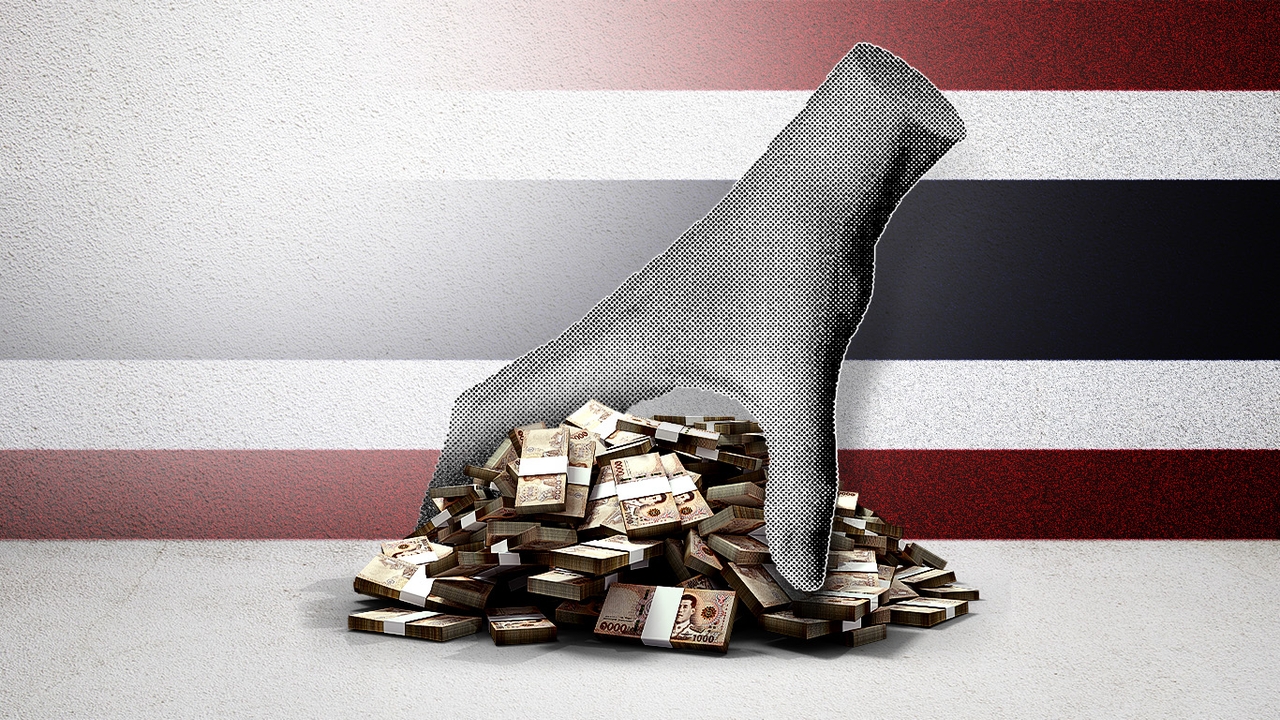
Although reports of scammers have decreased, many Thai people still lose money to criminals. In just one month (June 2026), online crime caused damages worth 640 million baht. Moreover, the 2025 Global Anti-Scam Alliance (GASA) report revealed that Thais lose up to 115.3 billion baht annually due to financial threats.
This is a serious problem the government must urgently address to reduce its impact on the population. So, what actions have the government and related agencies taken so far?
If money is transferred to criminals, it may be moved abroad "within an hour." To clarify this, we quote Dr. Aeknithi Nitithanprapas, Deputy Prime Minister and Minister of Finance, who explained in detail that
"Money taken by call center gangs and scammers from citizens rarely stays in one place. It is continuously moved through multiple transfers to erase traces, starting with deposits into one bank account, quickly transferred to another account, then converted into digital assets to make tracking harder. Some funds are used to buy gold because it is easily traded and can quickly be turned back into cash. Finally, the money often passes through registered companies as a front before being sent overseas." The same sum is moved across various locations and assets. The problem making suspicious financial transaction tracking difficult is that the data systems are not interconnected.
Because no agency has a complete overview of "where the money flows," criminals exploit this gap to move and launder money. Recently, the government collaborated with all relevant agencies to introduce four targeted measures, such as:
Previously, besides strengthening controls on online gold trading, the Bank of Thailand also mandated reporting of cash withdrawals over 5 million baht to reduce suspicious transactions. In October 2026, the BOT plans to further tighten gray money controls by expanding mandatory reporting to include cash deposits exceeding 5 million baht, requiring clear documentation such as the source of cash and explanations for exchanging large bills into smaller denominations—for example, explaining why 10 million baht is exchanged into 100-baht or 500-baht notes.
On the side of the SEC, due to rising issues with crypto mule accounts and increased gray money concerns, it has ordered enhanced KYC and CDD procedures. If suspicious transactions arise and customers refuse to provide information or provide insufficient details, service providers must refuse service.
Additionally, businesses are assigned shared responsibility if they neglect or fail to fully comply with standards causing harm to customers. The SEC is also progressing on the Travel Rule, a standard for tracking digital asset transactions, which concluded its public hearing on 10 July 2026, with updates expected soon.
Regarding gray money and nominee issues in capital markets, the SEC has proposed redefining "major shareholders" to include individuals who control businesses or shares (such as major lenders to companies), beyond those who influence policy and management, to improve transparency for investors on the true owners.
(Following theSupaporn Pimpong case involving Form 246-2 submission,it remains to be seen how the SEC will further adjust regulations.)
Resolving gray money issues may take more than one or two years, but this marks a turning point for regulators to view financial flows systemically, recognizing that blind spots can cause widespread impacts. Many challenges remain for all parties to urgently develop measures both to respond to problems and prevent serious incidents from occurring.
Sources cited:Bank of Thailand (BOT).Securities and Exchange Commission (SEC),Public Relations Department, Ministry of Finance
For economic information and government policies, follow ThairathMoney athttps://www.thairath.co.th/money/economics/thai_economics
Follow the Facebook page: Thairath Money at the link https://www.facebook.com/ThairathMoney