

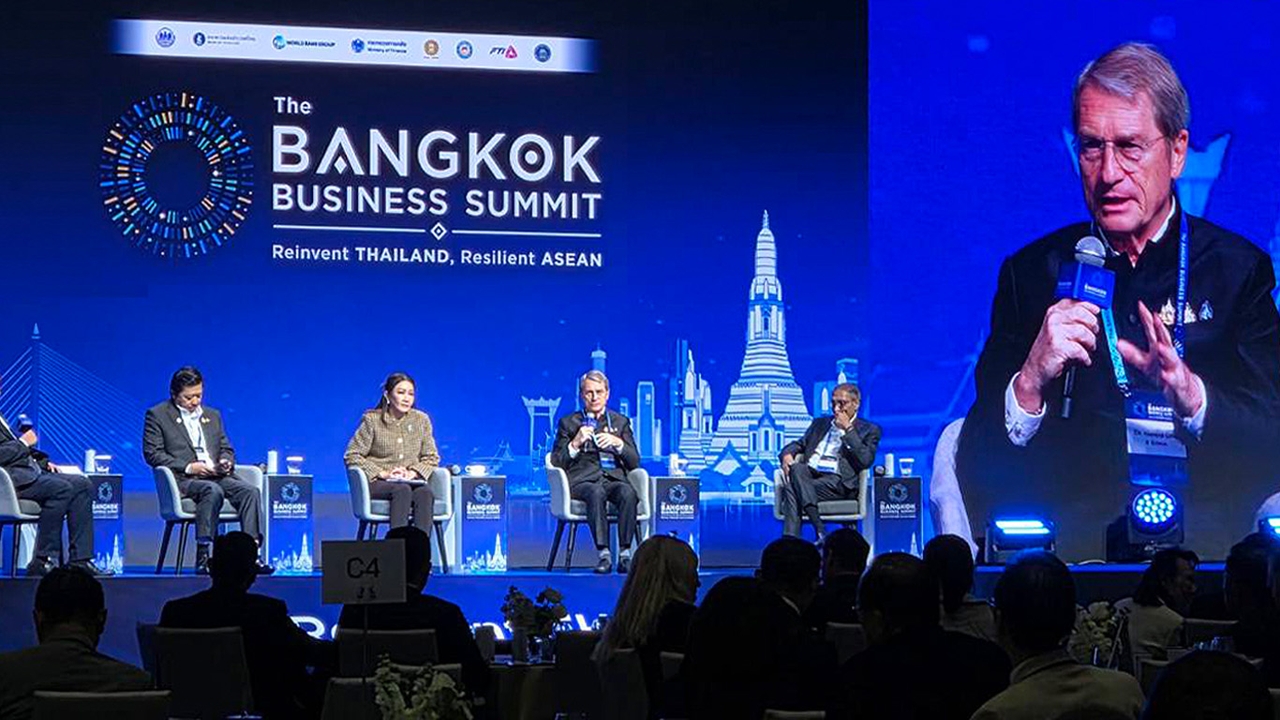
Amid Thailand's ongoing challenge of low economic growth, the world is rapidly changing due to geopolitical conflicts, trade wars, AI technology, natural disasters, and shifts in supply chains. The key question is not only how businesses will cope but what Thailand must invest in to create a new growth engine.
This question was addressed at the important forum The Bangkok Business Summit 2026 during the session Business Building the Future: Winning in Turbulence, which gathered perspectives from leaders of major Thai corporations including CP Group, Kasikornbank, B.Grimm, and Indorama Ventures.
The consensus at the forum is that global volatility forces Thailand to make new investment decisions spanning infrastructure, agriculture, technology, financial systems, and human capital development. To escape the low-growth trap, these investments must be interconnected as a system.
Supachai Chearavanont, Senior Vice Chairman of CP Group, observes that despite multifaceted business challenges—geopolitics, AI's rise, and domestic constraints from low economic growth—Thailand still possesses strengths that can be developed into opportunities.
One key area is agriculture and food, where Thailand benefits from its geographical location and food security. He cites durian as an example, which has become a major export product generating a market worth billions of US dollars, with further potential to develop processed foods, frozen foods, and related supply chain businesses.
The critical challenge is to understand regional needs and determine how Thailand will invest to enhance production capabilities accordingly.
Supachai believes investing in agricultural infrastructure such as irrigation systems, alongside technologies like Smart Farming and AI, will boost productivity, secure the agricultural sector, and extend benefits to small businesses, employment, and related industries within the supply chain.
Digital infrastructure must advance in parallel, as AI can reach its full potential only with adequate digital infrastructure. The transition should not be fragmented; to impact the national economy, public and private sectors must move in unison.
Supachai places great emphasis on investing in human resources, particularly education reform, talent development, and attracting foreign experts to elevate Thailand as a hub for technology and innovation including AI, robotics, materials science, business intelligence, and medical fields.
He sees technology advancement as dependent on people. If Thailand creates systems allowing talented individuals to realize their potential and welcomes international talent, it can become a new regional hub.
Environmental issues should not be separated from economic considerations, as increasing disasters impose direct economic costs. Investments in environmental prevention and mitigation are integral to sustainable development.
“Thailand is geographically fortunate, connecting China, India, and South Asia. With proper investment, we can boost economic growth, and the key lies in investing in human resources.”
When asked about game-changing variables for Thailand, Supachai highlighted AI, believing that effectively integrating AI to improve government and business efficiency will have widespread impacts.
While Supachai focuses on economic structure, Kattiya Indaravijaya, CEO of Kasikornbank, emphasizes that realizing opportunities requires a financial system that supports investment in the right directions.
She points out that according to World Bank reports, Thailand has potential to develop several future industries. However, building new industries cannot rely solely on capital; the financial sector must understand which businesses have long-term potential and provide support in funding, market access, technology, and global supply chain connectivity. Banks must shift from passively waiting for loan requests to actively keeping pace with customer and industry changes.
“Capital must be allocated precisely to areas that genuinely contribute to the country’s long-term growth.”
Another key factor she identifies for national competitiveness is openness to increasing competition within the country.
While many businesses face uncertainty, Dr. Harald Link, Chairman and CEO of B.Grimm Power Public Company Limited, adopts a positive stance. Based on B.Grimm’s long experience in Thailand, he believes the world has faced multiple crises and current circumstances do not justify halting business progress.
Thailand’s business environment, international relationships, and ability to form diverse partnerships are strengths. He views AI as an opportunity to learn and innovate, and stresses the need for businesses to create environments attractive to younger workers and foster collaboration between companies and partners.
“I think we are at the best moment because we have overcome many crises, and now the world is opening new opportunities for us.”
He reiterated B.Grimm’s philosophy of resilience over 150 years in Thailand: “We have never given up; we are always learning,” which suggests that Thai businesses now need positive mindset, courage, and good partnerships.
Aloke Lohia, CEO of Indorama Ventures Public Company Limited, draws from his company’s continuous global market expansion, observing that every crisis hides opportunities.
Current challenges include not only US tariffs or trade wars but also global overcapacity in many industries.
The solution lies in business adaptation, creating new capabilities, and seeking cross-industry collaboration. He believes Thai businesses should not limit themselves to domestic markets since Thailand can be a strong base for global expansion. Attracting foreign companies to invest in Thailand is another path to economic opportunities.
Ultimately, the deciding factor for seizing these opportunities is “people.” If Thailand can develop human capital and manage talent well, it will enhance its attractiveness for investment and upgrade its position in global value chains. For Thai businesses, he believes it is time to muster courage and enter markets where customers await.
“Thailand is a strong base for global market expansion. Businesspeople must gather courage to enter markets with waiting customers.”
Although these four executives represent different industries, their shared message at the Business Building the Future: Winning in Turbulence session is that Thailand’s economy cannot wait for global stability before growing.
Thailand retains advantages in geography, production base, food, medical sectors, international relations, and private sector potential. However, these must be converted into value-creating investments to build new economic engines as old ones face growth constraints.
If Thailand aims to escape the middle-income trap, investment cannot be measured solely by short-term returns. It must simultaneously build competitiveness in people, businesses, and the nation. Ultimately, volatility may be uncontrollable, but Thailand can choose either to resist change or use this moment to invest in establishing a new position in the economy.
Read economic and government policy news with ThairathMoney to help you "Manage your finances well, live well" at
Follow the Facebook page: Thairath Money at this linkhttps:// www.facebook.com/ThairathMoney