

The Joint Private Sector Committee (JPSC), comprising the Thai Bankers' Association, the Thai Chamber of Commerce, and the Federation of Thai Industries, together with the Ministry of Finance, the Bank of Thailand, the National Economic and Social Development Council, and the World Bank, convened the 'The Bangkok Business Summit 2026' under the theme 'Reinvent Thailand, Resilient ASEAN,' aiming to transform Thailand and strengthen its economic structural reform towards ASEAN integration.
This meeting marked a significant step in exchanging perspectives and policy recommendations led by the private sector, which will be presented to the Thai government and foreign investors worldwide.

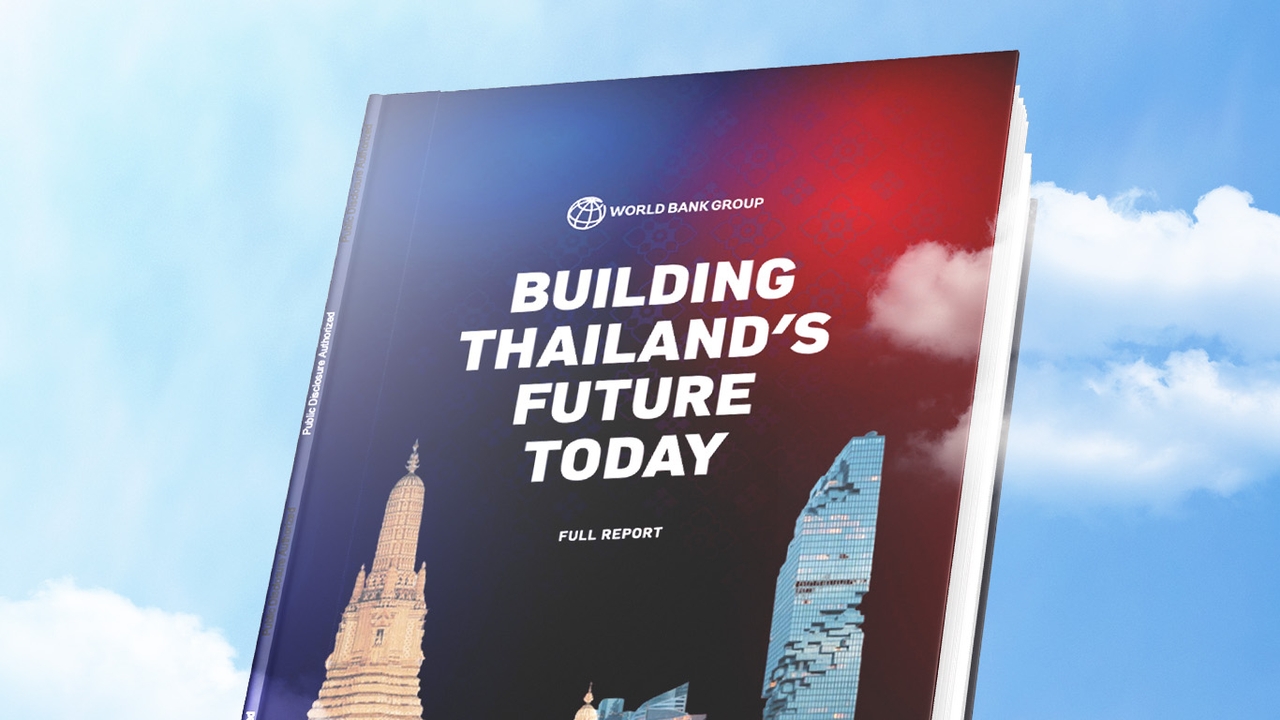
One of the key highlights of the event Bangkok Business Summit 2026 was the launch of the World Bank's new report 'Building Thailand’s Future Today'. This report proposes a pathway for Thailand to achieve high-income status through investment and reforms aimed at job creation, productivity enhancement, and laying the foundation for long-term growth.
Stephen N. Ndegwa, Country Director for Thailand and Myanmar at the World Bank, stated that Thailand has competitive strengths in many areas, having reached this point with a strong industrial base, world-class infrastructure, and a private sector integrated with regional markets.
However, with rapid economic changes, the development model that succeeded over the past 35 years since the 1991 IMF-World Bank Annual Meetings in Bangkok can no longer sustain adequate growth for the future.
Overall, Thailand’s economic growth has clearly slowed amid challenges from AI, shifts in global trade and investment directions, climate pressures, and an aging society. Thailand must revitalize and upgrade its capabilities, institutions, and investments to generate higher-quality job growth.
Since the COVID-19 pandemic, the average GDP growth rate was only 2.2% per year (2021-2024), with limited formal job creation, necessitating a new blueprint to restore growth, enhance productivity, and create better-quality jobs.
“The World Bank Group is ready to collaborate with the public sector, private sector, and development partners to bring global knowledge, finance, and operational experience to support reforms that will boost productivity, enhance competitiveness, and generate higher-quality jobs,”

said Catherine Ann Stapleton, Senior Economist at the World Bank. She added that over the past 35 years, Thailand has undergone a structural transformation, with the population of Bangkok and its metropolitan area reaching 20 million, becoming one of the world’s top 20 megacities. Meanwhile, GDP per capita more than doubled, and formal quality employment reached 11 million positions from a workforce of about 40 million.
However, Thailand’s economic growth noticeably slowed after the global financial crisis and was further impacted by the COVID-19 pandemic. Thailand would need until 2080 to become a high-income country under current trends. The major goal of this report is to accelerate this to 2037, requiring GDP per capita growth to reach 5.4% annually.
The World Bank’s new report launched today at the Bangkok Business Summit 2026 states that Thailand has the opportunity to accelerate its transition to an innovation-driven high-income economy by boosting productivity through enhancing capabilities and creating dynamism in business, labor, and local levels.
The report identifies new engines of growth that could raise growth from the baseline 2.9% to the target 5.4% by adding 2.5% growth via development of four future industries (+0.8%), promotion of future-ready firms (+0.7%), upskilling the future workforce (+0.7%), and developing future cities (+0.4%).
Meanwhile, Kwanphat Sutthithamkit, Senior World Bank official responsible for Thailand, added that the report proposes a reform agenda based on two mutually reinforcing pillars: capability enhancement and dynamism creation. Capability enhancement requires moving into higher-value economic activities by accelerating technology adoption, promoting innovation, developing workforce skills, increasing domestic value addition, and expanding positive investment spillovers.

The World Bank emphasizes five key future industries:
To drive these goals, the World Bank proposes economic structural reforms based on four key pillars:
1. Upgrading future industries
The World Bank selected five target industries with high potential for value creation and employment distribution: advanced manufacturing, agriculture and food processing, digital services, health and sustainable tourism, and the creative industries including media, digital content, and film.
Although the creative industry currently accounts for about 5% of GDP, it has maintained double-digit growth. If Thailand can convert expertise and culture into globally scalable intellectual property, similar to South Korea’s model, it could become a powerful new economic engine.
2. Business adaptability
Thailand currently has only 10 startups per one million population, far below Singapore's 1,000, and a new firm creation rate of just 2 per 1,000 workers, compared to 8 in high-income countries. Although trade accounts for 70% of GDP, technology transfer from foreign capital to local firms remains limited.
Thailand’s R&D investment is about 1% of GDP, compared with the East Asia and Pacific regional average of 2.5%. The report recommends increasing the share of SMEs investing in R&D from the current 8% to 20%, matching the OECD average.
3. Workforce skills enhancement
Thailand needs to improve education quality from early childhood through higher education. Currently, only 1% of Thai 15-year-olds have high-level math skills, compared to 9% OECD average and 25% in Singapore. Meanwhile, tertiary enrollment is 45% in Thailand versus 82% in high-income countries.
Additionally, addressing the aging population crisis requires mobilizing female labor potential. Research shows that halving the gender labor participation gap could almost fully offset labor force decline from an aging society.
4. Developing future cities
Thailand must decentralize development from Bangkok as the sole megacity towards building a network of globally competitive cities with efficient transportation links, renewable energy use, low-carbon urban development, and concrete natural disaster protections, such as flood defenses, to position secondary cities as new growth hubs.
To translate these proposals into action along the roadmap, the report highlights urgent and effective measures for future industries, centering on establishing prerequisites to unlock subsidies and funding that can be injected directly and efficiently into the economy for maximum benefit.
It also calls for mechanisms enabling industries to attract advanced technologies and skills effectively, extending beyond large companies to include SMEs, strengthening competitiveness among smaller enterprises.
Simultaneously, intensive workforce skill development is needed, establishing lifelong learning foundations starting with OECD-standard early childhood care centers, progressing to labor markets offering high-quality jobs, and developing cities with infrastructure and public utilities that facilitate access to finance and sustainable economic growth.
The launch of this report comes at a critical time ahead of Thailand hosting the IMF-World Bank Annual Meetings in October 2026 in Bangkok, showcasing its vision and attracting global cooperation to drive a new wave of economic progress.
Read economic and government policy news with ThairathMoney for your "Better Finance, Better Life" at
Follow the Facebook page: Thairath Money at this link https://www.facebook.com/ThairathMoney